
“Can you show me another way?”
Multiple representations show students there is more than one correct way to do the math. This is an important message in itself.
Multiple representations also allow students to learn new mathematical concepts and procedures.
For example, division can be thought of as sharing or grouping.
8 ÷ 2 = 4 can be thought of as:
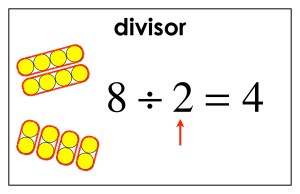 I have 8 items. I share them equally between 2 people. Each person gets 4 items.
- I have 8 items. I put them in groups of 2. I can make 4 groups.

I prefer the adjective flexible over multiple. Adaptability of, not number of, is what is important.
To learn how to divide integers and fractions, students must be able to visualize both representations.
For example, -8 ÷ 2 can be thought of as sharing equally between 2 groups. Each group contains four negative counters. However, -8 cannot be put in groups of +2.
Alternatively, having a negative number of groups does not make sense. However, -8 can be put into groups of -2.
Think about why 6 ÷ ½ is 12 (without simply applying the invert and multiply rule). Having a fraction for the number of groups doesn’t make sense. However, students can explore how many halves there are in 6 using pattern blocks or number lines.


3 × 2 is more than simply 3 groups of 2. An understanding of an area model of multiplication helps students to learn two-digit multiplication.
An understanding of this model will help students make connections between multiplying binomials and multiplying two-digit numbers.
As a secondary department head pointed out a meeting last year, teaching how to multiply binomials may be easier than teaching how to multiply two-digit numbers – in algebra, there isn’t the added complication of place value.
Now if only we would stop using the term FOIL…


 Chris Hunter