Mystery Transformation

A Principles of Math 12 learning outcome states “It is expected that students will describe and sketch 1/f(x) using the graph and/or the equation of f(x)”. In my classes, students were more likely to ask ‘the question’ at the beginning of this lesson than during any other lesson.

Over the years, I simplified my explanation. Three steps:

  1. asymptotes
  2. signs (i.e., if f(x) is greater than zero, then 1/f(x) will be greater than zero)
  3. invariant points (and other important points)

Most of my students were able to successfully sketch reciprocal functions. I had successfully prepared them for the provincial exam. Still, I wasn’t satisfied with this lesson. My students weren’t learning mathematics, they were just following directions – following my steps.

Together, Marc Garneau and I created the activity below, probably inspired by this book.

Warm-up:
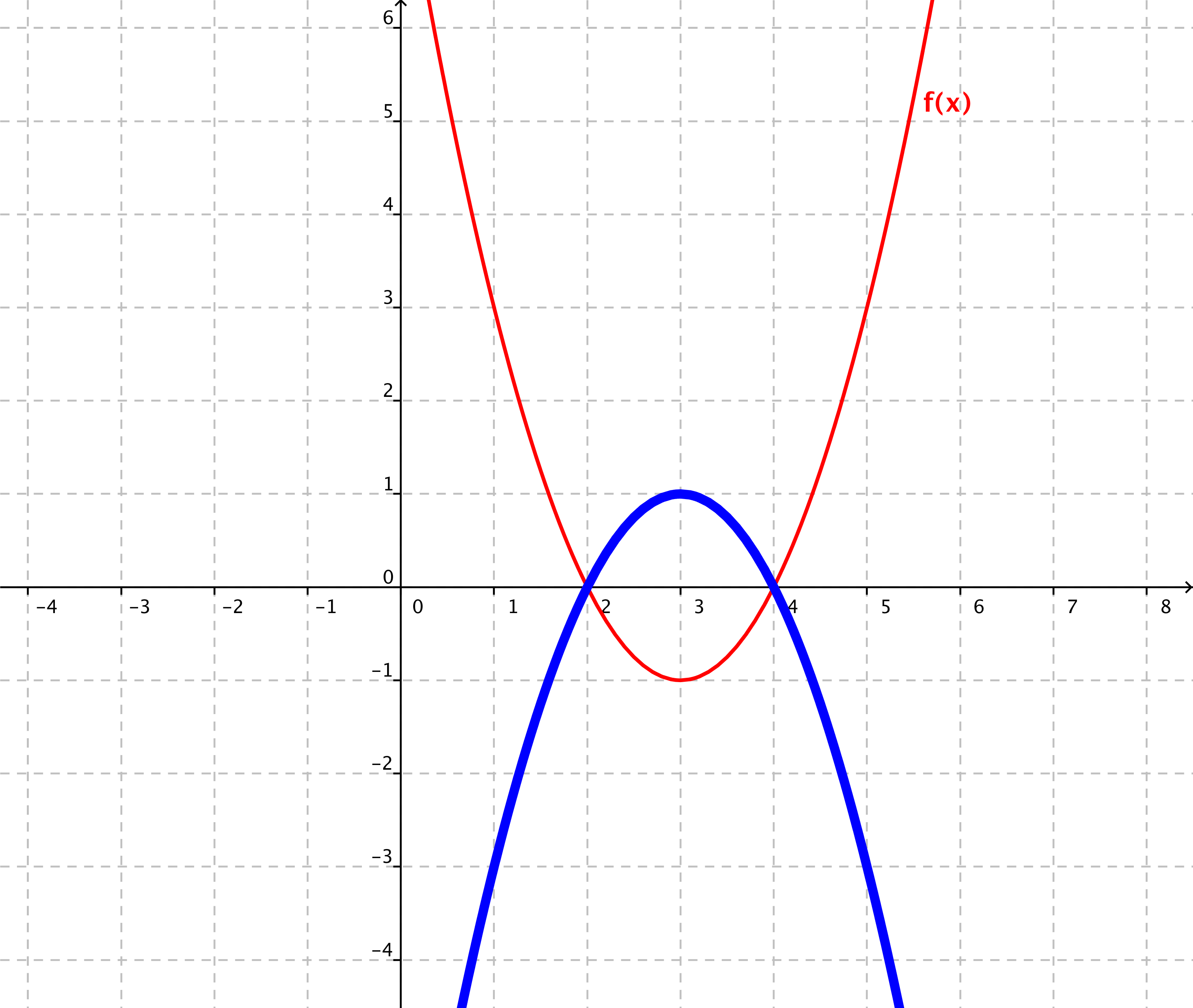
  1. How is the blue graph related to the red graph?
  2. Write an expression to represent this transformation.
  3. The point (5, 3) is on the graph of y = f(x).
    What point must be on the graph of y = -f(x)?

Activity:

  1. Have students work in groups of 3-4. Give each student in the group one of six cards.
  2. Have students record any observations they make about the graphs that are on their cards.
  3. Have students take turns sharing their observations. Encourage them to look for similarities and differences.
  4. Ask students to describe, in words, how the blue graph is a transformation of the red graph. Ask students to write an expression that represents this transformation. (The extra 2-3 cards can be used to test and confirm ideas.)
  5. Have students share their strategies with the class.


Discussion:

Sunita Punj invited us into her class to try out this activity. (Thanks again, Sunita!) Her students made some key observations, such as:

  • “There’s an asymptote at the x-intercepts”
  • “When the y is 1 or -1, it stays the same.”
  • “Points on the red graph that are 2 spaces up become points on the blue graph that are 0.5 spaces up.”

Sunita’s students were then able to use this information to discover that the blue graph could be obtained from the red graph by taking the reciprocal of the y value. I enjoyed listening to, and participating in, the mathematical conversations that were happening at each table.

  • “Is that always true?”
  • “I have a theory…”
  • “But why don’t the blue graphs touch the dotted lines?”

Students were not simply following directions. Nobody asked ‘the question’. (Still, if there is a real-world application here, I’d love to learn about it.)

There may be limited opportunities in Math 8-12 to have students identify a ‘mystery transformation’. However, I think it’s worth exploring the bigger idea – giving students questions and answers and then asking them to talk about how the answers may have been determined.

The first step in adding fractions is to find a common numerator.

“Okay, listen up! Today’s lesson will be on adding fractions. Let’s start with an easy one like 1/3 + 1/6. The first step is to find a common numerator, which, in this example, we already have. This becomes the numerator of the sum so let’s write a 1 up there. The denominator is, of course, itself a fraction whose numerator is the product of the denominators and whose denominator is the sum of the denominators. This gives us 1/(18/9), or 1/2.

Let’s kick it up a notch and try 2/3 + 1/4. Remember, the first step is to find the lowest common numerator, or LCN. You guys look a little puzzled. You remember learning this in grade 7, right? Since the LCN is 2, we have 2/3 + 2/8. Write a 2 up top. To determine the denominator, simply multiply and add to get 24/11. We have 2/(24/11). This is a tricky one since 24/11 doesn’t reduce nicely. Multiplying the common numerator by the denominator of the denominator gives us 22/24. One more thing… if you don’t reduce to lowest terms, I’ll have to deduct half a mark. 22/24 should be written as 11/12. I’ve typed up some notes. Take one sheet and pass the rest back.”

Christopher Danielson over at OMT shared the method above with me earlier this year. Recently, I presented it to a group of secondary math teachers. Christopher’s algorithm brilliantly initiates conversation about what is important in teaching and learning mathematics. For example, one teacher said “It works. I can prove that it works. But, it doesn’t make sense.” Another asked “It’s quick and easy, but does that matter?”

I think Christopher (@Trianglemancsd) plays it straight when he shows his algorithm to pre-service teachers. I couldn’t pull this off – more of a tongue-in-cheek thing for me. This elicited some (nervous?) laughter as teachers put themselves in the role of their students learning about LCD’s.

This segued to activities that do build conceptual understanding of fraction operations. We looked at:

  • using an area model to represent multiplication,
  • using pattern blocks to explore quotative division, and
  • using a common denominator to divide fractions.

These last two are connected… more on this later.

A New Bumper Sticker – My child is in the same classroom as your honour student

“Your rockstars aren’t the ones who put forward the best ideas. They put forward the safest ideas.”

Peter Liljedahl said this while discussing ‘A’ students and his numeracy tasks at last week’s pro-d presentation. I thought this was a great argument against ability grouping, in a bumper sticker kind of way. If we teachers were able to create problems and tasks with low floors and high ceilings, would that spell the end of honours classes? Probably not. Parents like the stickers. And they should.

I’m no rockstar, but I was an honour student. I know, I know, what happened? As either a student teacher or a new teacher, I attended a workshop (Kanwal Neel maybe?) and we were given the challenge of designing the largest popcorn box (or open rectangular prism) from a single sheet of paper. My partner (a secondary science teacher) and I (a secondary math teacher) were confident we had the winning design. We had a function, V(x) = x(8.5 – 2x)(11 – 2x). We had the quadratic equation. We had calculus! We had everything but the winning design. Beaten by a pair of primary teachers who had tape and the ability to ‘think outside the box’. (Sorry.)

Update: Kanwal sent me his largest box problem. The context has been changed to create the largest bentwood box.

Peter Liljedahl’s Surrey Presentation

On Friday I attended a pro-d presentation in which Peter Liljedahl shared his numeracy tasks. Peter’s tasks get students comfortable with ambiguity, get them writing about math, and get them to stop mimicking the teacher.

Early in the session, I wondered how these tasks could address pre-calculus learning outcomes. Later, Peter answered this for me when the conversation turned to finding time. “Why are we afraid to give up what isn’t working?” he asked.

“Who was your math teacher last year?”

“Uh… you were, Mr. Hunter.”

Despite learning (covering?) things like factoring trinomials or writing equations of lines in Math 10, sometimes my Math 11 students would act like they were seeing these things for the first time. So, why am I holding on to this? Why can’t I make time for numeracy tasks?

Peter works with teachers to design numeracy tasks that require the mathematics that students already have in place. This rules out grade level learning outcomes. He joked about trying to steer students towards a particular method of solving a problem – “Students are very good at smelling a word problem.”

While these tasks may not address grade level learning outcomes, they can be used to address the main goals of mathematics education described in our curriculum. Communication, perseverance, risk taking, motivation, engagement, and problem solving – all of these were listed by teachers as necessary to be able to do these tasks and all of these help define numeracy.

As an added bonus, helping students develop these skills will make teaching and learning grade level outcomes that much easier.

I look forward to trying out Peter’s tasks and developing new tasks with Surrey teachers.

Bacon And Eggsponents

Recently, a video showing a snappy way to add fractions was shared on the BCAMT listserv. Thankfully, it was panned.

This “butterfly method” also appears in Elizabeth DeCarli’s Ignite presentation, this time to help illustrate that “meaningful representations are greater than cute mnemonics.”

In my previous post, I wrote about one way in which my Math 10 teacher tried to make math memorable for his students. (Yes, I realize that since I still remember this, he was successful.) I also wrote about how this didn’t build any understanding.

As a teacher, sometimes I’d be frustrated/puzzled by what I heard from my students. Negative exponents send numbers “to the basement” (or upstairs if they’re already in the basement). The “Front Door Bomber” has one bomb for each person in the house (the distributive property). Why is a negative times a negative a positive? “When something bad happens to a bad guy, that’s good.”

When something bad happens to a good guy…

But I, too, was guilty.

I’m not talking about the usual suspects, FOIL and SohCahToa. I’m talking about “bacon and eggs”. Secondary math teachers can see slides 3 and 4 below and figure it out. Others probably stopped reading two paragraphs ago.

I imagine my students’ calculus professors being frustrated/puzzled by this. That makes me smile. A little. On the inside.

Aside from being unnecessary, two times out of three it’s incorrect and misleading. For example, in slide 8, is x the exponent or the answer?

I’ll no longer use FOIL in my classroom. Through algebra tiles, I’ll emphasize an area model. I’ll have a tougher time letting go of SohCahToa. It does help students memorize the definitions of the three primary trig ratios. However, whenever I asked my Math 10 students what they knew about trigonometry from Math 9, they would just say “It’s that SohCahToa thing”. No mention of big ideas or similar triangles. Suggestions?

A Visual Approach to Simplifying Radicals (A Get Out of Jail Free Card)

The radical sign is like a prison. Twelve can be expressed as a product of prime factors so √12 = √(2×2×3). The 2’s pair up and try to break out. Sadly, only one of them survives the escape. √12 becomes 2√3.

That’s how I was taught to simplify radicals. No joke.

I imagined the numbers yelling “All in the name of liberty! Got to be free! JAlLBREAK!” as they scaled the prison walls. To this day, I can’t get this song out of my head when I teach this topic.

Many students are shown this method, albeit without the prison imagery. Write the prime factorization of the number. Circle the pairs. Write/multiply circled numbers outside the radical sign. There is real math behind this procedure. By definition, √2 × √2 = 2. However, I found that students who were taught this method couldn’t tell me why √(2×2×3) = 2√3. Where did the other 2 go?

Instead, I asked students to evaluate √12, then 2√3, using their calculators. Why are they equivalent? Students factored √12 as √4 × √3 (with some scaffolding for some). They understood where the 2 came from. Some began by factoring √12 as √6 × √2. Correct, but not helpful. The importance of finding factors that are perfect squares was discussed.

Marc Garneau shared with me his visual approach to simplifying radicals.

Consider a square with an area of 24. The side has length √24.

This square can be divided into 4 smaller squares, each with an area of 6. The sides of these smaller squares have length √6. Two of these lengths make up the side length of the large square, so √24 = 2√6.

24 can also be divided into 3 rectangles, each with an area of 8. Again, correct, but not helpful. How to simplify √45 as 3√5 and √72 as 6√2 are also shown above. Again, factors that are perfect squares are key.

I think it would be interesting to try this out. Some students may prefer this method, but most students will likely move towards simplifying radicals without drawing pictures. But by drawing pictures as they are learning this skill, students will be connecting mathematical ideas and building conceptual understanding. New learning (simplifying radicals in Math 10) will be connected to prior learning (concept of a square root introduced in Math 8). Students will have a more solid understanding of why perfect squares are used.

Revisiting GeoGebra

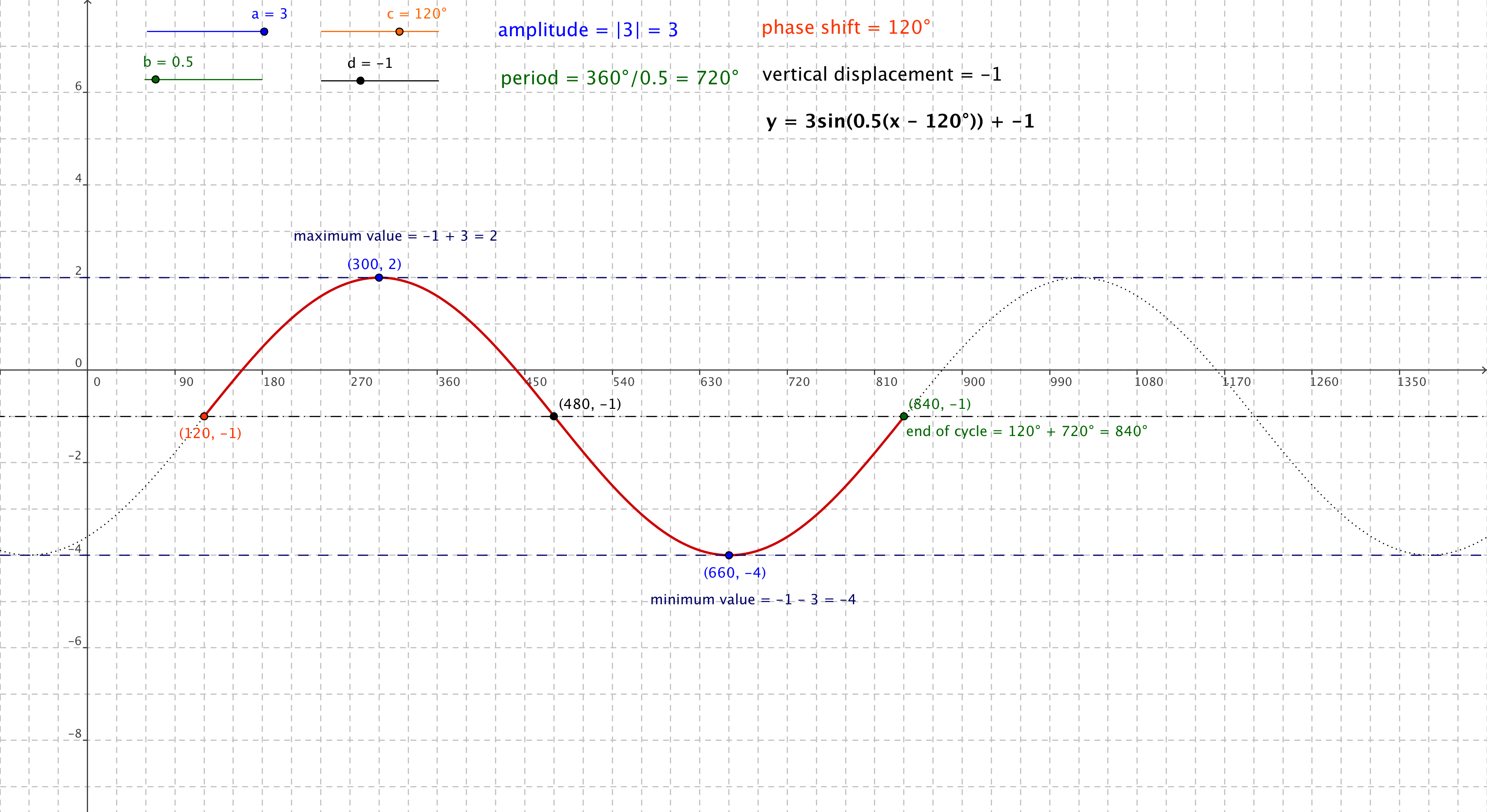
Four years ago I learned about GeoGebra and made some applets to be used in my classroom. I started by creating applets that demonstrated the effect changing slider values had on the graphs of trigonometric functions. I’d change a value and then ask the class to describe what happened to the graph. These constructions made excellent demonstrations. But that was the problem. The spectator experience was improved, but students remained spectators. (SMART Board fans take note: having one student at a time come to the front of the class does not change this.)

I also posted these applets on my class website. I thought students would try them at home to reinforce learning and check for understanding. They didn’t.

I wanted to move more towards having students themselves do the investigating. I constructed dynamic worksheets to explore slope and circle geometry in Math 10 and 11. Twice, I threw in the towel halfway through the period because of technical difficulties. The 15 laptops had to remain plugged in because their batteries no longer held a charge. The wireless network couldn’t handle having 15 laptops on it. The files were copied from my flash drive to desktops but only worked on some of the computers.

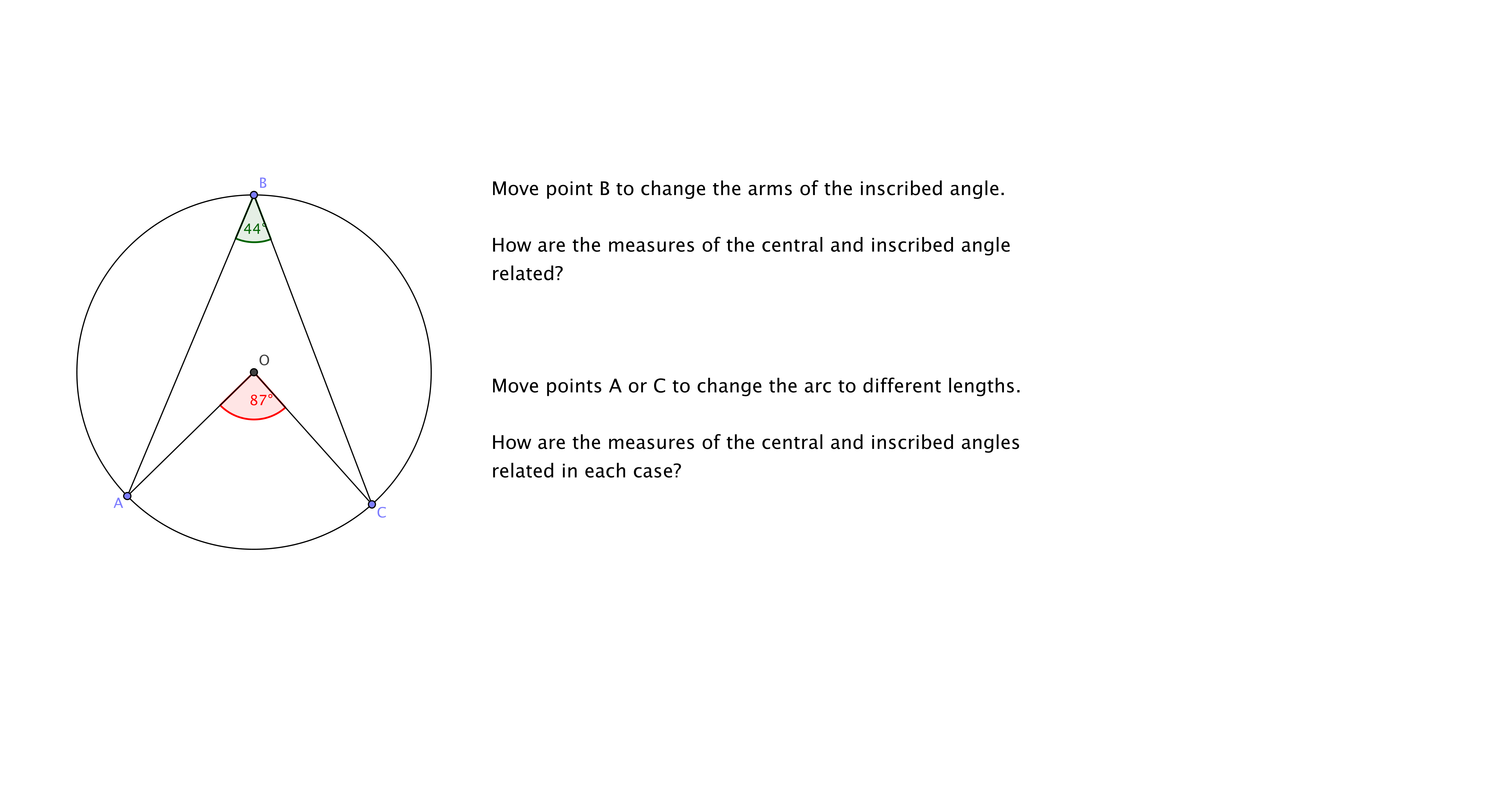
So, we went back to pencil and paper. Each student drew and then measured his or her own angles. Some students immediately observed the relationship. Others observed it after seeing the results of each group member. They asked “What if we move the inscribed angle off to the side more?” and “What if the central angle is larger?” Then, they set off to find the answers. Listening to these conversations, I wondered what this would have looked like had I been able to carry out my lesson plan.

In the four years since then, I’ve seen several GeoGebra/Sketchpad constructions created by other math teachers but very little that really excites me. A new tool to use while I stand and deliver? An e-version of an investigation that my students do using pencil and paper? Okay. I guess. Just don’t try to sell it to me as being more than what it is.

I want to incorporate technology into my teaching in meaningful ways. Here’s something from David Cox that could get me back on the GeoGebra bandwagon. It starts with a great problem that is enhanced because it is posed using GeoGebra. Students continue to interact with the applet as they attempt to solve the problem.

I uploaded some of my dynamic worksheets to GeoGebraTube and was very pleased to see that they worked on my iPad. I’d love some feedback on them. Was my assessment of them correct or are they salvageable? Also, I’m willing to give GeoGebra another try. Can you point me to exemplars?

Turn it Around

In More Good Questions: Great Ways to Differentiate Secondary Mathematics Instruction, Dr. Marian Small discusses the turn-around strategy to create open questions.

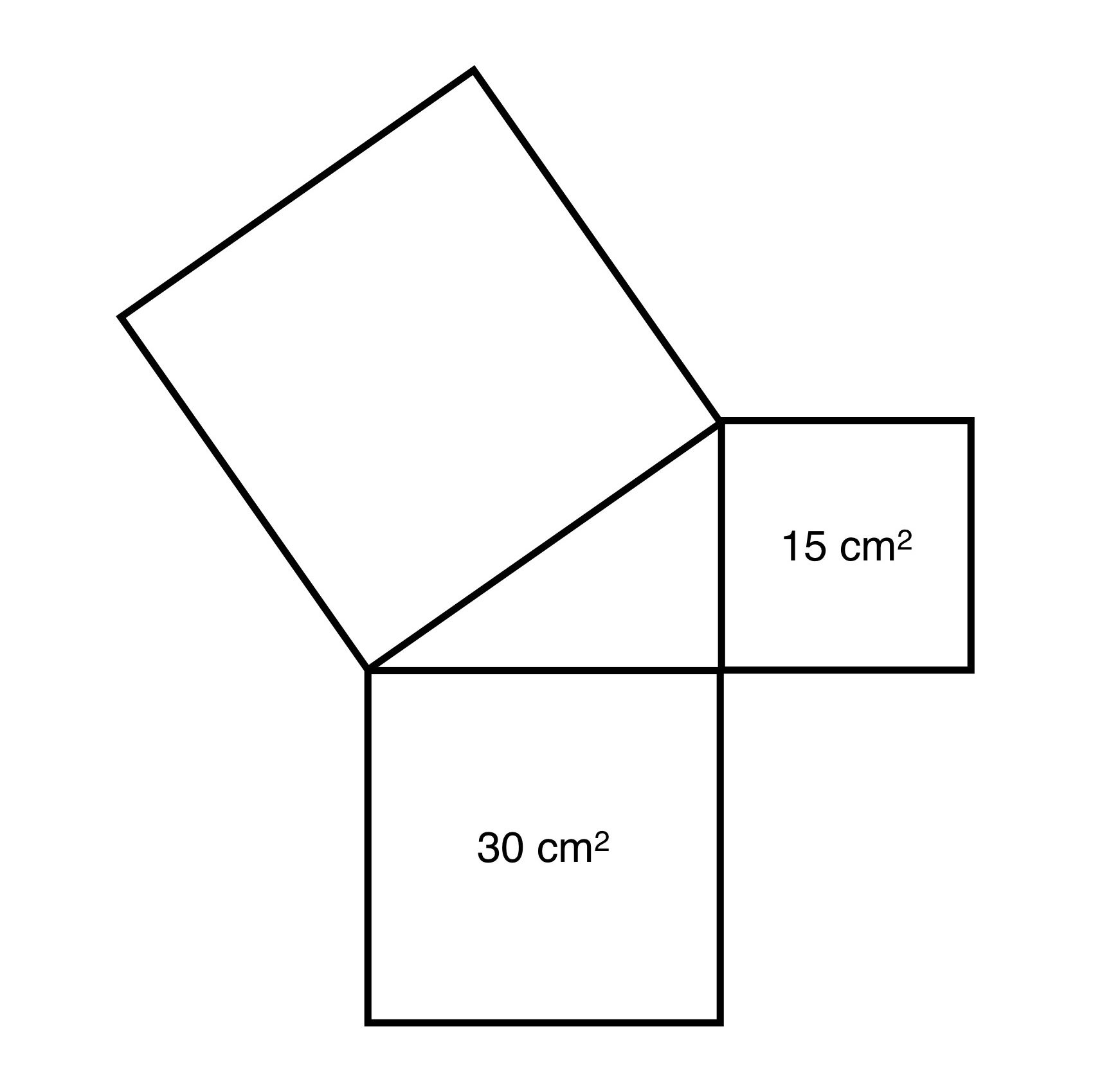
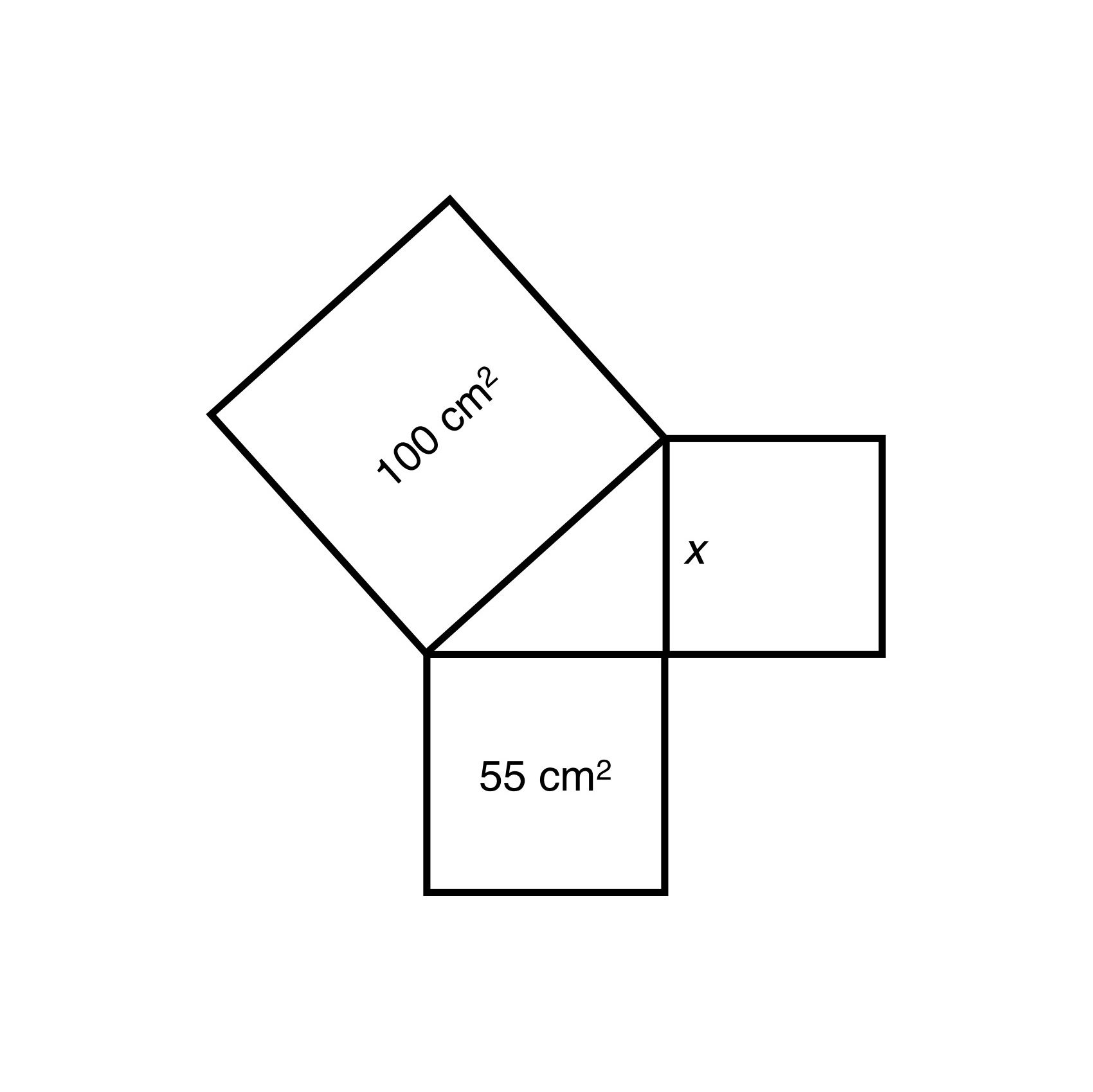
Instead of asking “The legs of a right triangle are 3 cm and 6 cm long. What is the hypotenuse?” the teacher can ask “The answer is √45. What could the question be?”

There are many possible questions. For example,

Determine the length of the hypotenuse.

Determine the length of x.

A square has an area of 45 cm². What is the side length?

What is an example of a square root that has a value between 6 and 7?

Which number is the greatest: √37, 6, 6½, √45?

Students will come up with a variety of questions. However, at first, I imagine the response to open questions such as “The answer is √45. What could the question be?” will be silence. Students are used to being asked questions where there is one correct answer. In math, you either get it or you don’t. It’s not just questions that need turning around. This black and white view of mathematics also needs turning around. With time and practice, class discussions about open questions can help change this attitude.

Two-Digit Addition – When Do I Show Them the “Real” Way?

Last week, I attended Carole Fullerton‘s parent presentation. She discussed strategies students have for adding two-digit numbers. Carole’s timing was great since I’ve been having similar discussions with teachers in recent weeks.

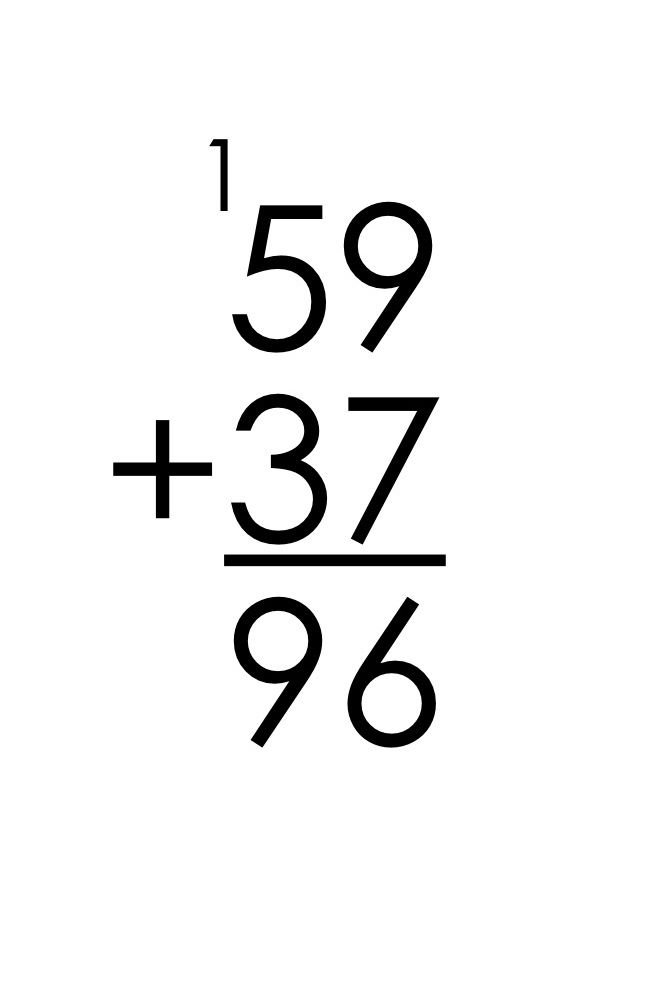
How many ways can you add 59 + 37?

The most common strategy that I see students use is to add the tens, add the ones, and then combine. Students working with ten frames naturally begin by grouping the 10’s, not the 1’s, together.

Students find other strategies. For example,

  • Add 1 to 59 to make 60. Take 1 away from 37 to make 36. 60 and 36 is 96. (make ten)
  • Add 1 to 59 to make 60. Add 3 to 37 to make 40. 60 and 40 is 100. Take the extra 4 away. (friendly numbers and compensation)
  • 30 more than 59 is 89. 7 more than 89 is 96. (add on)

These are the strategies I use to compute mentally. On paper, I fall back to the traditional right-to-left digit algorithm. It’s the result of performing thousands of such calculations in elementary school.

Students should be encouraged to write their mental math strategies down on paper. Some students will have to.

Teachers and parents appreciate these strategies. They make sense. Teachers and parents want mathematics to make sense to their kids. But at some point they always ask the question: “When should they learn the traditional/regular/real way?” They ask this because they are concerned their kids will not be prepared. “But do these strategies work for three-digit addition?” Yes.

“Relax. This will look familiar,” Carole joked. The same natural left-to-right strategy described above can be written vertically. We start with 50 and 30 is 80. Already, we know the sum is greater than 80.

Compare that with the traditional algorithm. We start with 9 and 7 is 16. We know the sum will have a 6 in the one’s place.

Which piece of information is more important? Carole made the point that accuracy is important. Always was, always will be. But it’s not where we should start. Strategies should be built on conceptual understanding. The emphasis of a left-to-right strategy is on number whereas the emphasis of a right-to-left strategy is on digits.

In her new blog, Amy Newman also writes about this. As well, she shares Carole’s key messages for parents helping children at home.