Keypad

From The Blacklist

Act 1

If you do know the four digits, how many combinations¹ could there be?

Act 2

Students may ask to see the four digits.

Keypad - Act 2
Keypad – Act 2

Remember to ask later if this information matters. That the digits are 1, 3, 4, 5 doesn’t; that there are four different digits — no repetition — does.

Act 3

My hope is that this resolution feels sort of anticlimactic — that Raymond Reddington’s “Now there’s only twenty-four combinations” on the screen doesn’t measure up to students’ shared strategies in the classroom.

Elizabeth Keen’s “Could be thousands of combinations” prior to Red’s sand trick could be an extension. At first viewing, it seems far-fetched that the character — an FBI profiler — doesn’t understand that there are exactly ten thousand four-digit possibilities (0000, 0001, 0002, …, 9999). But has Liz assumed that the digits cannot repeat? If so, how many combinations could there be? Students can no longer answer this question by systematically listing and counting each possibility.

I imagine this task as an introduction to, not an application of, permutuations. It provides a context for students to develop — not practice! — methods of counting without counting. Don’t bother if you’re anticipating a lot of knee-jerk 4!s from your students.

¹I know, I know… permutations.

Fair Share Pair

A couple weeks ago, I was discussing ratio tasks, including Sharing Costs: Travelling to School from MARS, with a colleague who reminded me of a numeracy task from Peter Liljedahl. Here’s my take on Peter’s Payless problem:

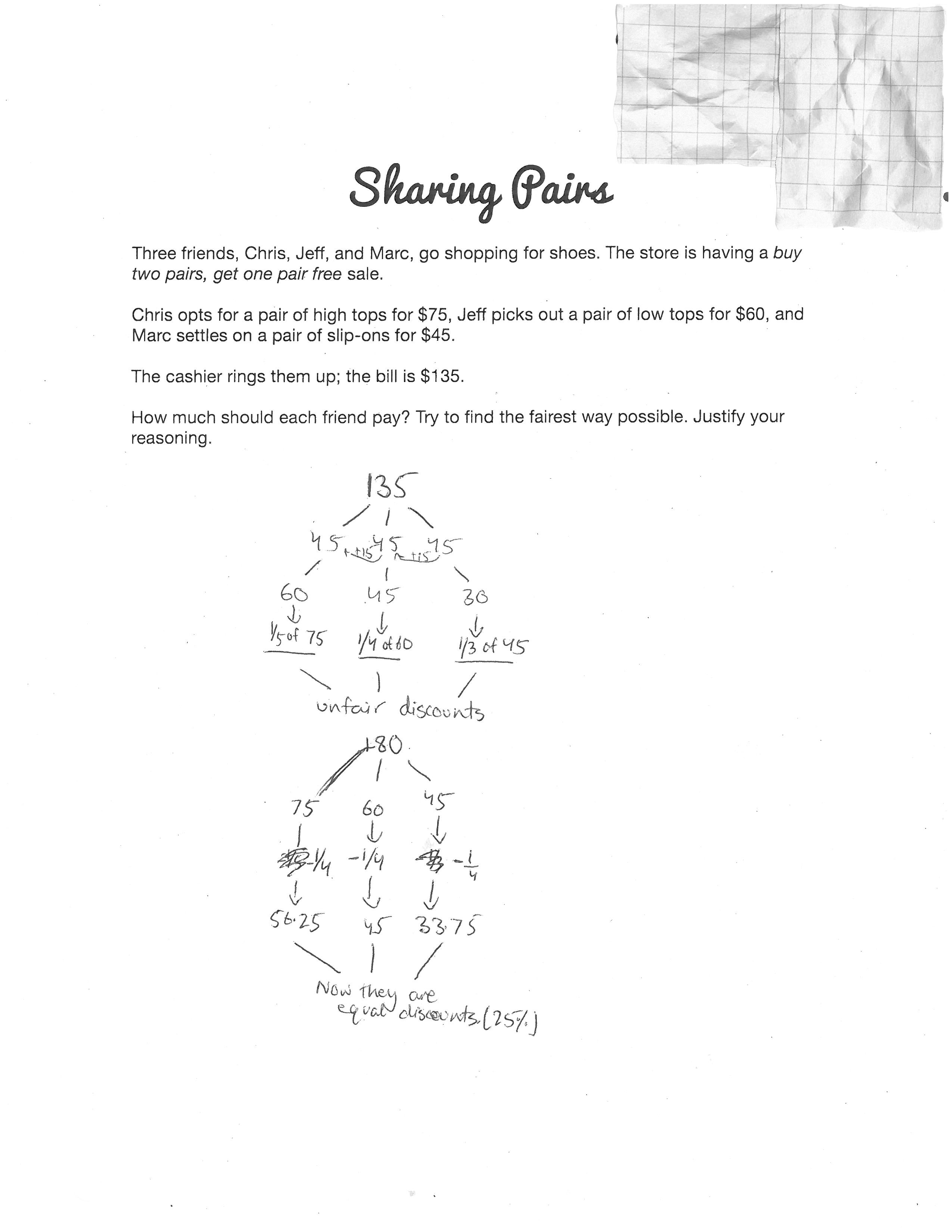
Three friends, Chris, Jeff, and Marc, go shopping for shoes. The store is having a buy two pairs, get one pair free sale.

 Chris opts for a pair of high tops for $75, Jeff picks out a pair of low tops for $60, and Marc settles on a pair of slip-ons for $45.

The cashier rings them up; the bill is $135.

How much should each friend pay? Try to find the fairest way possible. Justify your reasoning.

Sharing Pairs.pdf

I had a chance to test drive this task in a Math 9 class. I asked students to solve the problem in small groups and record their possible solutions on large whiteboards. Later, each student recorded his or her fairest share of them all on a piece of paper. If you’re more interested in sample student responses than my reflections, scroll down.

The most common initial approach was to divide the bill by three; each person pays $45. What’s more fair than same? I poked holes in their reasoning: “Is it fair for Marc to pay the same as Chris? Why? Why not?” Students notice that Chris is getting more shoe for his buck. Also, Marc is being cheated of any discount, as described by Student A. (This wasn’t a happy accident; it’s the reason why I chose the ratio 5:4:3.)

Next, most groups landed on $60-$45-$30. Some, like Student A, shifted from equal shares of the cost to equal shares of the discount; from ($180 − $45)/3 to $45/3. Others, like Students B, C, and D, arrived there via a common difference; in both $75, $60, $45 and $60, $45, $30, the amounts differ by $15. This approach surprised me. Additive, rather than multiplicative, thinking.

Student C noticed that this discount of $15 represented different fractions of the original prices; $15/$75 = 1/5, $15/$60 = 1/4, $15/$45 = 1/3. He applied a discount of 1/4 to all three because “it’s the middle fraction.” Likely, this is a misconception that didn’t get in the way of a reasonable solution.

Student D presented similar amounts. Note the interplay of additive and multiplicative thinking. She wants to keep a common difference, but changes it to $10 to better match the friends’ discounts as percents.

Student E applies each friend’s percent of the original price to the sale price. This approach came closest to my intended learning outcome: “Solve problems that involve rates, ratios and proportional reasoning.”

In spite of not reaching my learning goal, I think that this lesson was a success. The task was accessible yet challenging, allowed students to make and justify decisions, and promoted mathematical discourse.

Still, to increase the future likelihood that students solve this problem using ratios, I’m wondering about changes I could make. Multiples of 20 ($100-$80-$60) rather than 15 ($75-$60-$45)? Different ratios, like 4:3:2 or 5:3:2, might help; the doubles/halves could kickstart multiplicative thinking. (Also, 5:3:2 breaks that arithmetic sequence.)

Or, I could make changes to my questioning.

Sharing PairsWhen I asked “What do you notice?” students said:

  • the prices of the shoes are different
  • Chris’ shoes are the most expensive
  • Marc’s shoes are the cheapest
  • Chris’ shoes are $15 more than Jeff’s, which are $15 more than Marc’s
  • Jeff’s shoes are the fugliest

Maybe I could ask “What else could you say about the prices of Chris’ shoes compared to Marc’s?” etc. to prompt comparisons involving ratios. If that fails, I’m more comfortable connecting ratios to the approaches taken by students themselves than I am forcing it.

BTW, “buy one, get one 50% off” vs. “buy two, get one free” would make a decent “Would you rather?” math task.

h/t Cam Joyce, Carley Brockway

Sharing Pairs - Sample Student Response A
Sharing Pairs – Sample Student Response A
Sharing Pairs - Sample Student Response B
Sharing Pairs – Sample Student Response B
Sharing Pairs - Sample Student Response C
Sharing Pairs – Sample Student Response C
Sharing Pairs - Sample Student Response D
Sharing Pairs – Sample Student Response D
Sharing Pairs - Sample Student Response E
Sharing Pairs – Sample Student Response E

“They’ll Need It for High School” (Part 4)

In Part 1, I catalogued and critiqued common uses of “They’ll need it for high school.” Samuel Otten’s take on “When am I ever going to use this?” was an obvious influence. “Poor Pedagogy Preparation” was one of my categories: “I want them to get used to it” as an indefensible defence for the mad minute. Since that post, I’ve wondered about putting a positive spin on “I want them to get used to it.”

As a K-12 Numeracy Helping Teacher, I have the opportunity to teach in elementary and secondary classrooms alike. Often, I’m struck by how pedagogical similarities overwhelm any differences. Malcolm Swan’s ordering decimals lesson — a current favourite of mine — and my sinusoidal sort illustrate this.

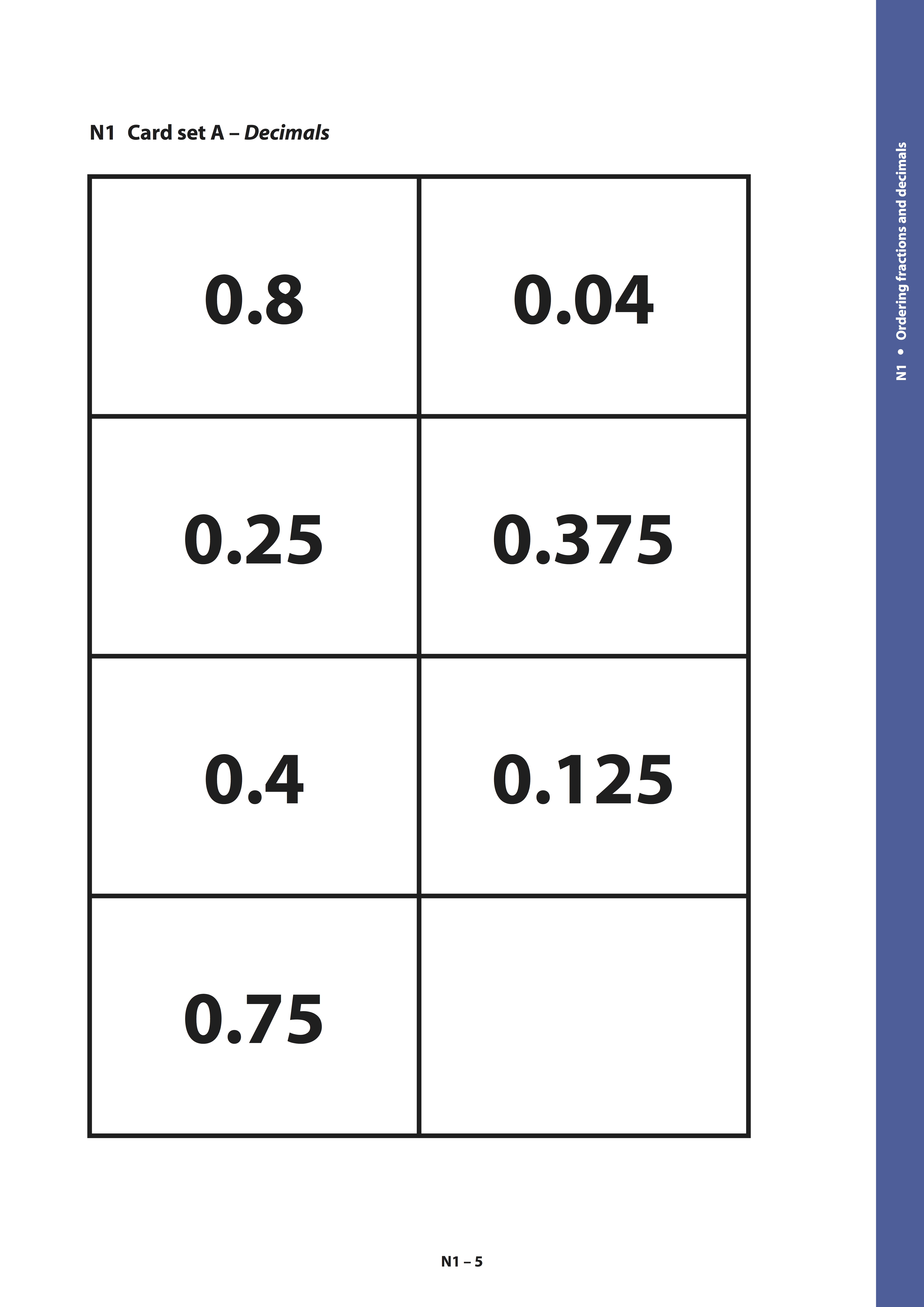
In Grade 5, students are asked to put the decimal cards in order of size, smallest to largest.

Card Set A - Decimals

The most common response is 0.4, 0.8, 0.04, 0.25, 0.75, 0.125, 0.375. This can be explained by how students compare whole numbers. Misconceptions are revealed, but not corrected. (The rest of the activity will take care of that.)

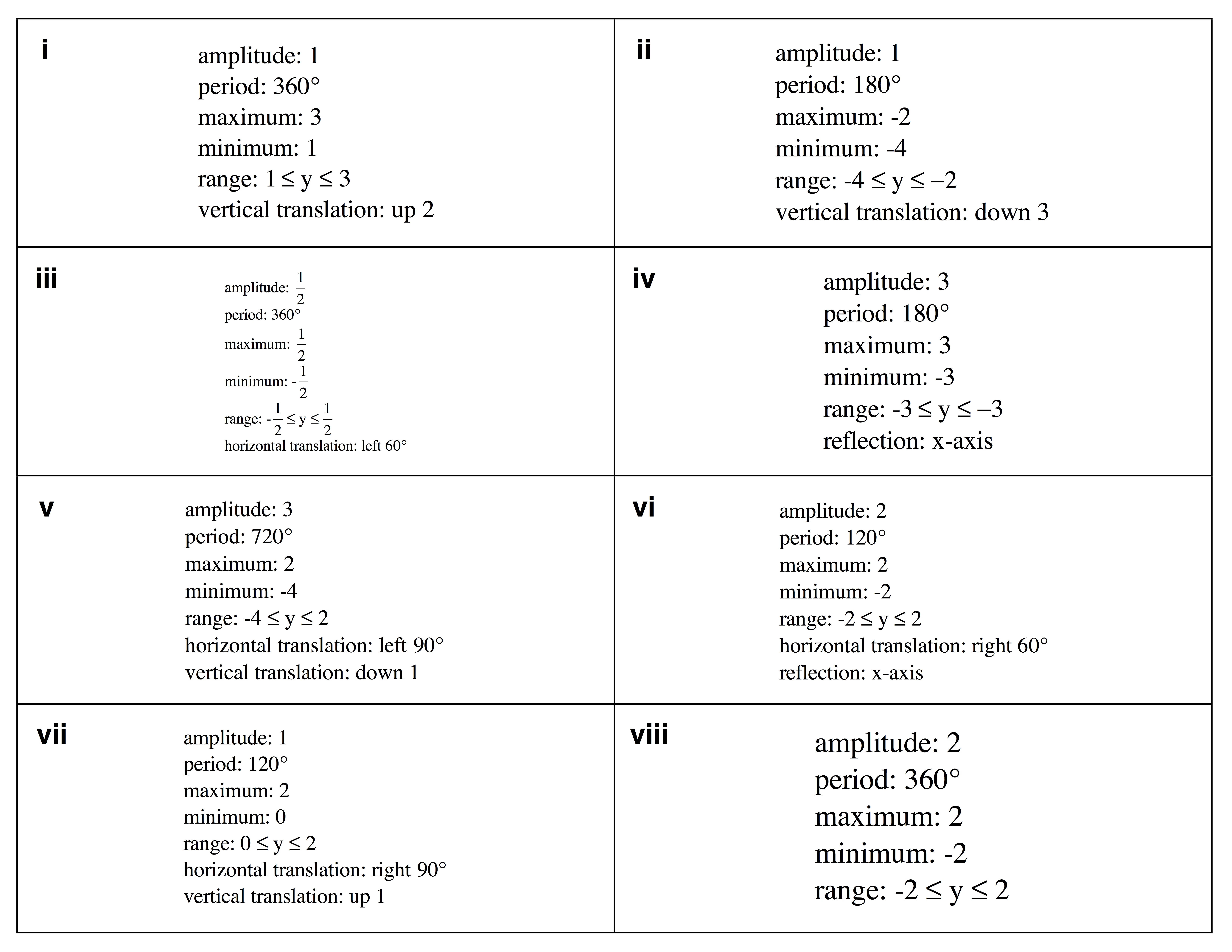
In Grade 12, students are asked to put the equation cards in piles.

Sinusoidal Sort - Equations

The most common response is to make two piles: sine and cosine. This can be explained by how students were introduced to y = sin x and y = cos x. This isn’t a misconception; there is no “right” sort. But it is unsophisticated. And it goes unchallenged. (The rest of the activity will take care of that.)

In Grade 5, students match hundred grids and number lines to their decimals. They explain how they know that the cards make a set, building connections between decimals and their understanding of fractions and place value. They argue. When there’s consensus, students are again asked to put the cards in order. I note their strategies that emerge (benchmarks, place value, equivalent decimals) for a class discussion.

In Grade 12, students match graphs and characteristics to their equations. They make conjectures. They explain how they know that the cards make a set, building connections between transformations of trigonometric functions and their understanding of transformations of other functions. When there’s consensus, students are again asked to put the cards in piles. I note their sorting rules that emerge (amplitude, period, phase shift, vertical displacement, range, maximum/minimum values) for a class discussion.

Elementary and secondary lessons need not be as closely aligned as above. It’s not about matching card matching activities. Or parallel “Which one doesn’t belong?” prompts. Or three-act math tasks for K-5. More generally, exploring and discussing ideas, working collaboratively in pairs/small groups, problem solving (and posing!), … you could make a case for students needing these experiences in elementary school because… wait for it… they’ll need it for high school. We want them to get used to it. I hope.

A nagging thought… I’m not convinced that pedagogy preparation is ever a satisfactory response to “So, what will they need?” Even if that pedagogy is positive. If we’re going to follow that pathway, then this question demands an answer not in terms of teaching methods but in terms of the mathematical habits of mind (or processes or practices or competencies) that these teaching methods aim to promote. (See my “Affective Domain” concerns in Part 1.)

That’s not to say that I wasted my time with this post. For me, it’s always helpful to think about and present examples of secondary mathematics education as something other than passive. Maybe that — reframing those pedagogical “TNIFHS” conversations with colleagues into something more promising — is the real value here.

Which One Doesn’t Belong?

(If wodb.ca brought you here, check out this post.)

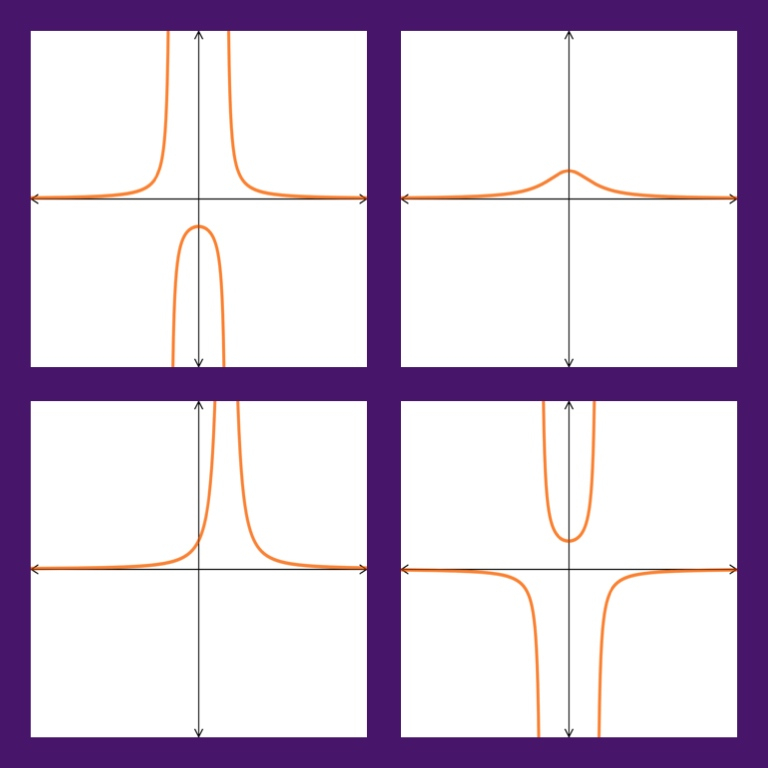
As part of an upcoming “TNIFHS” post, I wanted to include one example of what Christopher Danielson’s approach to a better shapes book might look like in a high school math class. [Update: Christopher’s Which One Doesn’t Belong? is available from Stenhouse; from Pembroke for Canadians.] But then I had some fun with this and created a few more. In each set, a reason can be given for each of the four options being the odd one out. I’ve done this type of thing with numbers and equations before. Worthwhile, but not what I’m going for here. Each set below is pictorial. Also, I went naked; I stripped the graphs of grid lines and ordered pairs. More noticing properties, less determining equations. Aside from graphs, where else in secondary mathematics might this fit? The last two images below are my attempts at answering this question.

Download the pdf.

WhichOneDoesn'tBelong?.001

WhichOneDoesn'tBelong?.002

WhichOneDoesn'tBelong?.003

WhichOneDoesn'tBelong?.004

WhichOneDoesn'tBelong?.006

WhichOneDoesn'tBelong?.007

WhichOneDoesn'tBelong?.008

WhichOneDoesn'tBelong?.009

Update: Mary Bourassa created a website.

Update (10/04/17):

https://twitter.com/MsTownsley/status/850410758307368961

Related: Alike & Different: Which One Doesn’t Belong? & More

Recommended: Simon Gregg’s WODB? album

“They’ll Need It for High School” (Part 3)

I’m picking “TNIFHS” back up. At the end of Part 1, I promised Part 2 would answer “What are the big ideas in elementary school mathematics that students will need for high school?” Instead, I talked times tables.

In this third half, I’ll refocus on these big ideas. Or one of them — one that came up in that initial “they’ll need long division for high school” conversation.

More than the standard algorithm, what students will need is an understanding of division as sharing (finding the number in each group) and measuring (finding the number of groups). More generally, what students will need is an understanding of the fundamental meanings of all four operations.

Here’s part of a task I presented to my secondary math colleagues:

Evaluate, or simplify, each set of expressions. Make as many connections as you can conceptually & procedurally, pictorially & symbolically.

fundamental meanings of all four operations

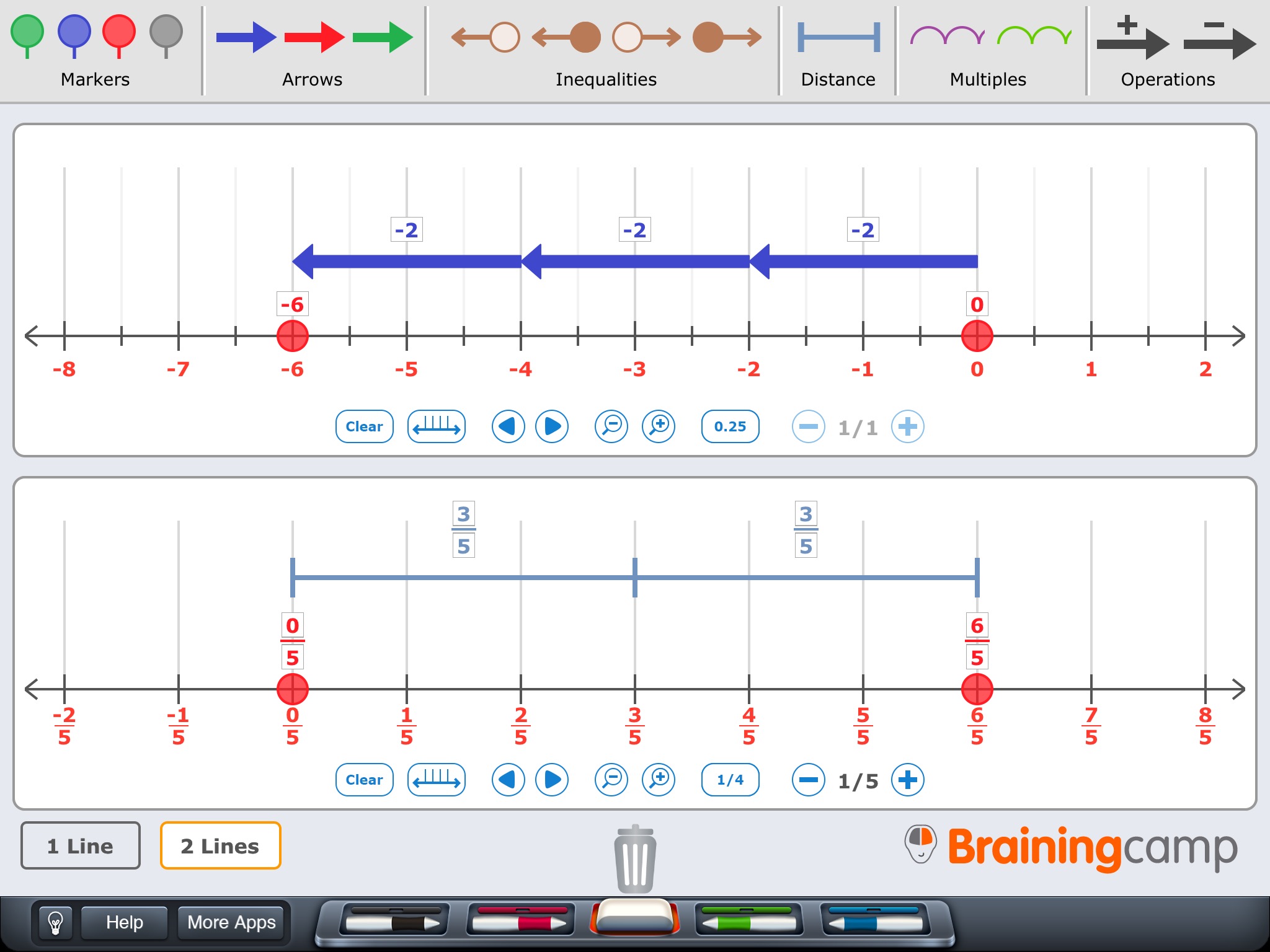
Sticking with division, in this task (−6) ÷ (+3) was chosen to bring to mind sharing (3 groups, −2 in each group) whereas 6/5 ÷ 3/5 was chosen to evoke measuring (3/5 in each group, 2 groups). (This often leads teachers themselves to revisit 6 ÷ 3.)

division
(−6) ÷ (+3) as sharing (top) and 6/5 ÷ 3/5 as measuring (bottom)

Flexibility is key. Consider (−6) ÷ (−3), 6/5 ÷ 3, 6 ÷ 0.3, 0.6 ÷ 3, 6x ÷ 3, 6x ÷ 3x, etc. (Note: division of fractions & integers are high school topics in Western Canada.)

(I’m not saying that dividing by a fraction — or decimal fraction — always means measuring. You can think sharing, which can be challenging. Andrew Stadel’s estimation jams are my favourite examples of this. How long is “All Along the Watchtower”?

4082414_orig

Did you see 2/3 in the picture? Did you divide by two, then multiply by three? In other words, did you invert and multiply? What’s the meaning of 2:40 ÷ 2/3 in this context?)

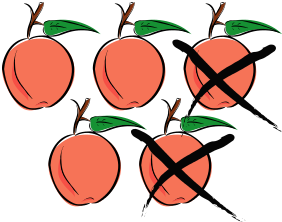
The subtraction set above is interesting. Teachers pick up that the expressions are variations on a theme: five “take away” two. Their pictorial representations tend to show subtraction as removal: “if you have five apples/quarters/x‘s/square root of two’s and I take away two…”

282px-Subtraction01.svg

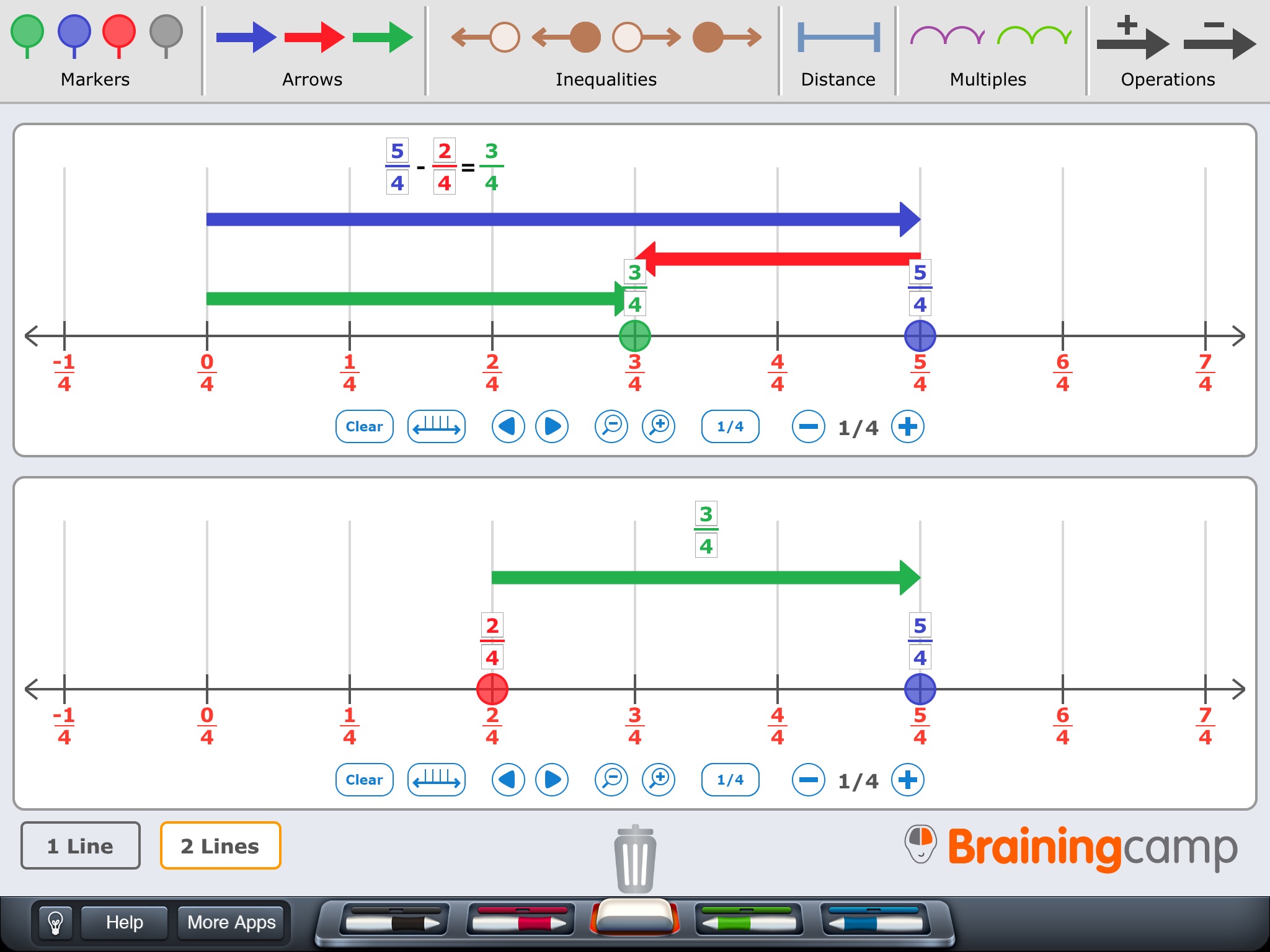
Pictorial representations that show subtraction as comparison (the “difference”!) are less frequent, but maybe more helpful.

subtraction
5/4 − 2/4 as removal (top number line) and comparison (bottom number line)

Consider (+5) − (−2). To “take away” negative two from positive five means introducing zero pairs whereas the “difference” between positive five and negative two means understanding that positive five is seven greater than negative two.

This second meaning is probably more meaningful in high school. For example, subtraction as removal reduces (1.89t + 15) − (1.49t + 12) to an exercise in collecting like terms whereas subtraction as comparison has students contrasting rates of change (e.g., cost per additional pizza topping) and initial amounts (e.g., the price of a plain cheese pizza). Similarly, if F_1(C) = 9/5C + 32 and F_2(C) = 2C + 30, then (F_2 − F_1)(C) compares conversions given by an estimate and the formula. When solving |x − 5| = 2, it’s more helpful to ask “What numbers differ from five by two?” than think missing minuends in take away problems.

Addition and multiplication — as well as other big ideas needed for high school such as proportional reasoning (or “multiplicative thinking”?) — will be addressed in future posts.

Cola Comparison

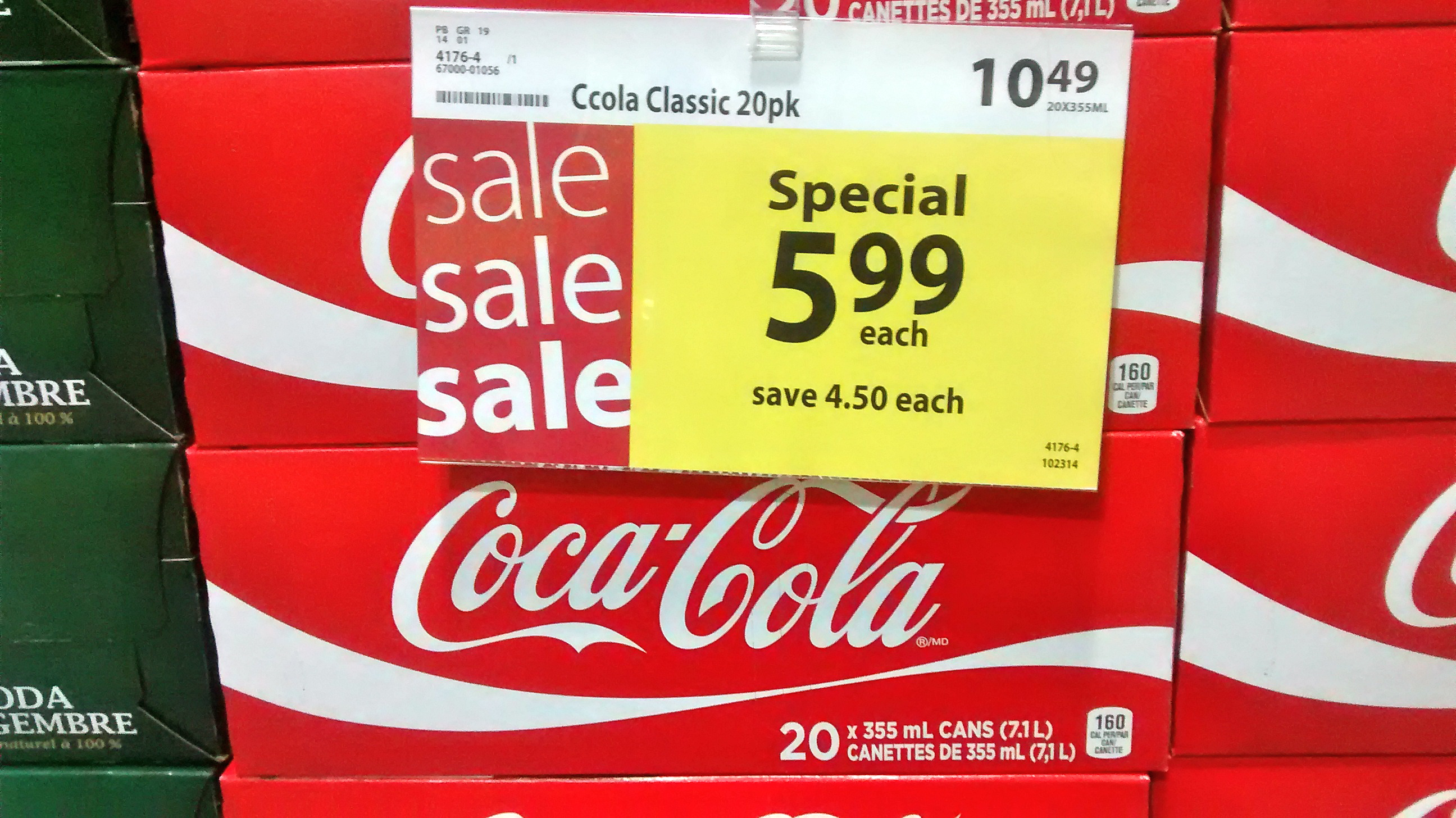
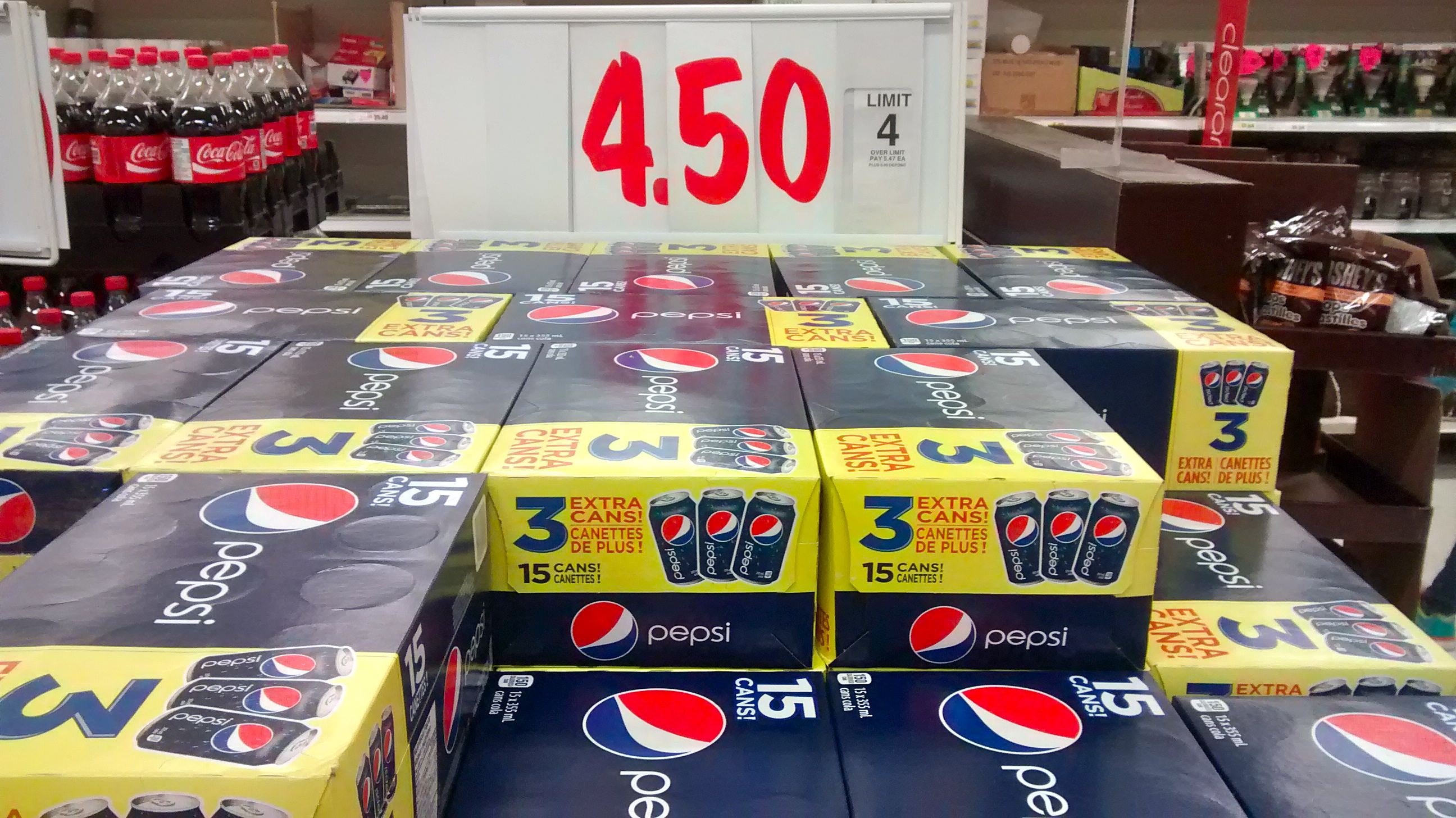
Coke is now sold in 20, not 24, packs!

Coke 20 (2)
Coke 12 (2)
Pepsi 24 (2)

So to determine the best buy, I couldn’t just double. I use that strategy all the time; it’s my Frank’s RedHot. The exclamation point is there because I think that 20 leads to more strategies than 24. (Some of) these strategies are listed in my 5 Practices monitoring tool below. I’m curious if you think that I have anticipated likely student responses correctly. What incorrect strategy could I have anticipated? I wonder how you’d purposefully sequence these responses during the discussion.

0001ar

More than SWBAT solve problems using unit rates, I want my students to recognize that there are many ways to solve rate problems and understand that we can easily compare rates with one term the same. This big ideas connects the strategies. In the fourth strategy above, we can think of 24 cans as a unit. Call it a “two-four” (Is that just a Canadian convention?) or a “flat” (Are we cool with calling the Pepsi cube a flat?). In fact, Save-On-Foods wants us to think of 24 as one; we’re encouraged to buy two packs of 12, a composed unit. For this task, I’d prefer that they didn’t, so I went back to the store and found this:

Cola 12

Comparing 20 packs with 15 packs is more likely to lead to common multiples than comparing 20 packs with 24 packs as above. Numbers matter. There’s this, but it doesn’t get us a clear winner:

Pepsi 15

Recommended: Dan knocks motivating unit rates out of the park; Christopher asks “What is one?” 

May 13, 2016: de La Cruz, Jessica and Sandra Garney. 2016. “Saving Money Using Proportional Reasoning.” Mathematics Teaching in the Middle School 21 (9): 552-561.

Table Talk

You don’t teach students the problem-solving strategy of Organize the Information: Make a Table by having them “complete the table.”

The activity “That’s Sum Challenge!” from AIMS asks “What sums from one to 25 can by obtained by adding two, three, four, five, or six consecutive numbers?”

One of the student pages looks like this:

0001EJ

I’ve designed this type of thing before. Fortunately, there’s a quick fix: ask the question, allow students time to work on the problem, ask the groups–or regroup and ask the class–”How can we organize this information?”

Likely, students’ tables won’t match the one above. Some students will probably make a table for two consecutive numbers, then three, and so on. To highlight the impossible sums, the helpful folks at AIMS have done the work of merging these tables into one. In their defence, kinda, the teacher pages has this under “Management”:

If you have a class that functions well with open-ended problems, you can explain the problem to them and have them solve it without using the student pages.

Subtracting the table engages more students at more levels. From “two consecutive numbers are always even and odd (or odd and even) and that gives us all the odd sums” to “the sums made by adding three consecutive numbers are all multiples of three” to “powers of two cannot be obtained because…,” each student can contribute to answering the key question “What sums can be obtained by adding consecutive numbers?” (The ellipsis is there because the reason isn’t immediately obvious to me.)

In the past, I had it back-asswards. Take the “How many different possible meal combinations are there on the kids¹ menu?” problem. I’d give ’em tables and tree diagrams up front. A problem became practice. Once I “turned the tables” and allowed students time to get started, I could later ask groups to share their tables or I could step in at just the right time with tree diagrams to help make sense of spaghetti nightmares.

¹Kid’s? Kids’? This is why I’m not a prolific blogger.

Related: The more sides you have, the smarter you are.

Recommended: “You Can Always Add. You Can’t Subtract.” Ctd. by Dan Meyer

How many do you see? How do you see them?

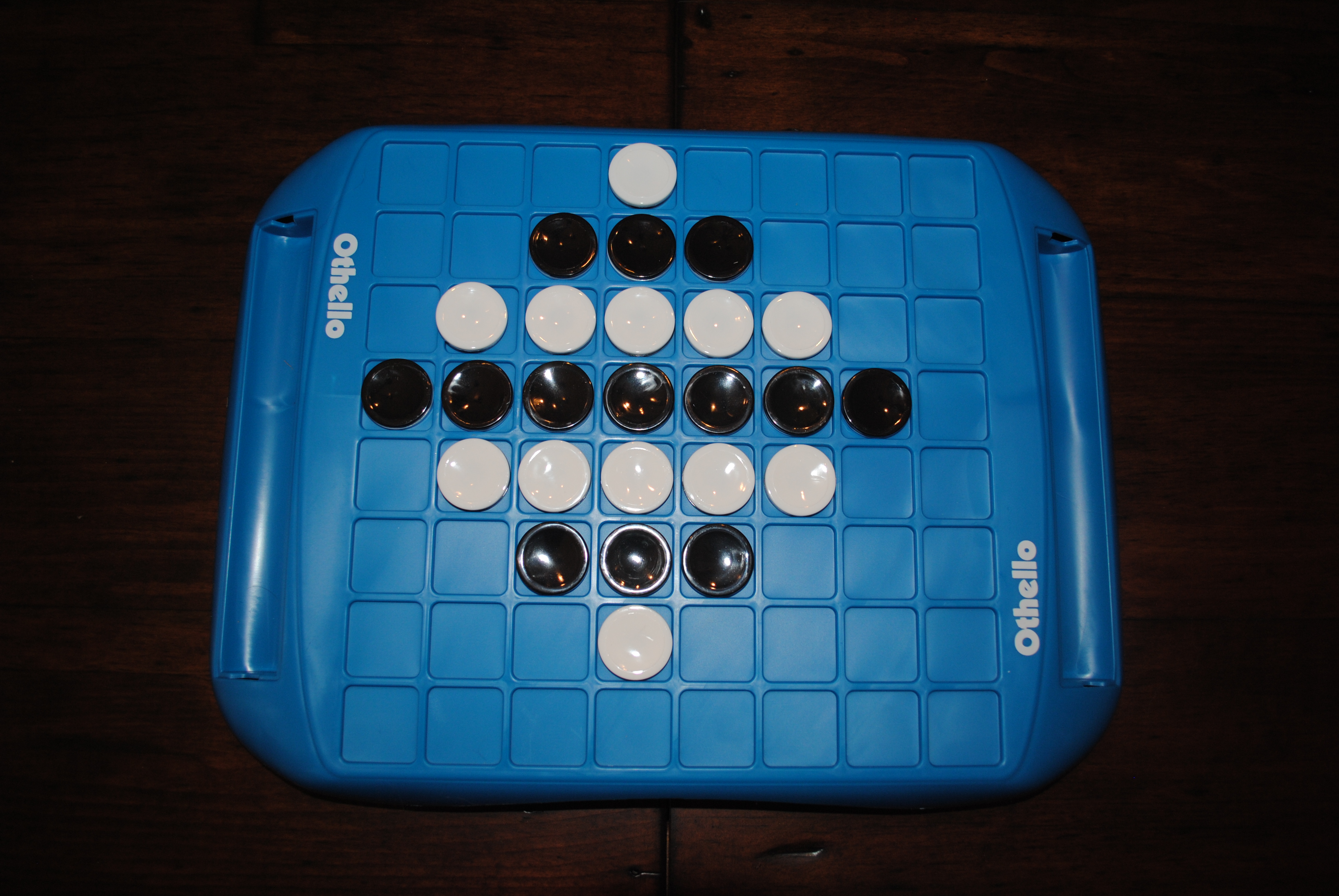
This summer, as Gwyneth and I were packing up Othello, I started playing with different arrangements of discs – mostly arrays – and asked her “How many?” I remembered the following arrangement, taken from AIMS’ Cookie Combos activity.

3^2+4*4
3^2 + 4 * 4

“Sixteen plus nine, so nineteen plus six… twenty, twenty-five,” she said. (I don’t think that she actually said “twenty” aloud. That came after my clarifying question: “Wait. Huh?”)

There’s a lot happening in Gwyneth’s bridging through twenty strategy – partitioning of quantities, place value, commutative property, breaking apart to make (a multiple of) ten. All within a three count, standard algorithm be damned.

This invented strategy discussion was a happy accident. The goal of this problem when we pose it to teachers is to see different ways to visualize the group and represent these using expressions. It’s about valuing different methods; the solution – counting 25 cookies – is easy enough.

How many do you see? How do you see them? How many different ways can you find?

25

Some popular solutions:

7+2*5+2*3+2
7 + 2 * 5 + 2 * 3 + 2 * 1

3*5+2*4+2
3 * 5 + 2 * 4 + 2

4*5+5
4 * 5 + 5

If you look just right, you can see two arrays:

4*4+3*3
4 * 4 + 3 * 3

A creative solution that involves counting what’s not there:

7^2-4*6
7^2 – 4 * 6

And moving what is:

output_rf0ouE
5^2

If you plan on using these images with your students, I recommend displaying the photo with just white discs. This leaves the problem open. Two colours were used above to illustrate various visualizations. This can steer student thinking. (See how the use of colour is intended to be helpful here.) If students miss one of the visualizations above, display that photo and ask for the expression (or vice versa).

Always, Sometimes, Never

This week should have been my first official – third unofficial – week back. Instead, I’m starting this school year as I ended the last – walking the picket line. I haven’t been up to blogging since this started.  Below is a draft from June. I never got around to finishing it. The ending has a “pack up your personal belongings” feel. I left it as-is; seems fitting that this post should come up short… I mean, 10% of my pay – and my colleague’s – was being deducted at the time. 

Recently, I invited myself to a colleague’s Math 8 class to try out Always, Sometimes, Never. In this formative assessment lesson – originally by Swan & Ridgway, I think – students classify statements as always, sometimes, or never true and explain their reasoning.
Sometimes-Always-Never-3

Because it’s June, we created a set of statements that spanned topics students encountered throughout the course. Mostly, this involved rephrasing questions from a textbook, Math Makes Sense 8, as well as from Marian Small’s More Good Questions, as statements. That, and stealing from Fawn Nguyen.

.doc .pdf

To introduce this activity, I displayed the following statement: When you add three consecutive numbers, your answer is a multiple of three.

Pairs of students began crunching numbers. “It works!”

“You’ve shown me it’s true for a few values. Is there a counterexample? What about negative numbers? Does it always work? How do you know? Convince me.”

Some students noticed that their calculators kept spitting out the middle number, e.g, (17 + 18 + 19)/3 = 18. This observation lead to a proof: take one away from the largest number, which is one more than the middle number, and give it to the smallest number, which is one less than the middle number; each number is now the same as the middle number; there are three of them. For example, 17 + 18 + 19 = (17 + 1) + 18 + (19 – 1) = 18 + 18 + 18 = 3(18).

I avoided explaining my proof: x + (x + 1) + (x + 2) = 3x + 3 = 3(x + 1). This may have been a missed opportunity to connect the two methods, but I didn’t want to send the message that my algebraic reasoning trumped their approach. “Convince me,” I said. And they did.

To encourage students to consider different types of examples, I displayed a ‘sometimes’ statement: When you divide a whole number by a fraction, the quotient is greater than the whole number. Students were quick to pick up on proper vs. improper fractions.

Next, students were given eight mathematical statements. We discussed some of the statements as a whole-class. Some highlights:

A whole number has an odd number of factors. It is a perfect square.

I called on a student who categorized the statement as always true because “not all of the factors are doubled.” We challenged doubled before she landed on square roots being their own factor pair. For example, 1 & 36, 2 & 18, 3 & 12, 4 & 9 are each counted as factors of 36, but 6 in 6 × 6 is counted only once.

The price of an item is decreased by 25%. After a couple of weeks, it is increased by 25%. The final price is the same as the original price.

Like the three consecutive numbers statement above, students began playing with numbers – an original price of $100 being the most popular choice. I anticipated this as well as the conceptual explanation that followed: “The percent of the increase is the same, but it’s of a smaller amount.” I love having students futz around with numbers; it’s so much more empowering than having them “complete the table.”

The number 25 was chosen carefully in hopes that some students might think fractions: (1 + 1/4)(1 − 1/4) = (5/4)(3/4) = 15/16. None did. There’s a connection to algebra here, too: (1 − x)(1 + x) = 1 − x². Again, I didn’t bring these up. Same reason as above.

One side of a right triangle is 5 cm and another side is 12 cm. The third side is 13 cm.

All but one pair of students classified this as always true. That somewhat surprised us. More surprising was how this one pair of students came to realize

BTW, the blog-less Tracy Zager has a crowd-sourced a set of elementary Always, Sometimes, Never statements.

Update: I stand corrected.

Math Picture Book Post #7: Bean Thirteen

A few ago, I was invited to teach a lesson on division (Grade 3). First, I read Bean Thirteen aloud – once just for fun. About Bean Thirteen, from the author:
Ralph warns Flora not to pick that thirteenth bean. Everyone knows it’s unlucky. Now that they’re stuck with it, how can they make it disappear? If they each eat half the beans, there’s still one left over. And if they invite a friend over, they each eat four beans, but there’s still one left over! And four friends could each eat three beans, but there’s still one left over! How will they escape the curse of Bean Thirteen?

(A funny story about beans, that may secretly be about . . . math!)

Bean Thirteen

Next, we revisited several of the pages. I asked students to write an equation to match the picture. I modelled this using magnetic “bean counters.” For the page above, students suggested 2 × 6 + 1 = 13; I introduced 13 ÷ 2 = 6 R 1. We discussed and recorded the meaning of this:

13 divided by 2

In pairs, students then chose their own number of beans (counters) and built different division as sharing stories for this number. They recorded (.doc) their stories using pictures, numbers, and words:

SDEC1-4124-14052811560

SDEC1-4124-14052811561

I called on students to share their stories with the class. They observed that some numbers gave remainders more so than others; Bean Thirteen can also be used to explore even/odd and prime/composite numbers.

This lesson served as the students’ introduction to division. I wrestled with the decision to introduce remainders at this time. An alternative problem – one consistent with both the prescribed learning outcomes and recommended learning resources – might be to start with 18 beans – a “nice” dividend – and share equally among 2, 3, 6, and 9 bugs – “nice” divisors. Note 15 ÷ 3 = 4 R 3 (and 15 ÷ 2 = 6 R 3) above. This mistake would not have happened had I not introduced remainders. I wonder if including remainders makes it more difficult for students to understand division and relate division to multiplication.

Then again, children will have already experienced remainders in everyday contexts.