Sinusoidal Sort

On Monday, I was invited to Sandra Crawford’s Pre-Calculus 12 classes to try out an activity we created together. Thanks, Sandra!

Sandra’s students were familiar with how transformations of functions affect graphs and their related equations. They’ve stretched & shrunk (vertically & horizontally), flipped (in the x-axis & in the y-axis), & slid (up, down, left, & right) linear (& piecewise linear), quadratic, absolute value, reciprocal, & radical functions. These were topics in prior units. In this unit, students were previously introduced to radian measure, the unit circle, the six trig ratios, & the functions y = sin x, y = cos x, & y = tan x. Next up: determining how varying the values of a, b, c, & d affect the graphs of y = a sin b(x – c) + d & y = a cos b(x – c) + d.

Such was the case when I last taught trig functions (in Principles of Math 12). Back then, my approach was to provide clear and concise explanations, connecting these transformations to those transformations (or, better, transformations of these to transformations of those). But was this necessary? Shouldn’t students be able to make this connection? On. Their. Own.

In small groups, students were handed a set of equation cards to sort and were asked to explain their sorting rule. We designed the equations so that there were plenty of similarities and differences in terms of whether or not there were leading coefficients, coefficients of x, brackets, etc., as well as in terms of the values of a, b, c, & d themselves. After all that, most groups just sorted the equations into sine and cosine functions — to be expected, I guess, given the focus of the prior lesson.

sort1

Next, students were handed graph cards and were asked to match each to the corresponding equation card. We encouraged students to make predictions, then test these predictions using technology. Interestingly, few reached for their graphing calculators or phones. We asked students if, having seen the equations and their graphs together, they wanted to re-sort.

sort2

This process was repeated with characteristic cards. Note: The terms amplitude and period were introduced the lesson before; phase shift and vertical displacement were not. Hence, horizontal translational and vertical translation at this stage of the lesson.

For the most part, students were communicating and reasoning mathematically, making connections, and problem solving. They were engaged with mathematics. A minority probably would have preferred to be engaged with taking notes.

Groups shared their sorts the following day. In the end, the functions were sorted in a variety of ways, which allowed Sandra to highlight each transformation.

sort3

A few groups struggled with matching all of the cards. Therefore, I reduced the number of functions. If finished, some students could be given two additional functions. Each of these is actually a phase shift of one of the initial eight (e.g., y = cos x + 2 ↔ y = sin (x + 90°) + 2). I wonder what they’d do with that.

Sinusoidal Sort (doc)
Sinusoidal Sort (pdf)

(Note: I’ve triple-checked these. Still, no guarantees.)

Survivor: 100 Chart Challenge

I don’t watch Survivor. Stopped watching after Richard Hatch, often competing naked, won the first season.

Channel surfing last week, this grabbed my attention:

Host Jeff Probst:

“Alright, let’s get to today’s duel. For today’s duel you’re gonna race across a balance beam, collecting bags of numbered tiles. You must then place the tiles in order, one to one hundred.”

(Aside: If there are three opponents, is it still called a duel?)

The reaction online was swift and harsh:

“It is seriously the most idiot-proof puzzle in the history of puzzles. You basically have to know how to count and that’s pretty much it.” (source)

But that’s not pretty much it. I mean, it is counting from one to one hundred (and that is how the contestants solved the “puzzle”), but it could be more than that. A better strategy involves comparing numbers, understanding place value, and identifying patterns found in tables.

At 1:49 and 2:02, we see two contestants, Laura and Brad, respectively, place 25 from the second bag (11 to 30).

26

A literal translation of “You gotta put ’em in order”? Each competitor places 25 only after placing 24. Then, he/she tries to find 26 in his/her pile o’ tiles. Some tiles are facing down. Suppose a player turns over a tile and finds 28 rather than 26. He or she should take advantage of another pattern and place it under 18.

At 3:11, it’s down to Brad and John for the last spot. At 3:18, Brad places 87 after 86.

87

He could have caught John if he had an understanding of place value. Suppose Brad turns over 94 before finding 87. Should he drop 94 and continue looking for 87 or just place 94 in the 9th row (9 tens) and 4th column (4 ones)?

This challenge reminds me of an activity I’ve used in Grade 3 classrooms. Take some 100 charts. Cut each chart into “puzzle” pieces. Place in a Ziploc bag. In pairs, have students reassemble. Ask students to describe how they solved their puzzle. This activity is much more engaging (and puzzling) than it has a right to be.

100 Chart Puzzle

Don’t be surprised if you see some completed 100 charts that look like this:

100 Chart Puzzle 2

Long Overdue: A Task for Calculus?

This week, the Vancouver Public Library is offering amnesty on long overdue fines. Readers with overdue fines stay away from libraries. The VPL wants them — patrons and their books — back.

Last year, someone dropped off a vinyl record at the VPL that was due in 1952. I wonder, “How much would have been accumulated in fines?”

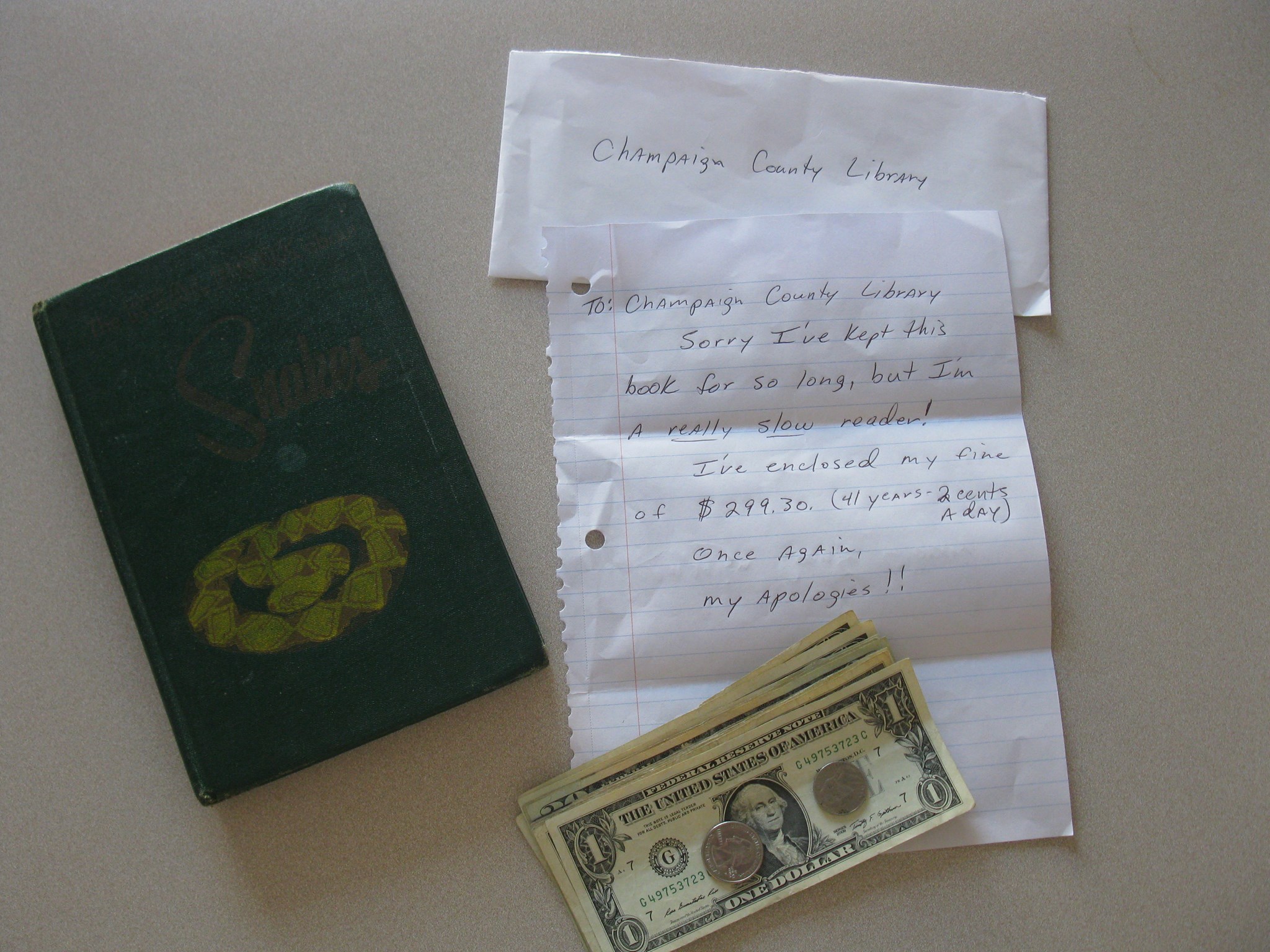
Earlier this year, a man returned “The Real Book of Snakes” 41 years late to a library in Ohio. He enclosed $299.30 — 2¢ a day for 41 years. Seems a tad light. Safe to say, the Champaign County Library does not charge two pennies a day in 2013. The Vancouver Public Library charges 25¢ a day. Let’s go with that. Two bits a day for 41 years works out to $3741.25. Seems a tad excessive.

overdue

So, what’s “fair”? Averaging doesn’t work. That assumes the amount of the daily overdue fine as a function of time is a linear relation, with a constant rate of change of about 0.5¢/year. An increase of one penny from 2¢ to 3¢ in the early seventies is a 50% increase whereas an increase of one penny today is a 4% increase.

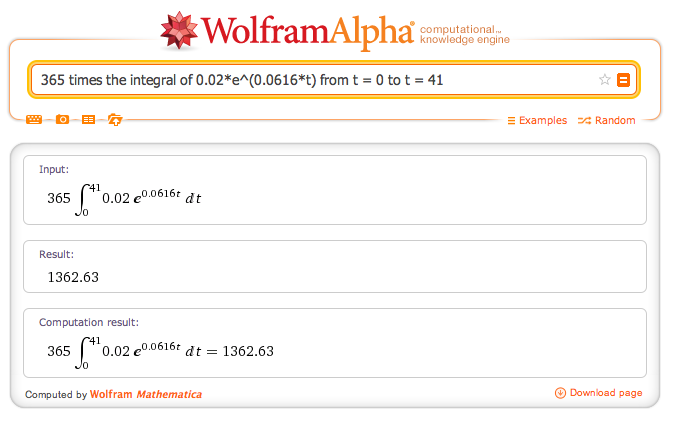
Instead, assuming the percentage increase is constant, an exponential function can be used (to approximate a step function). Solving 0.25 = 0.02*e^(r*41) for r gives r = 0.0616. Integrals, like overdue fines, have to do with change and the accumulation of change.

Does the following calculation give the total amount accumulated in fines? My calculus is rusty.

Screen shot 2013-10-29 at 9.03.40 AM

Also this year, “Fire of Francis Xavier” — along with a cheque for $100 — was returned 55 years late to the New York Public Library. How much should he have enclosed?

Remember this?

The start of a three-act task for Calculus, maybe? (Note: Click the links above to watch the news stories from Vancouver and New York.)

In the “real world,” overdue fines at the VPL max out after 42 days, or $10.50, at which time the book is regarded as lost and replacement fees and handling fees kick in. Once again, the “real world” is less interesting than asking “What if?”

Less Play-by-Play, More Colour Commentary

To many, Explain your thinking = Tell me your steps.

Which got me thinking about hockey.

In sports broadcasting, the play-by-play announcer gives a detailed account of the action. The colour commentator provides expert analysis and insight. The sideline reporter does this.

Listen for the difference (play-by-play vs. colour commentary) here:

From ‘Doc’ Emrick, play-by-play announcer, we learn:

  • Sidney Crosby tries to split the defence
  • Ryan Miller steers the puck into the corner
  • Crosby “crunches” the puck along to Jarome Iginla
  • Crosby scores
  • the game is over
  • Canada wins the gold medal

Emrick’s enthusiastic call certainly added to my enjoyment of the broadcast, but it did little to add to my understanding of the events. It’s the stuff of who, what, where, & when. I didn’t really need ‘Doc’ for this; I saw it for myself.

From colour commentator Ed Olczyk, who comes in at 0:50, we learn:

  • a two-on-two turns into a one-on-nothing
  • Sidney Crosby beats Ryan Miller under the pads
  • Jarome Iginla, as he’s falling down, makes a beautiful pass to Sidney Crosby
  • it’s man-on-man coverage in overtime
  • Crosby gets offensive position on Brian Rafalski

Olczyk answers how & why Crosby scores.

Back to the math classroom…

Explain your thinking.

Two fictional responses at two extremes:

Doc: First, I minused 5 from both sides. Then, I divided by 2 and got x equals 3.

Ed: We modelled open & closed using red & yellow counters. We looked for a pattern and noticed that the first three open lockers–1, 4, & 9–are perfect squares. We tested 24 & 25. Switching has to do with factors. Only the perfect squares have an odd number of factors: you only count the 5 for 25 once.

In many math classrooms (mine included), student explanations can sound more like the former than the latter; more detailed account of the calculations on the page than insight into mathematical thinking.

Math teachers can work backwards and determine that Doc completed a practice exercise; he solved 2x + 5 = 11 for x. They’ll also recognize that Ed solved a problem–the well-known locker problem. Students are more likely to explain their thinking if they are being asked to think.

But practice or problem, creating a culture of why–consistently asking “Why?”/”How do you know?”–can also insert colour.

At first, I thought this analogy might be helpful to students–a small part of conversations that also involve post-game analysis of shared student responses (formative feedback, exemplars, etc.).

Whiteboard apps, such as Explain Everything or Show Me, can be used to capture and share student thinking. Student-created videos shared with me (so far) are more play-by-play than colour commentary. There is a place for a description of events as they happen. In fact, I just used a step-by-step video tutorial to help me repair my dishwasher. But we’re talking about mathematics, not home appliance repair. Behind the bench of each student-created tutorial that gets a “meh” from me, there’s a teacher passionate about mathematics and/or technology. I think we have different gameplans. Maybe the sports broadcaster analogy would be helpful to teachers, too?

Got a student-created video that’s more colour commentary than play-by-play? See you in the comments.

And just for fun, the finer points of hockey:

A Turkey of a Graph

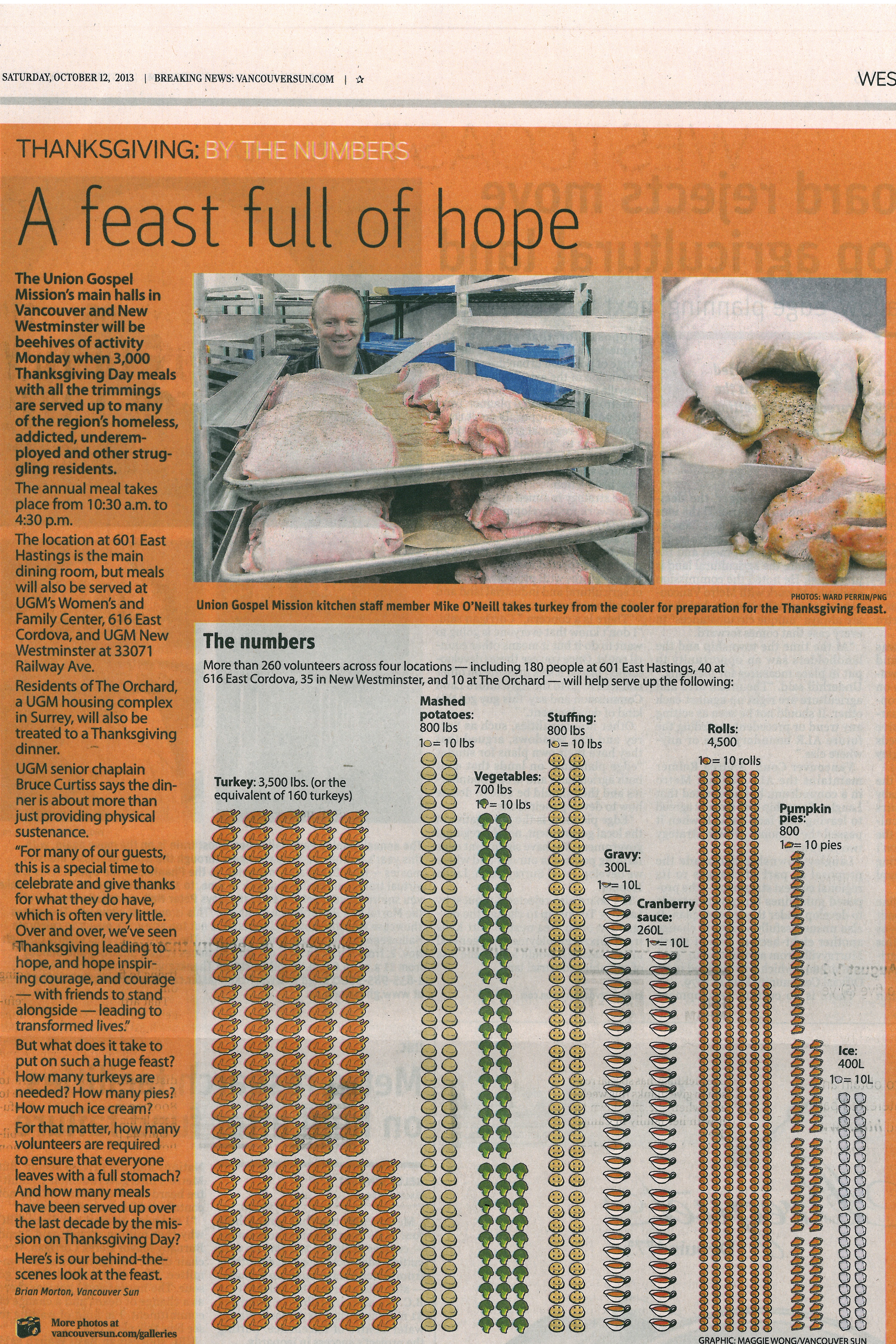
This news story could make for an engaging math task. The reporter even lists some questions students may have.

Thanksgiving

But what I really want to know is …

what is this?

Thanksgiving Graph

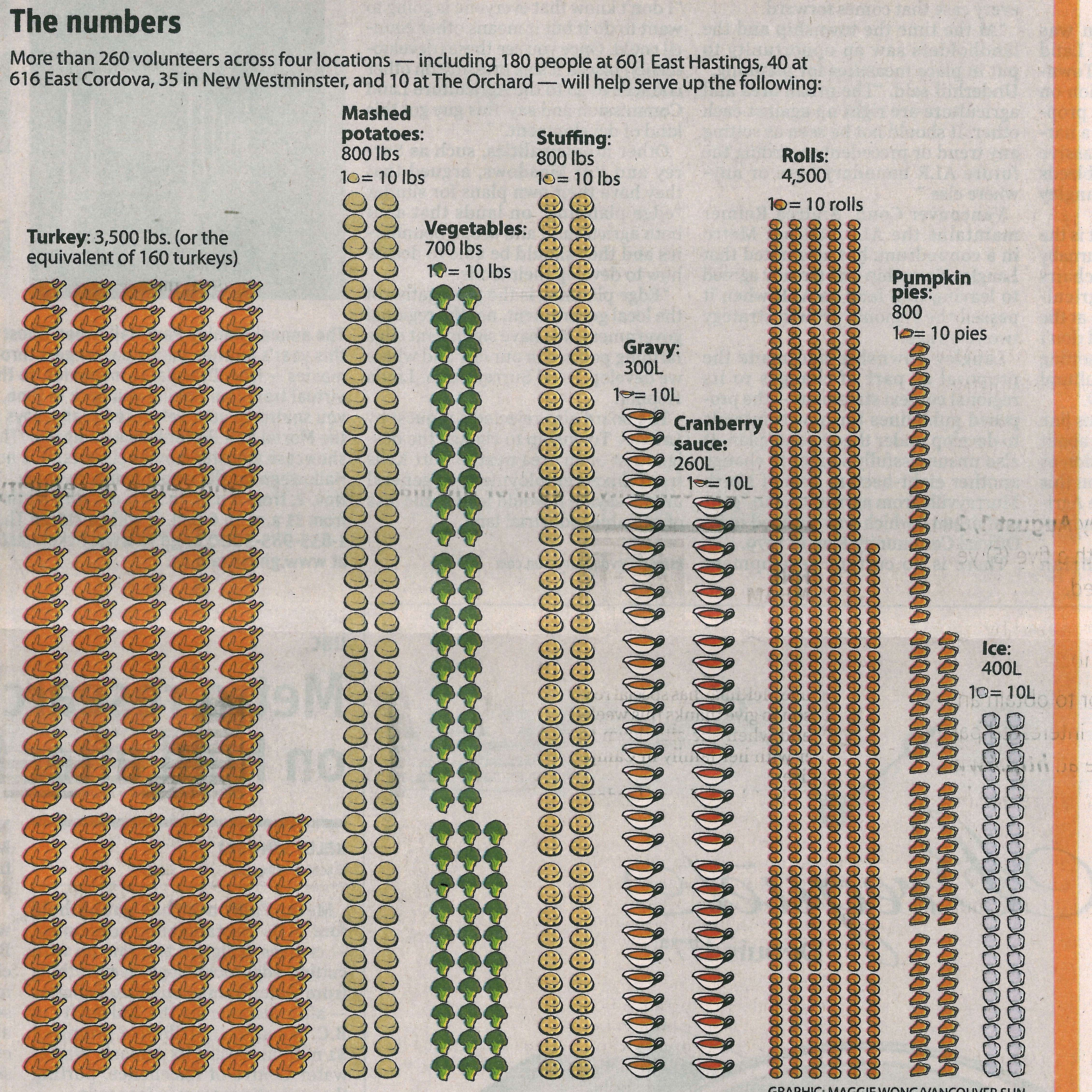
Graphs should reveal information about a situation (e.g., relationships, trends). Does this graph do that? The pictograph is cute, but does it suit the data? Choice of format aside, what’s with the different symbols/scales between categories? The reader can compare pounds of mashed potatoes to pounds of vegetables (kind of) and litres of gravy to litres of cranberry sauce, but what conclusion can he or she draw from comparing the mashed potato category to the gravy category (or to turkeys, rolls, or pies, for that matter)? And the spacing? At first glance, it looks like there are 80, not 100, pounds more mashed potatoes than vegetables. But wait–there’s an extra partial column of broccoli. At least it wasn’t Brussels sprouts.

Happy Thanksgiving.

Related:

xkcd: Tall Infographics

Ann, Brad, Carol, …

One of my favourite open questions we present to teachers:

Extend the pattern Ann, Brad, Carol, … , in as many ways as you can.

That’s it. Simple, but brings out some big ideas.

So what’s next? Daniel gets a lot of early votes: starts with D, male, six letters. At some point, the increasing pattern–start at three letters and add one each time–becomes challenging. Take Elizabeth. Starts with E? Check. Female? Check. Seven letters? Crap. Extending the pattern in this way eventually means hyphenated names.

Ted
Wait; was it any of those names with a “Lynn” after it?

After exhausting Ann, Brad, Carol, … as an increasing pattern–Eleanor!–teachers get creative with repeating patterns.

For example, looking at one attribute:

  • Aaron, Blake, Caleb (ABC)
  • Olivia, Jackson, Isabella (female-male-female)
  • Max, Liam, Jacob (3-4-5)

Looking at two or more attributes:

  • Andrew, Brooklyn, Christopher (ABC & female-male)
  • Ava, Bono, Chloe (ABC & female-male-female & 3-4-5)

What if Ann-Brad-Carol wasn’t the core of the pattern?

  • Ann, Brad, Carol, Connor, Amy, Bryn, Caden, Carter (ABCC & 3-4-5-6)

A different attribute:

  • Ann, Brad, Carol, Elijah, Genevieve (1-1-2-3-5 vowels)

Not mathy enough for you? Remember, not all teachers will have a positive attitude towards mathematics. This is a safe icebreaker. You can always follow it up with the mathier “Extend the pattern 5, 10, 15, … in as many ways as you can.”

The big idea? Patterns involve something that repeats. Sometimes items repeat, sometimes its the rule that repeats.

Ann, Brad, Carol, … can focus teachers/students on another big idea: the way you show information can make patterns easier to see. Moving from names to SET, spot the pattern in the photos below:

SET1

SET2

When I last posed the Ann, Brad, Carol, … problem, I encouraged teachers to rearrange the names to highlight patterns. One teacher connected this to 100 charts–an aha moment for her.

Big ideas above paraphrased from Marian Small’s Big Ideas.

This is part of this.

[TMWYK] Aero Bubble Bar

Recently, Nestlé launched the new AERO bubble bar throughout Canada and the UK.

For the benefit of the American readership:

cta_aero_bubblebar
Ten-frame!

From the press release:

As well as offering a unique bar design, guaranteed to stand out from the crowd, AERO’s innovation isn’t just for show. The new design sees the bar divided into ten easily snappable ‘bubbles’, making it less messy to eat and more portionable. What’s more, each of the ten ‘bubbles’ are designed to melt more easily in the mouth, maximising the taste of AERO’s signature bubbly chocolate.

I brought one home a couple weeks ago. I put the bar’s portionability to the test.

ow2ad

I snapped off two bubbles each for Keira (5), Gwyneth (8), and Marnie (N/A). Plus, two for me. (Missed math teacher opportunity, I know.) Two pieces were left over. “How much more should we each get?” I asked.

“Half,” Keira answered. She told me to make two cuts: two becomes four, or n(Keira’s family). For shits and giggles, we played with different cuts. What I learned from Keira:

the halves and the halve nots

“Or two-quarters,” Gwyneth piped up.

“Huh?” I returned, caught off-guard. “Tell me more,” I recovered. Gwyneth told me to cut each of the two bubbles into four quarters, giving us eight quarters. Eight pieces can be shared equally between four people. Each of us should get two pieces, or two-quarters.

Gwyneth’s strategy–divide each piece into fourths rather than make four pieces in all like her sister–surprised me. It’s a strategy that makes sense to her: dividing each piece into fourths means she’ll be able to form four equal groups. It’s a strategy that’s flexible: I don’t think she’ll be fazed by a curveball, like an additional bubble or family member.

Symbolically, we have:

0002W4

The result is trivial; her thinking is not.

For more math talk with kids, please follow Christopher Danielson’s new blog.

More often than not, more is less

In the summer, Costco peddles a buttload of educational workbooks. You know the ones: collections of every worksheet necessary for your child to complete <insert grade here> Math. Can’t find them? Look over by the Christmas trees.

I picked up the Grade 3 book. Just browsing. Killing time. I opened to this page:

add:subtract words

I’m not a big fan of this approach. Forget about comprehension, just scan for the add or subtract words. See more, think add. But it’s not that easy. More shows up in five of the practice exercises. Try them.

  • In the picture, how many more 4-legged animals are there than 2-legged ones?
  • Peter has 39 goats.  He wants to have 64 goats.  How many more goats should he buy?
  • Peter has 68 animals on his farm.  He buys 23 more.  How many animals does he have now?
  • 413 gulls are joined by 311 more.  Then 136 more gulls come.  How many gulls are there altogether?
  • There are 576 gulls, but 153 fly away.  Then 283 more leave.  How many gulls remain?

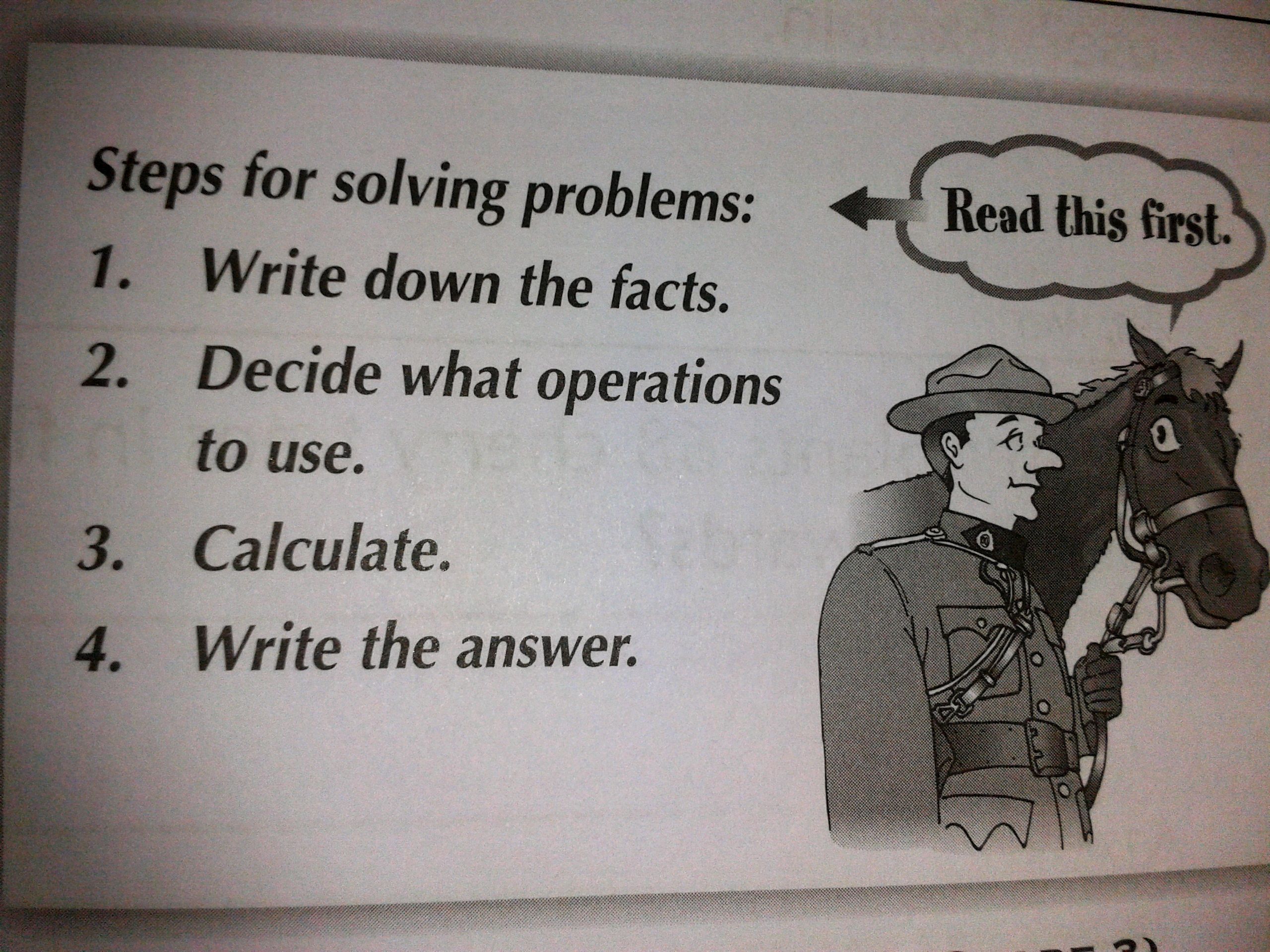
A mountie (really?!) tells kids (Canadian, no doot) to decide on the operation.

mountie

From the answer key:

  • In the picture, how many more 4-legged animals are there than 2-legged ones? 15 − 12 = 3
  • Peter has 39 goats.  He wants to have 64 goats.  How many more goats should he buy? 64 − 39 = 25
  • Peter has 68 animals on his farm.  He buys 23 more.  How many animals does he have now? 68 + 23 = 91
  • 413 gulls are joined by 311 more.  Then 136 more gulls come.  How many gulls are there altogether? 413 + 311 + 136 = 860
  • There are 576 gulls, but 153 fly away.  Then 283 more leave.  How many gulls remain? 576 − 153 − 283 = 140

Subtraction is used to answer three of five questions with this ‘add’ word. Actually, kids will think addition for the first two questions (12 + 3 = 15 and 39 + 25 = 64) but that’s another post.

Checked baggage

Last week, James Cleveland (@jacehan) shared this:

It is weird. You would think the size limit would be volume, not combined length, right?

The first question that came to my mind was “What are the dimensions of the bag with the greatest volume?”

A “cubey” bag with a length and width of 21 inches and height of 20 inches would have a volume of 8820 cubic inches, or 5.1 cubic feet. The airlines are banking on your bag looking more like the one pictured above. The dimensions are not shown, so let’s assume the golden ratio is at play here:

w + l + h = 62
w + w(1.618) + w(1.618²) = 62
w(1 − 1.618³)/(1 – 1.618) = 62
w = 11.84
w = 12 in, l = 19 in, h = 31 in

A “golden” bag would have a volume of 7068 cubic inches, or 4.1 cubic feet. If passengers were able to check a “cubey” bag, they’d be able to pack about 25% more. Of course, the airlines would still get ’em with the weight limit.

I guess it does make sense to express the size limit in inches rather than inches cubed. After all, a bag with a length and width of 1 inch and height of 7068 inches would also have a volume of 7068 cubic inches.

Math teachers have seen this type of problem before, but never like this. We’ve seen farmers with x feet of fencing faced with the challenge of enclosing the largest possible pig pen. In later grades, we insist that the farmer use the exterior of the barn as one side. Length is given and area is maximized. This can be reversed. That is, given the size of the pen, our farmer must use the least amount of fencing.

We’ve seen problems in which surface area is given and volume is maximized (like the popcorn box problem or the rolling paper into cylinders thing). Again, this can be reversed. Timon’s Piccini’s pop box design task is in this family.

The checked baggage problem, on the other hand, jumps a dimension. We’ve never seen problems in which length is given and volume is maximized. I wonder if this opens up some interesting possibilities.

It stuck.

“Find the right in the wrong.”

As a student teacher, my mentor teacher gave me this advice. It stuck. For 15 years, it’s been a helpful mantra. A reminder to:

  • focus on what students are able to do when solving multi-step equations,
  • recognize some mistakes as being overgeneralizations (e.g., a negative plus a negative is a positive), and
  • think of contexts in which math mistakes make sense (e.g., 1/3 plus 2/5 does not equal 3/8, except with at-bats in baseball, or powerplays in hockey, or marks in math class, or …)

You assign grades. Your gradebook offers suggestions.”

Advice given to me as a first year teacher. It stuck. Not helpful day-to-day but invaluable on certain days (i.e., when marks are due). Over the years, remembering this gave me permission to consider other evidence of what a student knew (e.g., classroom observations and conversations with the kid) and assign a higher letter grade when appropriate. Obvious to me now, but as a beginning teacher? Not so much.

Also, it helped me take the top-down policy of “No 46s to 49s” in stride. Bent out of shape, some colleagues took this to mean “45 is the new 50.” Others reacted like a Tim Horton’s franchise owner facing the Canadian government’s phasing out of the penny: rounding down 46s and 47s, bumping up 48s and 49s. Most teachers felt compelled to call students in to finish just enough missing work to reach the magical 49.5. I avoided the silliness. Marks were my decision. Always were. Now I just had fewer options.

tim hortons penny
#anyqs?

“I ask my students to explain their thinking, and they automatically reach for the eraser.”

Not advice but an observation made by a colleague earlier this year. It stuck. I’ve been working on consistently asking “Why?” both with students in classrooms and with teachers in workshops. It’s easy when students (or teachers) give incorrect answers. Hence the association, built up over time, between “Can you explain?” and the eraser.

It’s also easy when students (or teachers) present an unexpected solution method. But even “I’m curious. Can you explain?” is met with skepticism. “It must be a trick, I must be wrong,” the thinking goes. My reaction to seeing the hand reach for the eraser is often something like “No, it’s right! I just don’t know how you got it. Can you help me make sense of it?” That first part feels cheap. Reassuring the student/teacher may lessen his/her anxiety, but it frees him/her from having to construct a viable mathematical argument. It’s disempowering.

Tougher, for me, is asking “Can you explain?” when I instantly recognize the solution method (e.g., Group A, lowest common multiple, check. Group B, proportion, check. Group C, unit rate, check). But not asking “Why?” here creates the reaction described above.

“How often do you see a student reach for the eraser?” could be another.

Each sticky quote above (< 140, btw) is probably long forgotten by the speaker. Certainly, they would be surprised to learn that I remember. I’m curious, what are your sticky quotes?