
“They’ll need it for high school.” I hear that. A lot. From elementary and secondary alike. I’ve been doing the K-12 Numeracy Helping Teacher thing (think “Math Coach”) for four years now. Previously, I taught Math 8 to 12. Twelve years. In Part 1, I’m going to look at math topics, teaching practices, and other things related to readiness where this phrase is used.
The Chestnuts
Long division and times tables.
Teaching long division may be the greatest time suck in all of elementary mathematics education. When I was new to this gig, I asked an intermediate teacher “Why the em⋅PHA⋅sis on long division?” “TNIFHS,” she answered. Having taught HS, her answer surprised me. A HS student will spend 5 years × 90 classes/year = 450 classes, give or take, in math. She will not need long division in 449 of them. HS math teachers, back me up here — one lesson: polynomial division. That’s it. Her turn to be surprised. But don’t blame her: this idea gets a lot of play in the media.
Over lunch at a recent pro-d workshop — the tortelloni was lovely — a mathematics professor from a local university complained that her Calculus students struggled with long division. How could she know? What’s long division got to do with Calculus? Finger Pointing 101.
This is not a call for scrapping the standard long division algorithm in K-7. We need more history of mathematics in math class, not less. Wanna argue dividing multi-digit dividends by multi-digit divisors without using technology is an important life skill? Fine. But don’t point to HS math.
“How can I teach them when they haven’t even memorized their times tables?” is my Groundhog Day conversation. Granted, recall of the multiplication facts is important. And overblown; it’s no silver bullet.
Worse still is “they need to quickly recall the basic facts for high school.” How fast? Faster. But “faster equals smarter” is not a productive belief for learning mathematics at any level. And we know Mad Minutes cause math anxiety. This bleeds into the next category…
Poor Pedagogy Preparation
“They’ll be lectured to at high school.” Often, this is an assumption, one many HS teachers I know take issue with. And, even if it is true, “I want to get them used to it” is not much of a defence. The same holds true of assessment and homework. Future poor practice should never be the reason for current poor practice. High school math teachers are guilty of making assumptions and justifications looking ahead, too.
They’ll Need High School Math for High School Math
Michael Pershan posted a few calculus readiness tests on his blog. One question jumped out at me:
Let 

If this isn’t calculus, it’s damn close. I can’t think of a conceptual context outside of calculus in which there’s a need for the difference quotient. (Compare this with what they’ll really need for calculus from Christopher Danielson’s NCTM session from a year ago.)
I wonder what this looks like at HS. Maybe SWBAT simplify 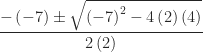
This is silly, but it does illustrate one problem I have with TNIFHS: we meet students where they’re at, not where we want them to be.
The Affective Domain
So, what will they need? “Give me a student with a positive attitude towards mathematics, who’s persistent, who’s curious, etc. and she will be successful in high school,” I’ve answered in the past. I stand by this.
But there’s a problem with this answer. Implied in “they’ll need it for high school” is “they’ll need it before high school” (see times tables). I’ve met HS math teachers waiting for these curious, persistent students to one day show up at their classroom doors.
Another problem: there are big ideas, or enduring understandings, or key concepts, or whatever you want to call them, in mathematics that students will need for high school and this answer gives them short shrift. These will be discussed in Part 2.














 Chris Hunter
