Get yourself 920 calories, playa

sakir-10

How many watermelons do you see?

You might be a math teacher if you answered five. Whereas a normal person sees produce, a math teacher sees fractions (4 × ½ + 4 × ¾) or perfect squares (3² − 2²).
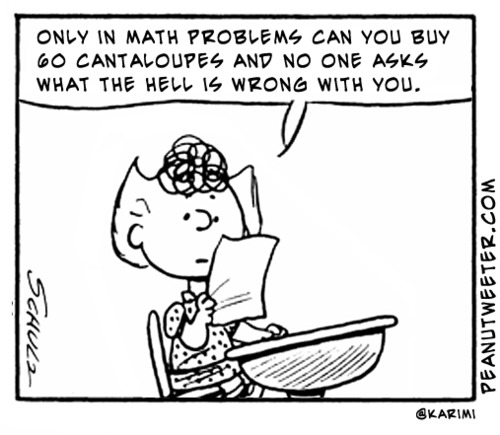
onlyinmathproblems

As a student, I never asked Sally’s question. To me, math was like an action movie (minus the action). It required suspension of disbelief. I accepted that.

As a teacher, I want more for my students. I want my students to use mathematics to better understand the world around them (i.e., the real one).

So when world-class pool player and Korean War expert Dr. Tae craved a burger, I wanted to find a connection between mathematics and the real world.

The best that I could come up with:

Two burgers and one order of regular fries have 2020 calories. Four burgers and three orders of regular fries have 4660 calories. How many calories are there in each menu item?

There’s plenty not to like about this problem. As a real-world application of mathematics, like a Subway foot-long sandwich, it doesn’t measure up. For starters, it asks students to pretend that the total number of calories is known while the number of calories in each menu item remains a mystery. “We all use math everyday” meets “Yeah, right.” It would be easy to dismiss this problem. Pseudocontext. Full stop.

However, I also want to use the real world to have my students better understand mathematics. Whereas I’m critical of this problem presented as an application, I’m much more accepting of it as an investigation.

To introduce solving systems of linear equations, I have asked similar questions. My students would reason that if two burgers and one order of fries have 2020 calories, then four burgers and two orders of fries must have 2 times 2020, or 4040, calories. Comparing this with the number of calories in four burgers and three orders of fries means one extra order of fries adds 4660 – 4040, or 620, calories. Two burgers must then have 2020 – 620, or 1400, calories. Each burger has 1400 ÷ 2, or 700, calories. Students have solved a system of linear equations using the elimination method. All before having x‘s and y‘s thrown at them. My role was to help my students link their ideas within this context to this:

Solve using elimination.
2x + y = 2020
4x + 3y = 4660

Is that the real issue?

Don’t mean to burst your bubble

via Colossal, an art, design, and photography blog:

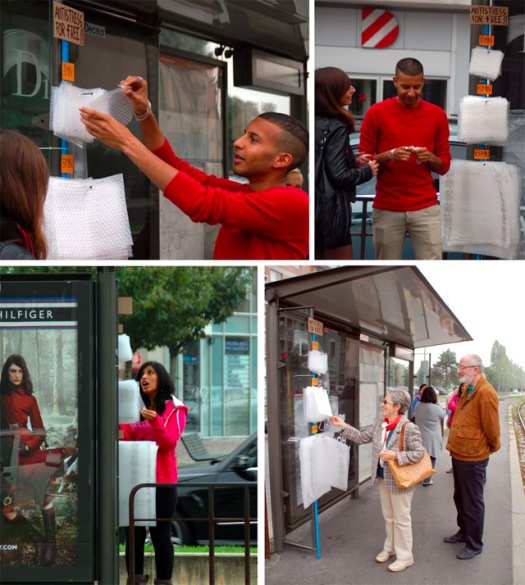
stress-4While waiting for a train, commuters can help themselves to square sheets of bubble wrap labelled with how long it would take to pop them.

stress-5

I love this idea. The world is a better place because of it. I hestitate to bring this up, but …

the math is wrong.

Bubble Wrap Length

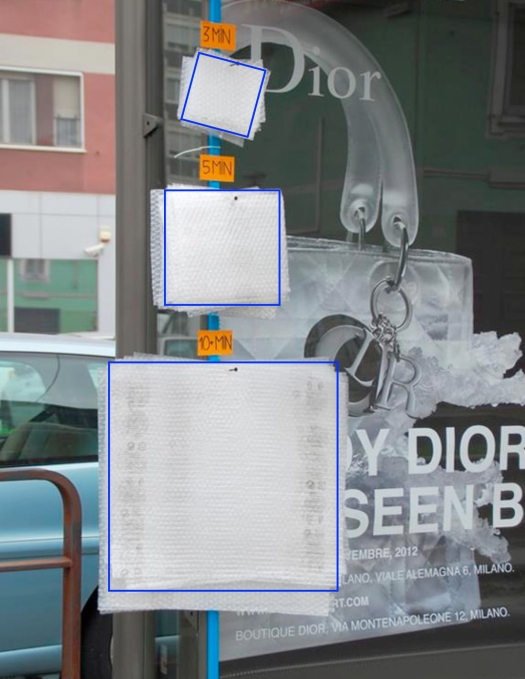
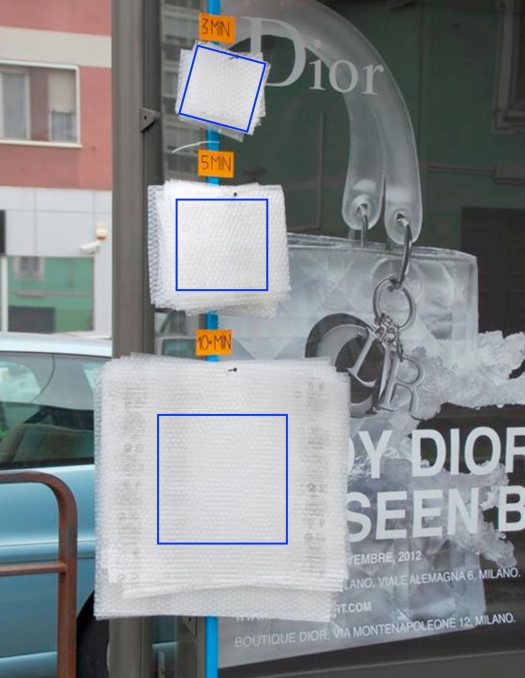
It looks like the approximate times are based on length. Above, the ratio of side lengths is 3 to 5 to 10, or 1 to 1.67 to 3.33. Let’s assume that the small sheet does, in fact, take 3 minutes to pop, one bubble at a time. The large sheet does not have 3.33 times more bubbles; it has 3.33 times as many rows and 3.33 times as many columns. Therefore, it has 3.33^2, or 11.11, times as many bubbles. A better approximation for the large sheet would be 30 minutes. If we base the approximate times on area, the ratio of sides lengths would be 3 to √(5/3) to √(10/3), or 1 to 1.29 to 1.83, as shown below.

Bubble Wrap Area

I’m thinking about how I could use this image or idea in class. Some possibilities:

1. As-Is

Display the photos. Ask students, “Are the times accurate?” Have students apply their understanding of the relationship between scale factor and area. M’eh.

2. Hands-On

Display the photos. In pairs, have students record how long it takes to pop a small square sheet of bubble wrap. Pose the problem, “A square sheet takes twice as long. What are its dimensions?” Have students test their predictions. In this activity, students develop their understanding between scale factor and area. They poke holes in the common misconception that when dimensions are doubled, area is doubled, too.

3. Three-Act

Play a video of a small square sheet of bubble wrap being popped. Include a timer. Maybe a soundtrack, too. Play the beginning of a video showing a large square sheet of bubble wrap being popped. Have students guess how long it will take. Ask, “What information would be useful?” Show the dimensions of the squares. Play the answer video.

I see this task being similar to Dan’s Penny Circle. Dan filmed himself filling a circle with 663 pennies so that the rest of us wouldn’t have to. I have a roll of bubble wrap measuring 24″ by 30′. Before I take one for the team and spend a ridiculous amount of time enjoying bubble wrap, any suggestions?

Math Picture Book Post #3: Miss Lina’s Ballerinas

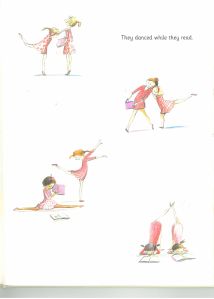
Miss Lina’s Ballerinas by Grace Maccarone is about “teamwork, making new friends, and the pleasures of ballet.”

It’s also about math.

In my previous post, I wrote about multiplication in terms of groups of and arrays. Both models can be explored in Miss Lina’s Ballerinas. Eight ballerinas–Christina, Edwina, Sabrina, Justina, Katrina, Bettina, Marina, and Nina–dance in four groups of two

Miss Lina's Ballerinas Groups

and four lines of two¹.

Miss Lina's Ballerinas Array

What happens when a new girl, Regina, arrives? Spoiler alert: three rows of three. What if there were ten dancers? Eleven? Twelve?

If you are playing alongMiss Lina’s Ballerinas falls into my third category; the math concept is between the pages but the author did not intend to write a math concept book.

¹ This bugs me. Should it?

Kitchen Table Konversations

There are things my daughters say that make me feel proud to be their dad. From my 7-year-old:

“I have a lot of stuff. For my birthday party, can I ask each of my friends for a toonie instead of a present? I’m going to give the money to the SPCA.”

“Dad, that new song by The Sheepdogs sounds a lot like The Black Keys, don’t you think?”¹

There are also things my daughters say that make me feel proud to be their mathteacherdad.

One day this week, we were talking math at the dinner table.

Being in Grade 2, Gwyneth is not yet learning about multiplication at school. However, her best friend knows about “timesing,” so she is curious and motivated. We’ve been discussing multiplication in terms of groups of. Don’t worry, we’ll have conversations about arrays later. Dropping in, mid-conversation:

Me: What do you notice?
Gwyneth: Two groups of three is the same as three groups of two.

At this point, I could have said, “That’s right. Changing the order doesn’t change the answer.” I didn’t. Being a math teacher and her dad, I also could have said, “That’s because multiplication is commutative, Sweetie.” I didn’t.

Me: What about three times five and five times three?
Gwyneth: Three groups of five is … fifteen.
Me: How do you know?
Gwyneth: Well, two groups of five is ten and one more group makes fifteen.
Me: Okay, so what about five times three?

What she said next, after a brief pause, blew me away.

Gwyneth: Nine and six make fifteen.
Me: How did you get that?
Gwyneth: I took one away from six to make ten and …
Me: No, I get that. I mean where did the nine and the six come from?
Gwyneth: Well, three groups of three is nine and two groups of three is six.

I was asking my daughter questions to have her explore the commutative property and she drops the distributive property into our conversation! Any English teachers still reading this blog after my last post may question my use of an exclamation mark. Math teachers will not. Gwyneth understands, conceptually, that 5 × 3 = (3 × 3) + (2 × 3).

I asked her to draw this for me. She drew five groups of three dots.

Gwyneth: Three, six, nine, twelve, fifteen.
Me: Wait! What about the nine and the six?
Gwyneth: I said those. Three, SIX, NINE.
Me: Yeah, I heard you. But, before, you ADDED the six and the nine.
Gwyneth: Dad, I’ve got LOTS of strategies.

I was so proud to hear her say this that I didn’t even mind the eye-rolling.

In his book The Joy of x, Steven Strogatz writes about the counterintutiveness of the commutative law.

Whereas it is intuitive to Gwyneth that adding five to three should be the same as adding three to five, it is not intuitive to her that having three groups of five should be the same as having five groups of three.

Why is 5 + 5 + 5 …

obviously the same as 3 + 3 + 3 + 3 + 3?

Strogatz makes the point that if we visualize 3 × 5 as a rectangular array with 3 rows and 5 columns …

and turn this picture on its side giving us 5 rows and 3 columns, or 5 × 3, …

then 3 × 5 must equal 5 × 3. The commutative law becomes more intuitive.

Strogatz, a frequent guest on Radiolab, goes on to give examples of real-world situations in which people forget, or refuse to accept, the commutative law.

Once again, I have taken a page out of Christopher Danielson’s playbook with this post.

¹ I just learned that The Sheepdogs’ album was produced by The Black Keys’ Patrick Carney. Impressive kid, eh?

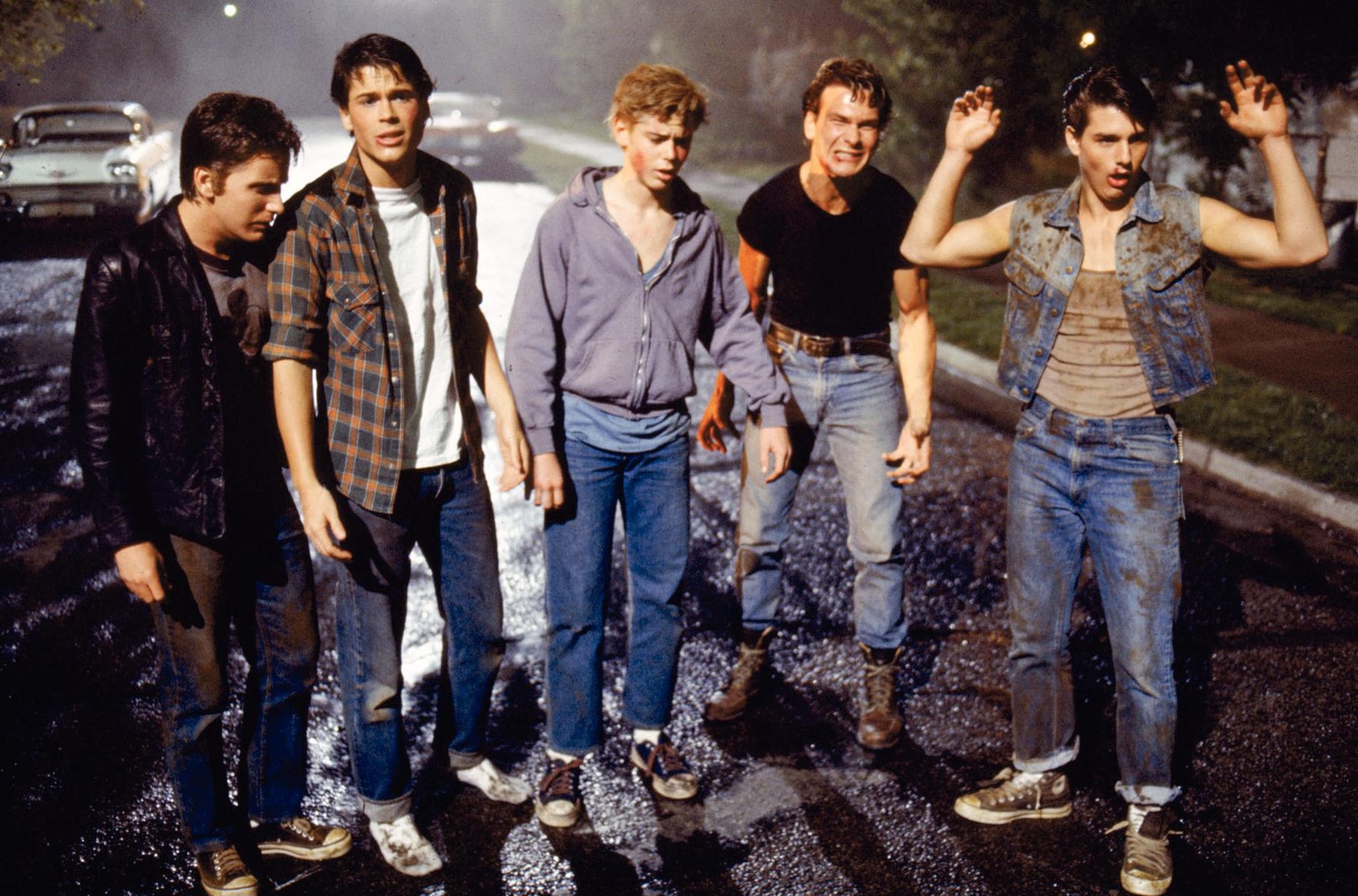
The role of Ponyboy Curtis will by played by the Mathematics Department Head.

“English teachers differentiate all the time. Why don’t math teachers?”

I’ve heard this more than once. It irks me for a couple of reasons.

First, I’m not convinced that most English teachers do differentiate. After all, students still read The Outsiders in English 8. I read The Outsiders in English 8. The year was 1987. Do the math. Twenty. Five. Years. Are we to believe that this same group of educators have been too busy in the last quarter of a century meeting the diverse needs of all of their learners to find time to pick a different novel? During this time, Tom Cruise, who starred in the movie adaptation, found time to get married and divorced– three times! Google outsiders essay. Three million five hundred ninety thousand results. I’m  just sayin’.

Second, if differentiated instruction is more common in English class than it is in math class, it may be because it is easier. Some teachers of English 8 may simply assign an alternate book to read based on reading level. What can teachers of Math 8 simply do?

I’ve seen samples of those Outsiders essays. I’m no English teacher, but some of them wouldn’t look out of place in a Grade 3 classroom. Others could easily have been written by a first-year university student. In fact, Google search results suggest that maybe they were.

The Greasers’ reaction to “No WiFi”

In English Language Arts, from Grade 1 to 12, students brainstorm, draft, revise, edit, and publish. In short, they write. What is the equivalent in Mathematics?¹ Complete this sentence: In Mathematics, from Kindergarten to Calculus, students…

It’s not so easy, is it? Two-thirds of the Three Rs can be verbs. English gets to read and to write. Math gets a noun. Differentiating narrow nouns–numbers to 10 000 in Grade 4, integers in Grade 8, logarithms in Grade 12–is difficult. What verb could math teachers have?

The answer, I think, is to problem-solve. The BC mathematics curriculum document supports this: “Learning through problem-solving should be the focus of mathematics at all grade levels.” However, school mathematics is often taught in such a way that students do not encounter problem-solving on a regular basis. Sadly, to practice might be more accurate of students’ math classroom experiences. This is not mathematics.

Yeah, but it’s a nice bus.

Regardless of how or if English teachers differentiate, one size fits all math instruction is not acceptable. I am in no way letting my fellow math teachers off the hook. I am, however, suggesting that questions like “Why don’t math teachers differentiate like English teachers?” are not accurate or helpful. We’re not so different after all.

Pushback, as always, is welcome but must be expressed in the form of a five-paragraph essay.

Stay gold.

¹ I’m having a “Scrambled Eggs” moment. If you believe I have plagiarized this part, won’t you please, please help me?

Quadratic Patterns

Having students write an equation that describes a pattern involving toothpicks, pattern blocks, or colour tiles is nothing new. However, students (teachers?) often focus on patterns in the table of values rather than properties of the pattern itself. Visualizing the pattern can help students write the equation. For some, this approach may be new.

For example, consider the following pattern:

In each figure, students may see a rectangle with two squares attached, one above and one below. That rectangle has a width of n and a length of n + 2. The expression is n(n + 2) + 2.

Some students may see the pattern in a different way. But what about the students who don’t see anything? For them, some scaffolding is necessary. Note the scaffolding in the pattern below.

Students may see one red square, two green rectangles, and two blue tiles in each figure. That is, they see n^2 + 2n + 2. The use of colour is intended to be helpful. Of course, some students may ignore this hint. I’m cool with that. They may see a large square with one tile attached, or (n + 1)^2 + 1.

Again, look for the scaffolding in the pattern below.

Students may see a rectangle with a number of tiles being removed, as suggested by the dotted lines. That rectangle has a width of n + 1 and a length of n + 2. The number of tiles being removed is equal to the figure number. Alternatively, students may visualize  2(n + 1) + n^2.

Did you notice that each of the expressions above are equivalent? They must be. Each of the three patterns begin with 5, 10, and 17 tiles. Each pattern/expression tells the same story, but in a different way.

My goal was to design three parallel tasks. Have students choose one of the three representations… just don’t tell them they’re the same.

My three-part lesson plan:

Marc and I created two more sets of patterns. All three:

For more, please see Fawn Nguyen’s Pattern Posters.

Conversations about teaching mathematics don’t just magically happen.

Recognize these two staff members?

Person A (thinks he) has a lot to say. He likes to talk. He needs to talk. You can’t ignore Person A. He won’t let you.

Person B also has a lot to say. Maybe. He doesn’t like to talk. Besides, Person B also has a lot of marking. He brings it to staff meetings and pro-d workshops.

I’ve been both Person A and Person B. The following activity, “The Interview Matrix”, allows me to be neither. I first participated in “The Interview Matrix” in a session facilitated by Jordan Tinney.

The Process

Participant are divided into groups of four. Group members number themselves from 1 to 4.

Over six five-minute rounds (see below), each member interviews and is interviewed by the other three group members. For example, in Round 1, Person 1 interviews Person 2 about Question 1; in Round 2, Person 1 is interviewed by Person 4 about Question 4. In the seventh round, each person writes a summary of the responses to his/her question.

Participants are reorganized into four groups according to question number. Those who asked the same question gather together to share their findings.

Finally, everyone hears the summaries of the four questions from each of the four groups.

The Questions

I chose four themes rather than four questions. Question 1, for example, is actually made up of three questions. It is not necessary for participants to answer all three. Hopefully, at least one of them is of interest to the person being interviewed.

Summary

The word community is used in 3 of the 4 questions. It was interesting that groups interpreted this differently– community of teachers on staff, community of learners in the classroom, community of parents. This was deliberate on my part.

I’ve used this activity with three different groups and each time the participants have enjoyed it. Some math team mentors have taken this activity back to their schools to generate discussions.

One word of caution… at last, everyone gets to hear what that guy with the stack of marking has to say.

I think we can all agree…

In a recent conversation with a group of math teachers, one colleague began a statement about the role of math teachers with this: “I think we can all agree…”

One problem… we did not all agree. “Actually…” I began my reply.

His statement was something like this: “…our primary role/responsibility is to make math easier for students by efficiently providing them with clear and concise explanations.”

There was a time in my career when I might have agreed with him. In fact, I probably spent the first ten years of my career striving to get better at exactly that. And, over time, my explanations did get better. I took pride in my ability to deliver content in bite-sized easy to digest pieces. This ability defined me as a teacher.

Simultaneously, I was growing more uncomfortable with this. I felt like I was teaching punctuation when, really, I wanted to be teaching literature. If I wanted my students to think mathematically, persevere in solving problems, appreciate mathematics, etc. my belief about my role had to change. In short, I had to “be less helpful.” I had to let go of what I had worked so hard to accomplish.

Back to that conversation at the school… here we were discussing the effectiveness of a particular problem-based lesson while holding opposing beliefs about what it means to teach.

“FOSSILS!” –Lewis Black

Lately, I’ve been thinking  about ways to bring forward these beliefs. I created an activity and tried it out over the last two days with two groups of math team mentors and administrators. The gist of it:

  1. Place each belief statement where you think it belongs on the truthiness continuum.
  2. If necessary, rewrite each statement so that it can be placed on the far right.

Teachers enjoyed the activity and I enjoyed eavesdropping on some thoughtful conversations. Each belief statement was inspired by actual comments that I have heard in the last two years. For what it’s worth, two of the statements (I won’t tell you which two) were taken directly from the WNCP Mathematics K-7 Integrated Resource Package and educators placed these statements, unedited, on the far right.

Below are some examples of how teachers rewrote statements so that they felt right– from the gut.

There are three types of people: mathy people and non-mathy people.
became
All students are capable of learning mathematics. Mathematical thinkers are created, not born.

(Okay, I served up a softball.)

The most effective way to have students learn basic facts is by building brain muscle memory through timed drills and lots of practice.
became
The LEAST effective way to have students learn basic facts is by building brain muscle memory through timed drills and lots of practice.

Ha! BTW, other groups focused on the importance of having flexible strategies.

And check this out:

The primary role/responsibility of the teacher is to make the learning of mathematics easier for students by efficiently providing clear and concise explanations.
became
The primary role/responsibility of the teacher is to provide opportunities for students themselves to make sense of mathematics, to scaffold when necessary, and to help students make connections to the big ideas. 

Of course, it’s not enough to believe. There’s also the challenge of putting these beliefs into practice. But that, I think we can all agree, is a different conversation.

Update: Truthiness Cards for Secondary Teachers

Northwest Mathematics Conference 2012

I was asked to post my presentation slides and I promised to have them up this weekend. If you were not in attendance, they probably don’t make a lot of sense. If you were in attendance, I probably didn’t make a lot of sense.

Some of the activities that I shared were my own; other activities were my renditions of the works of masters.

Some quick links:

The Masters
Fawn Nguyen’s Barbie Bungee & Follow Up on Friday Bubbles
Andrew Stadel’s Estimation 180
Kate Nowak’s Absolute Value Both Rigorous and in Context

Also, I blogged about K8’s activity in this post: Teachers Make Excellent Pirates – Two Treasures from Blogs I Follow.

Me
The more sides you have, the smarter you are.
Math Picture Book Post #2: Calvin Can’t Fly
Hey, I just met you and I wanna rock your gypsy soul
Revisiting GeoGebra

I haven’t blogged about the linear/quadratic patterns activity (yet), but here are some similar posts: Linear Functions – Concretely, Pictorially, Symbolically (my first post) & Revisiting Pictorial Representations of Linear Functions.

Special thanks to Eddi Vulic for being my straight man (“What’s that in the pudding?”) and for pointing out my mispronunciation of Nguyen. Oh well, at least this probably didn’t leave the room…

Oh crap.

I’ll leave you with this:

Math Picture Book Post #2: Calvin Can’t Fly

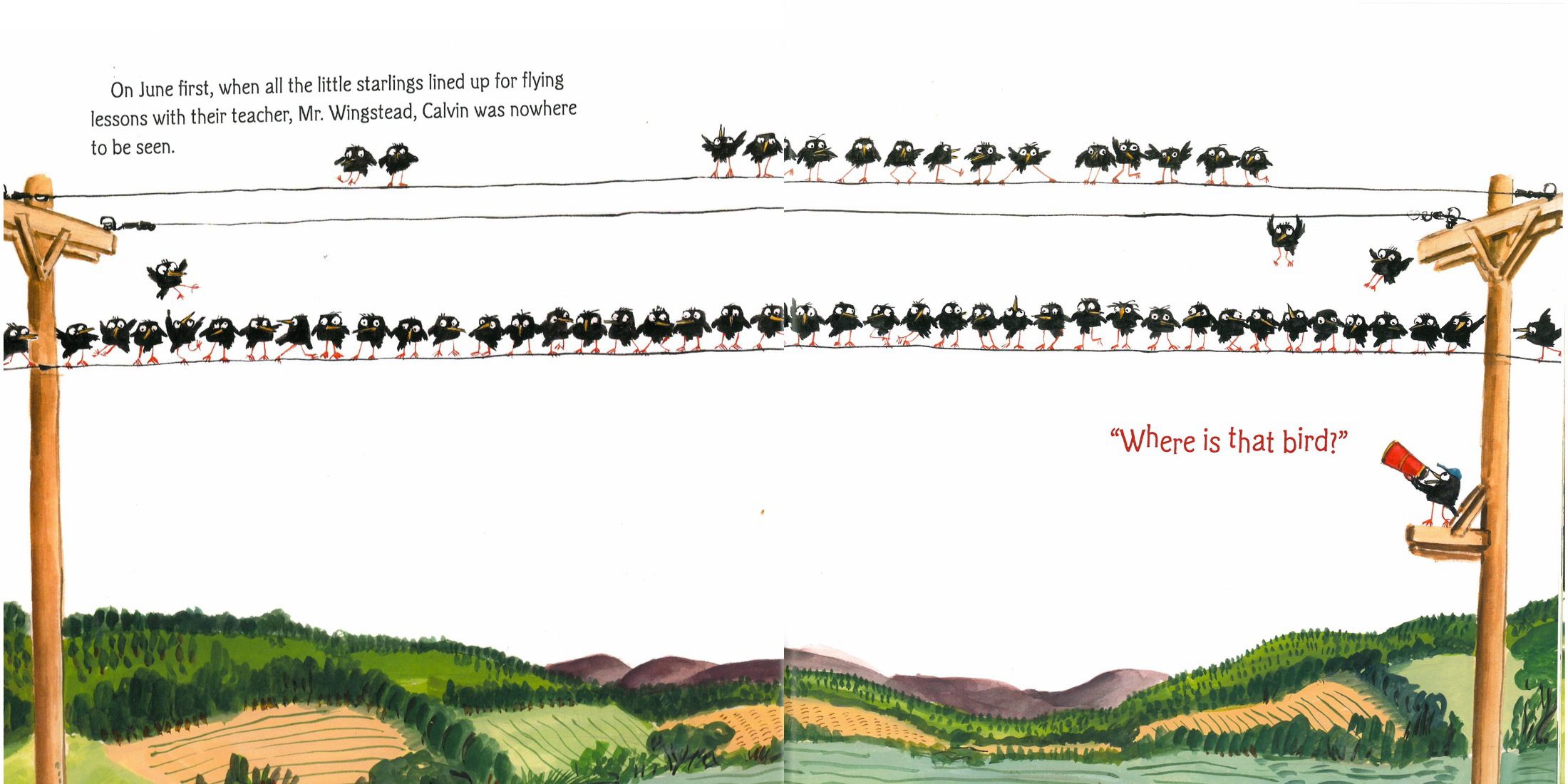
In my first math picture book post, I suggested these may fall into three categories. In this post, I’ll take a look at a book from the third category. Calvin Can’t Fly by Jennifer Berne is the story of a young starling who reads while his brothers, sisters, and cousins learn to fly. Calvin uses his aquired knowledge to save his migrating family from a hurricane. Calvin Can’t Fly is about a love of books (and libraries!). It’s about being different. It’s not about math. That is, the author did not intend to write a book about mathematics. Nonetheless, we can find math if we look for it…

How many starlings are there in the picture below? Take a guess. It’s free!

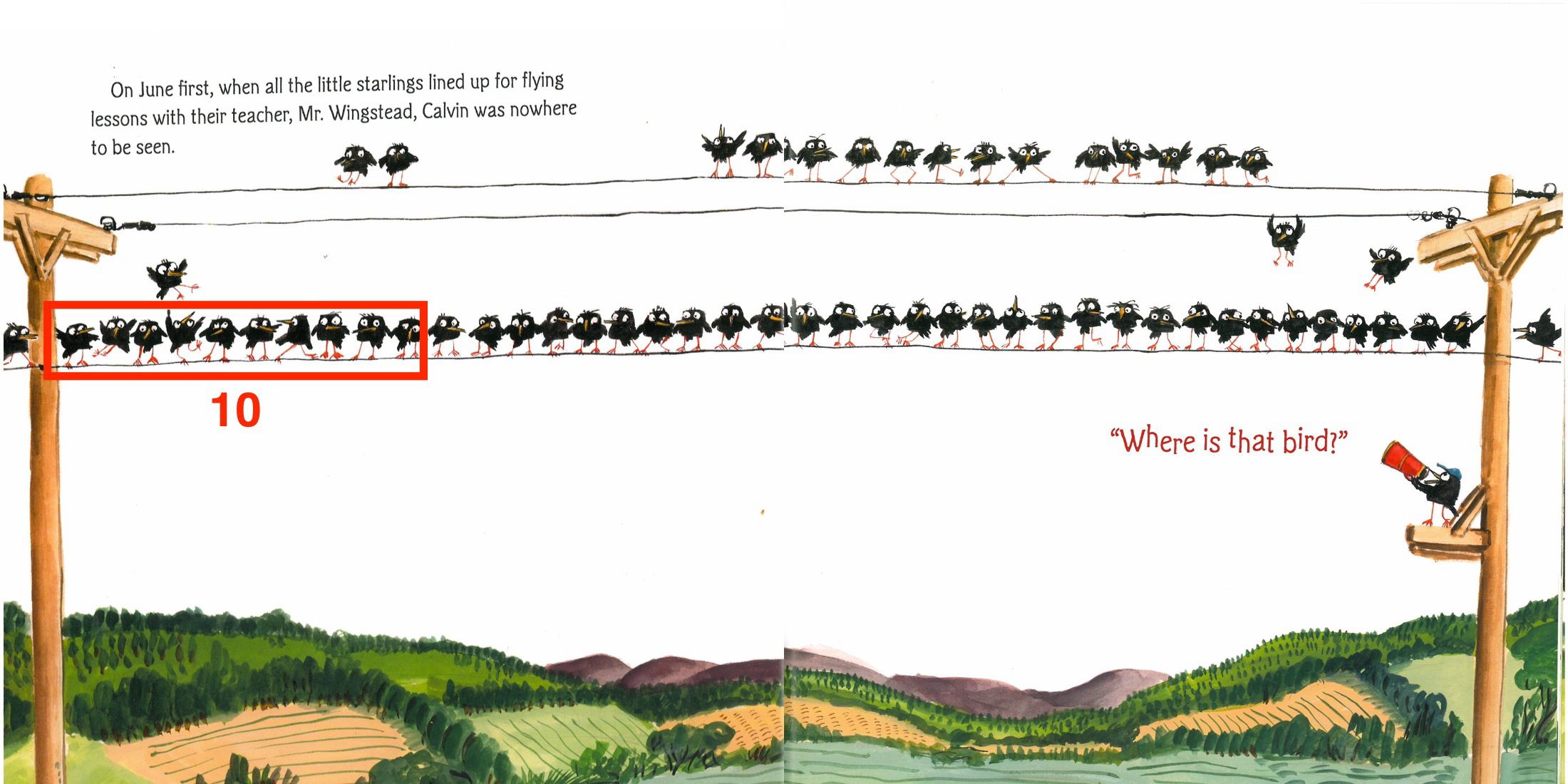
It helps students to use a referent–a group whose quantity they know–to estimate the quantity in a larger group. A group of ten can be used (see below). Students can visualize the number of starlings in terms of groups of ten. Making groups of ten helps students count– it’s a place value thing. There are several other pages where students could be asked to estimate the number of starlings.

Do you want to change your estimate?

One of the problems with my three categories is that it requires guessing the author’s intent. I am arguing that Jennifer Berne did not write “the story of a bookworm birdie” with referents in mind. Of course, I may be wrong. If I ever interview Jennifer Berne, she may insist that there is hidden meaning in her art– kinda like some sort of children’s literature anti-Dylan.

Watch the first 40 seconds of the video below for more estimation fun. Also, you have to watch uber-intense hair hat guy as he asks Dylan about the hidden meaning in the t-shirt he wears on the cover of Highway 61 Revisited.

Note: Great Estimations & Greater Estimations by Bruce Goldstone provide more opportunities for students to practice using referents to estimate. And check out Andrew Stadel’s new blog, Estimation 180Day 7 nicely uses a referent established on Day 6.

Ain’t that somethin’?