The first question that came to my mind was “How many different phrases are there?” To determine the number of possibilities for a task, we multiply the number of choices for each stage of the task. Phrases are generated by stringing together a verb, adjective, and noun. There are 53 choices of verbs, 65 choices of adjectives, and 66 choices of nouns. So, there are 53 × 65 × 66 = 227 330 “finely crafted phrases of educational nonsense.”
The teacher who posted the education jargon generator writes “I would be remiss if I did not thank my district’s professional development staff for introducing me to many of these gems.” Hah!
Wait! I resemble this remark. I’ve been prepping three all-day workshops that my team and I are facilitating giving this week. While I do use many of these words individually, I hope that I get called on it if I ever string three of them together, be it in person or on this blog.
From Louis C.K.’s Live at the Beacon Theater (expletives, and humour, deleted):
I have a lot of beliefs and I live by none of them. That’s just the way I am. They’re just my beliefs, I just like believing them. I like that part. They’re my little “believees,” they make me feel good about who I am, but if they get in the way of a thing I want, I do that.
I’ve been thinking about teaching believees.
“Mistakes are opportunities to learn.”
“Students need to be comfortable taking intellectual risks.”
Warm fuzzies. Cheezy posters.
CHRIS HUNTER
And then…
“Fifteen percent of your grade will be based on homework.”
Doesn’t exactly encourage students to make and correct errors or take risks, does it?
“Struggle is a necessary part of learning.”
“Problem solving builds perseverance.”
More warm fuzzies. More cheezy posters.
And then…
Simplified, spoon-fed, step-by-step directions. Practice pretending to be problem-solving.
Why the vast disconnect? Do we really just like the believing part? It can’t be about things we want. Who wants to mark homework? Who wants to teach follow-the-recipe mathematics?
March 5, 2013: I wrote this post about six months ago but didn’t publish it; it seemed a tad negative. But it is a reminder to teach by my beliefs. So I guess there’s that.
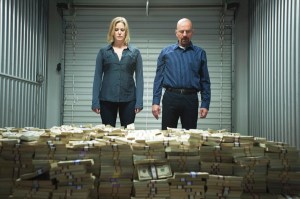
Today, the threat of an NHL lockout draws nearer. The league and its players have a pile of money and little regard for their customers. Kinda like these two:
Lockout or not, it is that time of year. Some hockey talk:
Well it’s too late tonight To drag the past out into the light
In 2003, the Vancouver Canucks faced the Dallas Stars in the first round of the Stanley Cup playoffs. Canucks fans may remember the opening game of this series as the one in which Henrik Sedin scored the game-winning goal late in the fourth overtime period. They may also remember it as the most boring playoff series ever. Considering the series went 7 games and 3 games went to overtime, this was no easy feat. In the middle of the series, the final scores were 0-2, 2-1, 2-1, and 1-0. During this stretch, the colour commentator said something like “Turco has a save percentage of 0.960, but he’s gotta be frustrated because the guy at the other end [Luongo] is playing twice as good”. Luongo’s save percentage was 0.980¹.
This floored me. How can that be? We’re talking about a difference of only 2 percentage points. He must have made a mistake. Twice as good?
The answer lies in part-part-whole relationships. What if we focussed on the other part in this part-part-whole relationship, the goals against?
What if, rather than save percentages, goalies’ goals against percentages were discussed? Let’s abbreviate this as a goalie’s GAP. Heh. Seems fitting:
Turco’s GAP would be 0.040; Luongo’s 0.020. Yep. Harry Neale was right. A GAP of 0.020 is twice as good as a GAP of 0.040 since 0.020 × 2 = 0.040. Still, we’re talking about a difference of only 2 percentage points.
Is it getting better? Or do you feel the same?
But wait. GAP is a unit rate. We’ve been talking about unit rates on this blog. Luongo’s GAP of 0.020 means 0.020 goals per one shot against (or 20 goals per 1000 shots against). This can also be expressed as one goal per 50 shots against (1/0.020 = 50). Turco’s GAP of 0.040, on the other hand (the left one), means 0.040 goals per one shot against. This can be expressed as one goal per 25 shots against. Let’s call this a goalie’s Shots Against per Goal, or SAG. Fifty versus 25 seems like a much bigger difference than 98 versus 96. Just visualize the bar graphs.
Did I disappoint you? Or leave a bad taste in your mouth?
In Vancouver, the goalie controversy is proceeding to its logical conclusion.
For your consideration:
Roberto Luongo
Save Percentage (Sv%) = 0.919
Shots Against per Goal (SAG) = 1/(1 − 0.919) = 12.35
Cory Schneider
Save Percentage (Sv%) = 0.937
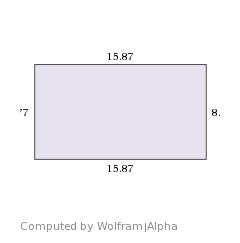
Shots Against per Goal (SAG) = 1/(1 − 0.937) = 15.87
Just for fun, here’s one more:
Dwayne Roloson
Save Percentage (Sv%) = 0.886
Shots Against per Goal (SAG) = 1/(1 − 0.937) = 8.77
Will it make it easier on you now? You got someone to blame
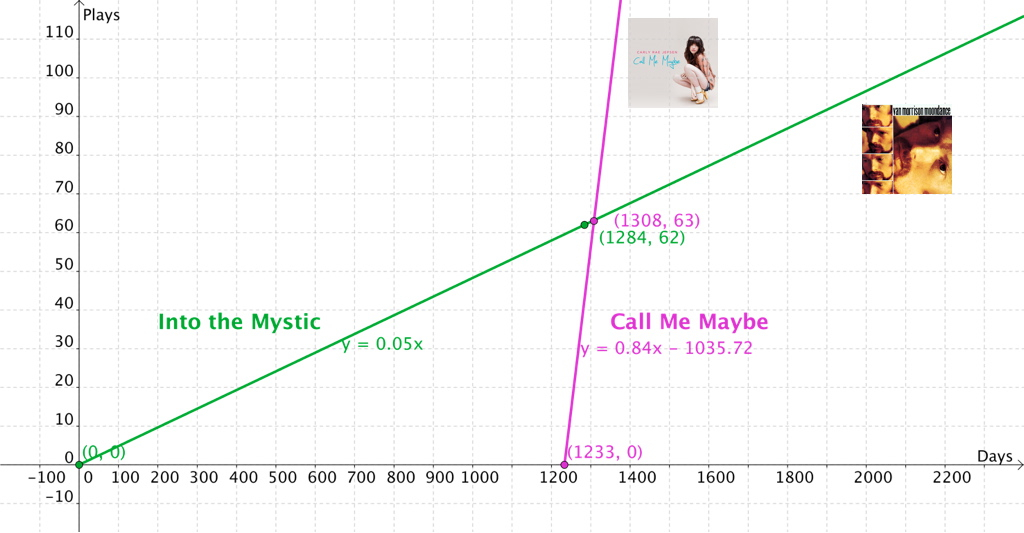
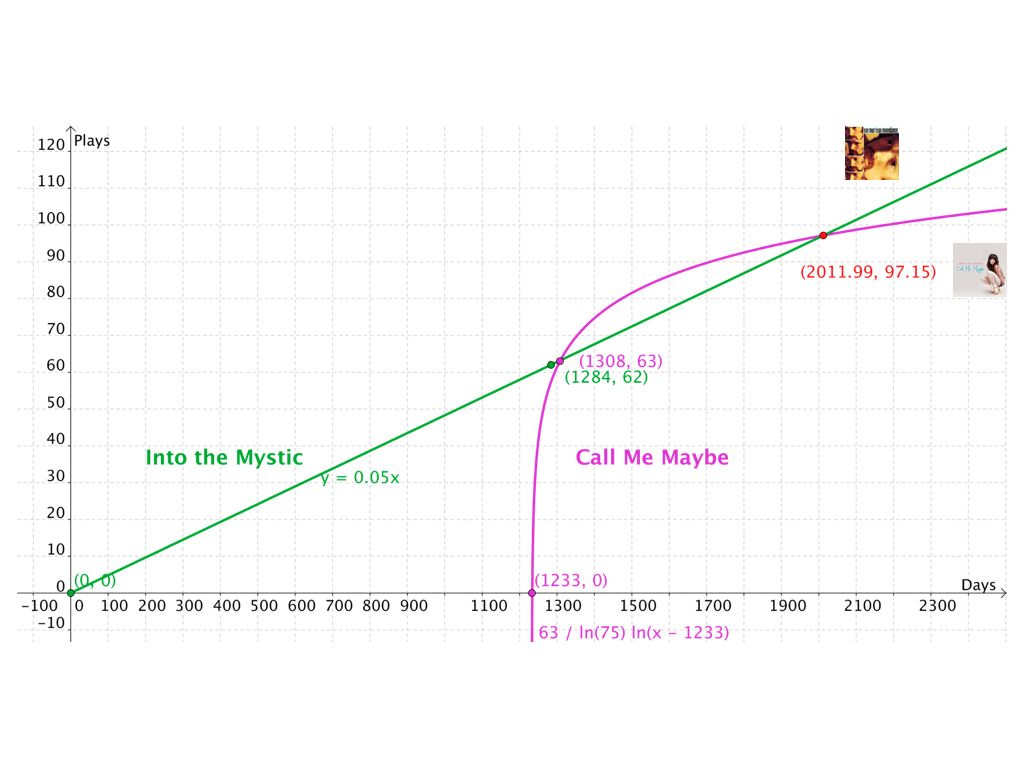
First, “Van the Man”. On October 13, 2008, I added “Into the Mystic” to my library (‘Date Modified’ in iTunes). I’m calling this t = 0. I’ve played it 62 times. I last played this “song of such elemental beauty and grace” 1284 days later on April 19, 2012.
Jepsen’s up next. “Call Me Maybe” was added (not by me) on February 28, 2012. This is 1233 days after I added “Into the Mystic”. Seventy-five days later, on May 13, 2012, I listened to this sugary pop tune for the 63rd time. This is 1308 days after adding “Into the Mystic”.
NB: Screenshots of the iTunes Summaries for both songs would make a better first act. Here’s the summary for “Call Me Maybe”:
My initial questions were:
When did this happen?
Could I have predicted this?
How will the number of plays compare in the future?
I modelled this situation using a system of linear equations. For the Irish singer-songwriter, we get p = 0.05d, where p is the number of plays and d is the number of days. For the Canadian Idol, we get p = 0.84d − 1035.72.
Comparing slopes is an obvious discussion topic. The line for “Call Me Maybe” is much steeper than the line for “Into the Mystic”; the rate of change is 0.84 plays/day versus 0.05 plays/day.
This problem can also be used to explore unit rates. Unit rates can be expressed in more than one way. It’s about what one is one.
I wanted to express the equation p = 0.84d − 1035.72 in the form p − 63 = 0.84(d − 1233). Slope-point form tells a better story than slope-intercept form in this situation but my GeoGebra skills are rusty.
Having students look at their own iTunes libraries might make a better investigation than practicing solving catch-up problems like this:
I assumed that this situation could be modelled using linear relations. For “Into the Mystic”, fair enough. I think this reasonably approximates the real data. Outside of perhaps when I was commenting on Michael Pershan’s blog, I didn’t go through a Van Morrison phase. Van Morrison is in my wheelhouse and “Into the Mystic” is just in the rotation. The number of plays per day is (almost) constant.
For “Call Me Maybe”, this assumption is likely incorrect. The song’s got legs but the instantaneous rate of change has to be decreasing, right? For my mental health, I hope it is. That many plays would surely take its toll.
And what if Carly has competition?
What if I modelled this using a logarithmic function? Check this out:
Note that ≈ 5½ years after first being added to my library, “Into the Mystic” can be expected to pass “Call Me Maybe”. The natural state of the universe is restored.
This is my favourite photo. It’s of my youngest daughter, Keira, and my dog, Skye, while on a walk this past spring. I said “Say cheese” and they did. Both of them. Unknown to me at the time, it would be the last picture I would take of Skye. In the next two weeks, Skye’s health rapidly deteriorated to the point where my wife and I had to make the difficult decision. It has been tough on all of us. I still catch myself holding the gate open for her behind me as I go between the front and back yard.
This has been particularly hard for my 7-year-old daughter, Gwyneth. She understands why we are not getting another dog. But that hasn’t stopped her from researching dog breeds on the internet. Non-stop. If you ever meet my daughter, she’ll ask you questions like “D’you know that Labrador retrievers have webbed feet for swimming?”, “D’you know that pugs have a hard time breathing because of their flat faces?” and “D’you know that poodles are hypoallergenic?” Think Jonathan Lipnicki in Jerry Maguire. She’s that kid. And I love her for it.
But this is my math blog…
The other day Gwyneth came to me to tell me she wasn’t happy about what she had read on JustDogBreeds.com. Here it is:
Did you catch what was troubling my daughter? Here’s two more:
Here’s our conversation, as I remember it¹:
Gwyneth: They say Golden Retrievers are the smartest. And they say Papillons are the smartest. But they also say Poodles are the smartest. Shelties too!
Me: So, what’s the problem?
Gwyneth: They can’t all be the smartest.
Me: So, what should it say?
Gwyneth: One of the smartest. Not the smartest.
The smartest means:
Golden Retrievers > Papillons
Papillons > Golden Retrievers
Not okay with Gwyneth.
One of the smartest means:
Golden Retrievers ≥ Papillons
Papillons ≥ Golden Retrievers
Though the layperson typically thinks of mathematicians as being focused on numbers, that is actually not the case. That false view is a consequence of the mathematics taught in high school. Only at university are you likely to encounter the mathematics done by the professionals. High among our real areas of expertise are logical reasoning, rigorous proof, and the precise use of language.
Maybe it’s because her dad is bothered by things like “increased student scores by 50%” when they mean “increased the number of students passing by 50%” that my daughter is concerned about the precise use of language. And I love her for it.
A recent “Shark Tank” episode featured two entrepeneurs pitching MiX Bikini, the world’s first interchangeable swimsuit. Here’s a sneak peek:
Two things piqued my interest.
Thing One: The Product
“It’s no secret women love to stand out, but there is nothing worse for [a] woman than being at the beach and seeing another girl in the same bikini,” one partner says.
Nothing? Really?
Here’s how it works:
First, assuming [a] woman is not offended by the claim above, she selects a style of bikini top (halter or triangle). Next, she chooses one of 40 colours/patterns for the bikini top. She does this twice (right and left). She then selects a style of bikini bottom (classic or ‘scrunchie’) and picks out one of 33 colours/patterns. (In the “Shark Tank” video, the second model switches out the back bottom. On the Mix Bikini website, the front & back of the bikini bottoms always match.) The bikini tops must be connected. Customers must choose between rings or strings. Rings are available in 10 colours, strings in 9. Of course, bikini tops also need neck strings (right and left). Double neck strings come in 9 colours, rings & strings in 10.
This begs the question… How many Frankenkinis (sp?) are possible?
The website advertises it is possible to create thousands of bikinis.
Thousands? Try millions.
What number do you get? What assumptions do you make? Is fuschia & leopard print different than leopard print & fuschia? I maintain it is. It is best that I not elaborate.
Thing Two: The Pitch
“We are seeking fifty thousand dollars in exchange for five percent of our business,” says the first partner.
“That means that you’re saying the company is valued at one million dollars,” says Daymond, one of the Sharks.
“It was ten percent we were asking,” interrupts the second partner.
“So half a million dollars,” Daymond clarifies.
Uh-oh. The budding businessmen are confused. Mathematically disoriented. The Sharks smell blood. SPOILER ALERT– all does not end well. How did this happen? What went wrong?
My guess? The Sharks have number sense. They have mental math strategies. Daymond understands 5% is equal to 1/20. Therefore, if 1/20th of the business is valued at $50 000, then the total value of the company can be calculated by multiplying by 20 (or, more likely, by doubling and multiplying by 10). If $50 000 is 10%, or 1/10th, of the company, then the Sharks can multiply $50 000 by 10 (or, more likely, halve $1 000 000, the original evaluation).
In the “Shark Tank”, the Sharks often counter with benchmark percentages– 5%, 10%, 25%, 50%, 75%. I suspect the Sharks have strategies for other popular percentages (eg, for 40% they may halve, halve, and multiply by 10).
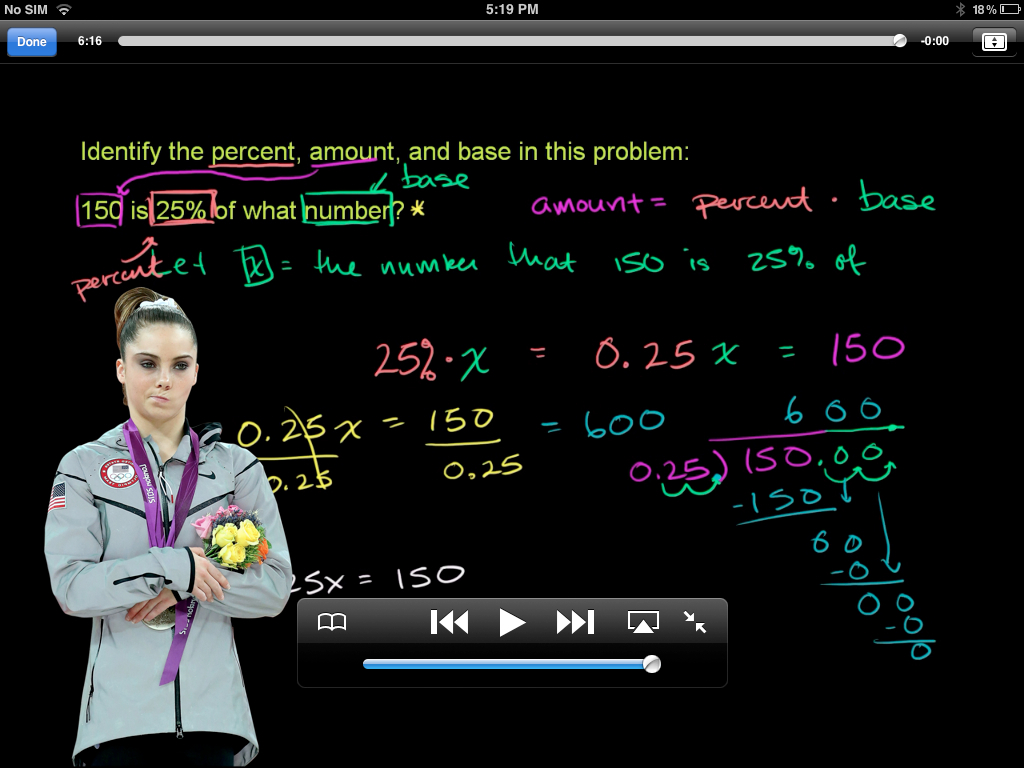
Our pitchmen, on the other hand, do not have number sense. They do not have mental math strategies. The bikini guys have procedures. The bikini guys have this:
BTW, if you’re looking for a lesson on combinations, check out Pair-alysis from Mathalicious.
Maybe I’ve seen one too many deconstructed Caesar salad or peanut butter and jam sandwich on TV. Or maybe I’ve heard “This workbook covers the curriculum” one too many times¹.
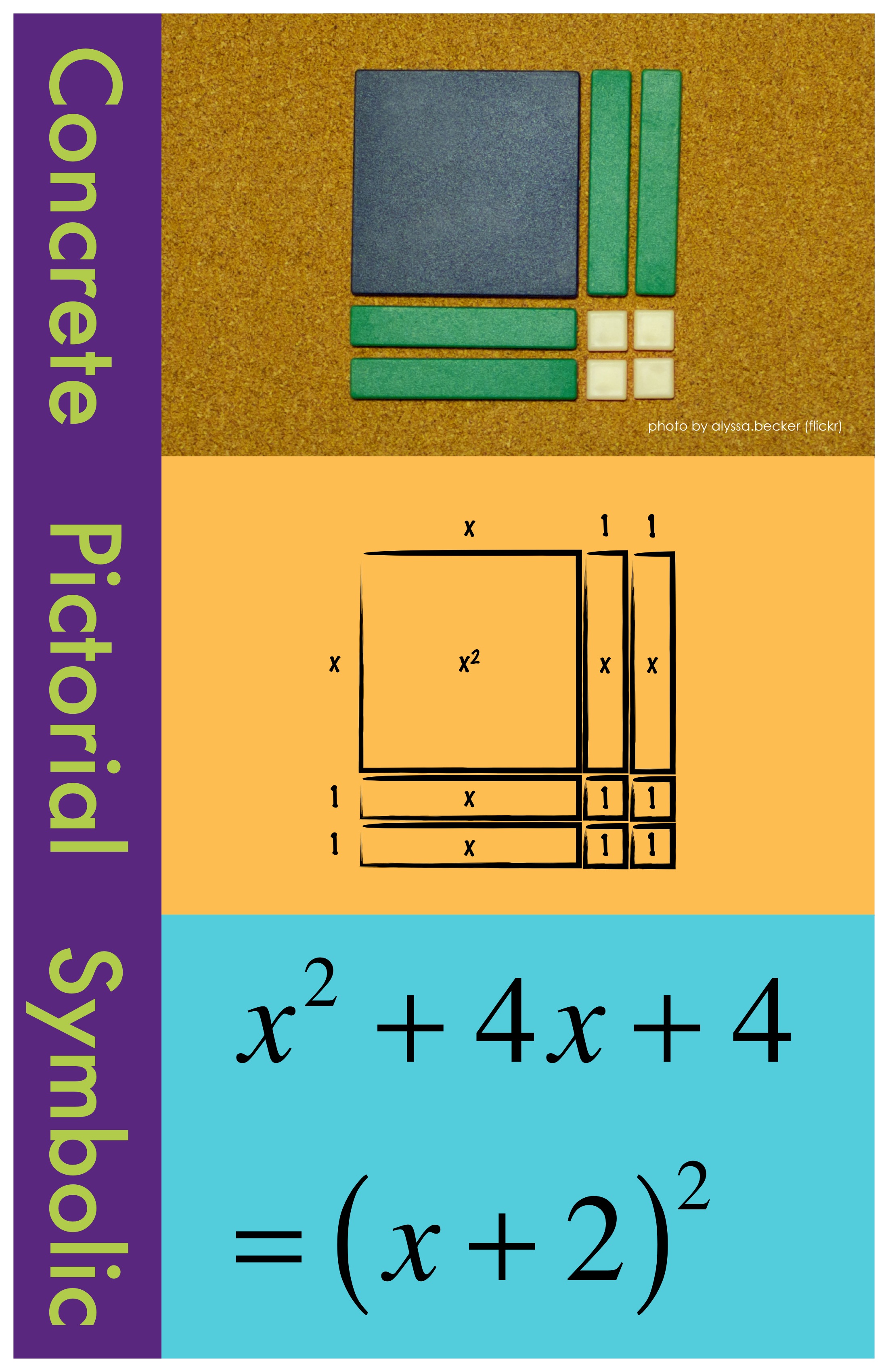
It is expected that students will demonstrate an understanding of multiplying and dividing positive fractions and mixed numbers, concretely, pictorially, and symbolically [C, CN, ME, PS]
“It is expected that students will”
It’s about students’ learning. Worked examples on the whiteboard or in a textbook may be evidence of the teacher’s or publisher’s learning.
“demonstrate an understanding of”
Not will be able to. Students need to make sense of mathematics. Justifications and explanations are required for answers and methods.
“multiplying and dividing positive fractions and mixed numbers”
This is a topic. Curriculum is more than a collection of these.
“concretely, pictorially, and symbolically”
No longer just suggested, the use of concrete materials (i.e., manipulatives) is prescribed² as is having students draw to represent their thinking (diagrams not decorations).
[C, CN, ME, PS]
From K to 12, seven processes are to be integrated within the learning of mathematics. The ‘C’, for example, means that students should be provided with opportunities to communicate their learning– to write about and discuss mathematical ideas.
¹ To my US reader(s)– in my province, curriculum is different than recommended learning resource (i.e., the textbook). In theory, the textbook is not the course. In practice…
² For many teachers, this is probably the biggest change to the curriculum. Earlier this year, I created the posters below. My intent was to generate conversations among teachers, not to teach the concept. Plus, I got to be artsy-fartsy. Enjoy.
Lately I’ve been enjoying Veritasium’s videos on misconceptions about science. From the Veritasium YouTube channel:
If you hold views that are consistent with the majority of the population, does that make you stupid? I don’t think so. Science has uncovered a lot of counterintuitive things about the universe, so it’s unsurprising that non-scientists hold beliefs inconsistent with science. But when we teach, we must take into account what the learners know, including their incorrect knowledge. That is the reason a lot of Veritasium videos start with the misconceptions.
I’ve been thinking about students’ misconceptions about mathematics. What math concepts are counterintuitive? How might starting with the misconception play out in the math classroom? Probability probably provides the most potential, from a pedagogical point of view. (Do robot graders give high marks for alliteration?) The classic Monty Hall problem or birthday problem are just two examples of this. Exponential growth can also be counterintuitive – see Chris Lusto’s alternative to the doubling penny problem.
One common misconception students have is that (a + b)^2 is equal to a^2 + b^2. In my classroom, I’d start with this misconception then have students substitute values before exploring this with algebra tiles. Not exactly Why does the Earth spin? type stuff. Still, addressing this misconception right off the bat provided us with a problem to solve – if (a + b)^2 is not equal to a^2 + b^2, then what is it equal to and why?
Recently, I was fascinated by Dan Meyer’s Coke v. Sprite question because my gut reaction was wrong. Twice. Please watch Dan’s act one video now. I’ll wait.
What fraction must you drink to balance the Coke can on edge?
My guess was that there was more Sprite in the Sprite glass than there was Coke in the Coke glass. After all, I reasoned, the Coke that was added to the Sprite also contained a small amount of Sprite.
When I did the calculations, I was surprised to learn that the amount of Sprite in the Sprite glass and the amount of Coke in the Coke glass were the same:
Assume the original amount of each is 100 mL.
Assume 10 mL of Sprite is transferred to the Coke.
10 mL of pop is transferred back to the Sprite. Stirring means 10/110, or 1/11, of this is Sprite. 100/110, or 10/11, of this is Coke.
The amount of Sprite in the Sprite glass is now 90 mL + (1/11)*10 mL = 90 10/11 mL.
The amount of Coke in the Coke glass is now 100 mL – (10/11)*10 mL = 90 10/11 mL.
Before watching Dan’s act 3 video, my colleague Shelagh Lim and I modelled this with colour tiles:
Start with 12 green tiles on the left and 12 red tiles on the right.
Move 4 green tiles to the right. Now, 4/16, or 1/4, of the tiles on the left are green. 12/16, or 3/4, are red.
4 tiles are moved back to the left. To simulate the effect of stirring, 1 of these 4 are green. 3 of these 4 are red.
The number of green tiles on the left is now 8 + 1 = 9.
The number of red tiles on the right is now 12 – 3 = 9.
Shelagh asked, “What if you don’t move back 1 green and 3 red? What if you close your eyes and take out 4 random tiles?” In other words, does stirring matter? I argued it did. “Something something proportions,” I said.
Mind. Blown.
I want students to experience this feeling of enjoyment at being led astray by their intuition. But, more importantly, students must also experience the feeling of enjoyment that comes from following their intuition and being correct. The former is not possible without the latter; to be amused by failure, there needs to be an expectation of success.
Last Friday night, while the rest of the world was lining up to see The Avengers, I took my daughters to see The Pirates! Band of Misfits. Our hero, The Pirate Captain, desires to win the Pirate of the Year Award. He explains to his rag-tag crew, “Every time I’ve entered I’ve failed to win, so I must have a really good chance this time.” The gambler’s fallacy! In a children’s movie, no less. [The gambler’s fallacy is the belief that previous failures indicate an increased probability of success on subsequent attempts. It’s why I renew my (share of) Canucks season tickets every year.]
Fast-forward to Tuesday, lunch. I’m in the line-up to pay for my fish taco when I spot this¹:
“I like rice. Rice is great when you’re hungry and you want two thousand of something.” – Mitch Hedberg
I immediately ask myself, “How many Rice Krispies is that?” Other (more interesting?) questions soon follow:
“What size of Rice Krispie square could you make with these?”
“How many big marshmallows would I need to make this giant Rice Krispie square?”
“How many calories would that be?”
“How many ‘Snap, Crackle, Pops’ could I expect from 22 lbs of Rice Krispies?”
These sequels/extentensions offer more than “How many Rice Krispies are there in 50 kg?” In addition to proportional reasoning, there are connections to volume and probability.
I’ll upload this to 101questions. I’m curious if other math teachers will find it perplexing but that’s not really what’s important to me. What is important is that I’m starting to see math everywhere.
I blame Dan Meyer.
¹ From ages 15 to 24 I worked as a grocery clerk at Safeway. Sometime during a new hiree’s first shift, we’d ask him to run and do a price check on some seemingly mythical item such as pork wings, ice mix, or a 20 kg bag of puffed wheat. Huh. Who knew?
Subitizing – two years ago, I had no idea what it was.
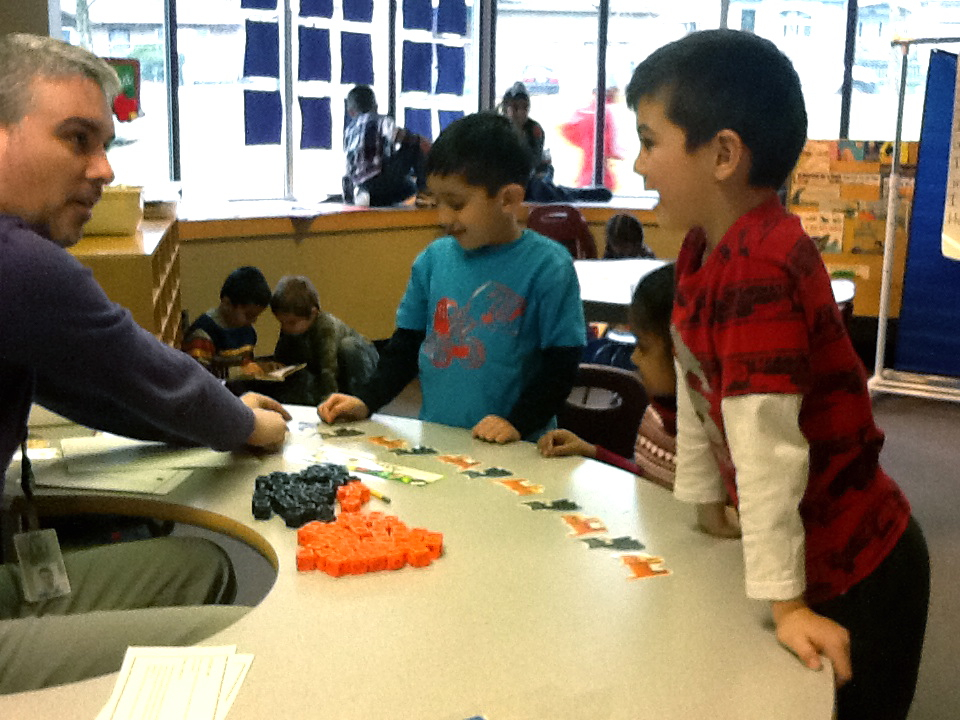
In September 2010, I was asked to do my first demo lesson as Numeracy Helping Teacher. In a Kindergarten classroom. I taught Math 8 to 12. I was terrified a little nervous. Thankfully, Sandra Ball was there to hold my hand provide moral support. In these last two years, I have become much more comfortable in primary classrooms. And I can pronounce subitizing and tell you what it is – it’s recognizing, without counting, one to five objects (“1, 2, 3, What do you see?”).
That’s me. The one on the left.
This year, it has been very rewarding to support Surrey Kindergarten/Grade 1 teachers with an assessment package developed by Carole Fullerton and Sandra Ball. “What Do They Know?” focuses on three areas: subitizing, partitioning/decomposing, and patterning. In addition to fall and spring assessment tools (instructions, blackline masters, materials, rubrics), an instructional resource with suggestions for subitizing, partitioning/decomposing, and patterning lessons is also included. Carole and Sandra wrote about WDTK in a special elementary mathematics issue of BCAMT’s journal, Vector. Please read the article here.
With all-day-K in effect this year, the timing is perfect. There is time (It is time?) to focus on early numeracy. The number of Kindergarten teachers in Surrey has almost doubled this year, many of them teaching Kindergarten for the first time.
WDTK provided me with opportunities this year to work with K/1 teachers. When teachers invited me into their classrooms, I asked them to choose three kids. Then, I modeled each of the three assessment tasks with these three students. After, the teachers and I discussed the results. It was common for these teachers to be surprised by their students. Often students who were identified as struggling demonstrated capacity in at least one of the three areas. Sometimes these students even outperformed their high-achieving classmates. Later, these teachers were able to complete the assessment tasks on their own with the remaining kids.
I look forward to spending more time in Kindergarten classrooms – every secondary math teacher should get the opportunity at some point in his or her career.




























 Chris Hunter