Kids to learn to do math the old way, just like previous generations didn’t

Last week, Nancy Allan, Manitoba’s Education Minister, announced the province’s revised back to basics math curriculum. The move was applauded in a Winnipeg Free Press article.

So, why the changes? From the Winnipeg Free Press: “I heard from parents that their kids were lacking basic arithmetic skills,” Allan said. “It was during the (2011) election, and I picked this up on the doorstep.”

What we know about how children learn mathematics is no match against a politician with a political football. Allan spent “two years of serious work with [the province’s] education partners. We have met with all the math professors, the superintendents have been part of this.” Notably absent from the list: math educators, faculties of education.

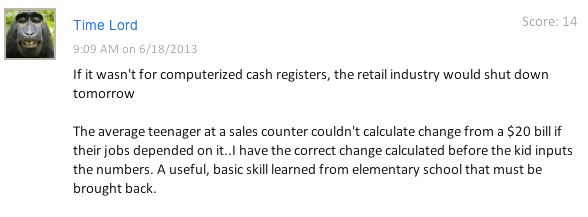
The bottom half of the internet gives us a glimpse of Allan’s doorstep. I could have saved her those two serious years. Rather than a revision, her “kids these days” constituents could have been placated with the addition of one prescribed learning outcome, one PLO to rule them all:

Students will be able to make change.
change

Where an appeal to logic has failed the reform movement, an army of pimply-faced cashiers able to count back change to John Q. Public – even after he’s thrown down an extra nickel after the fact – might just succeed. Of course, this skill involves applying the mental math strategy of thinking addition for subtraction, not the standard subtraction algorithm. But let’s not tell them that.

The Winnipeg Free Press article featured a poll asking readers “Which of these everyday math tasks could you tackle without a calculator?”

Two of my favourites:

  • Determine how much you should leave for a 20% tip at a restaurant.
    14% (6192 of 45357 votes)
  • Halve a recipe that calls for 2/3 of a cup of an ingredient.
    12% (5577 of 45357 votes)

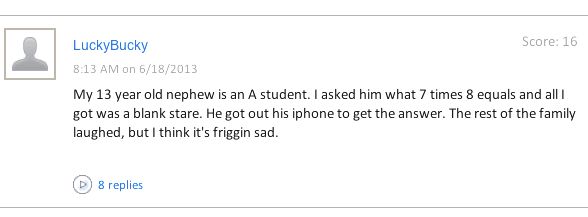
The results are interesting in light of the following: “The minister said the revised curriculum makes Manitoba the first province in Western Canada to go back to placing an emphasis on basic skills previous generations had.” At best, it looks like previous generations have misplaced those basic skills. At worst, they never had ’em. Psst, hey kids… remember this the next time your uncle quizzes you with “What’s 7 times 8?” He may be asking because he doesn’t know.
uncle

So, what happened? Previous generations learned to do math, by definition, “the old way.” They were taught the standard pencil and paper algorithms. In the two tasks above, the standard algorithms are far from efficient. In the first task, a more efficient strategy is to divide by ten and double. In the second task, it’s two thirds of a cup… two thirds… twoOOOoooOOOooo thirds.

Buried in the announcement: “Allan said the province will provide parents with a website to help them understand what their kids are learning.” Admirable. But its necessity is an indictment of the parent’s, not the child’s, mathematics education. Not many politicians are going to pick that up on the doorstep.

Recommended: Dr. Keith Devlin’s response to a recent New York Times article

Update: Frank beat me to it.

December 10, 2013: From a Grade 4 WNCP approved textbook, no less:

0001UP0002np

Parts Unknown

Last night, I caught a recent episode of “Anthony Bourdain: Parts Unknown.”

My first thought, “Ten-frame!” My second, “A possible three-act math task?”

Act One

I wrestled with including the first fifteen seconds of the clip. Will students ask their own questions if they suspect they’re going to answer one of Bourdain’s? Does the remainder of the clip make sense without this? Or, are the first fifteen seconds the first act, the remainder the second? By the way, Bourdain does a pretty good job on his blog of tossing out questions students may have:

Was I doing a good thing? Is it OK to be in the chocolate business? I don’t have any problem with wealthy people who can afford making impulse buys in expensive gourmet shops spending a lot of money on my chocolate. But where does the money go? In fact, where does this chocolate come from anyway? Just about everybody loves the stuff. It’s everywhere. A fundamental element of gastronomy. But I knew so little about it. Where does it come from? How is it made? Most importantly, who does it come from? And are they getting a good piece of the action? Or are the producers, as in so many cases, getting screwed over? I very much hoped to find that whoever was growing our cacao was, at the end of the day, happy about the enterprise — that life after Eric and Tony’s Excellent Chocolate Adventure was, on balance, better than life before.

Act Two

What information would be good to know? I wanted to know, what is a “nosebleed price”? From the man himself:

Thing is, it’s a very boutique-y, very high end, screamingly expensive end of the biz. One of the only 7,000 bars we were able to produce (the whole year’s supply sold off in just a few months) cost the nosebleed price of $18. Even reflecting the remote location, the rarity of the raw ingredient, the long trip from the mountains to the city to Switzerland and then to the States — the whole artisanal process — that’s still a f**k of a lot of money for a chocolate bar.

It looks to me like the producers get 15% of each chocolate ten-frame for the raw cacao, labour another 2.5%. For comparison, the three investors get 5% each.

Act Three

Raw Cacao: $2.70/bar; $18 900 in total
Labour: 45¢/bar; $3150 in total

Doesn’t exactly answer “Are they doing a good thing?” does it? And is it even possible to “show the answer” to this question? Can we adapt this task so that students use proportional reasoning to make a case for our cacao growers rather than just perform a couple of quick calculations? That is, can students use math to answer “How fair?” rather than “How much?” Differences in purchasing power and cost of living between nations now come into play.

Maybe this just doesn’t fit the three-act framework. Too bad. I kinda liked this sequel: How long would a Peruvian cacao grower have to work to purchase a luxury chocolate bar in Manhattan?

Suggestions?

Pentagons and Poodles

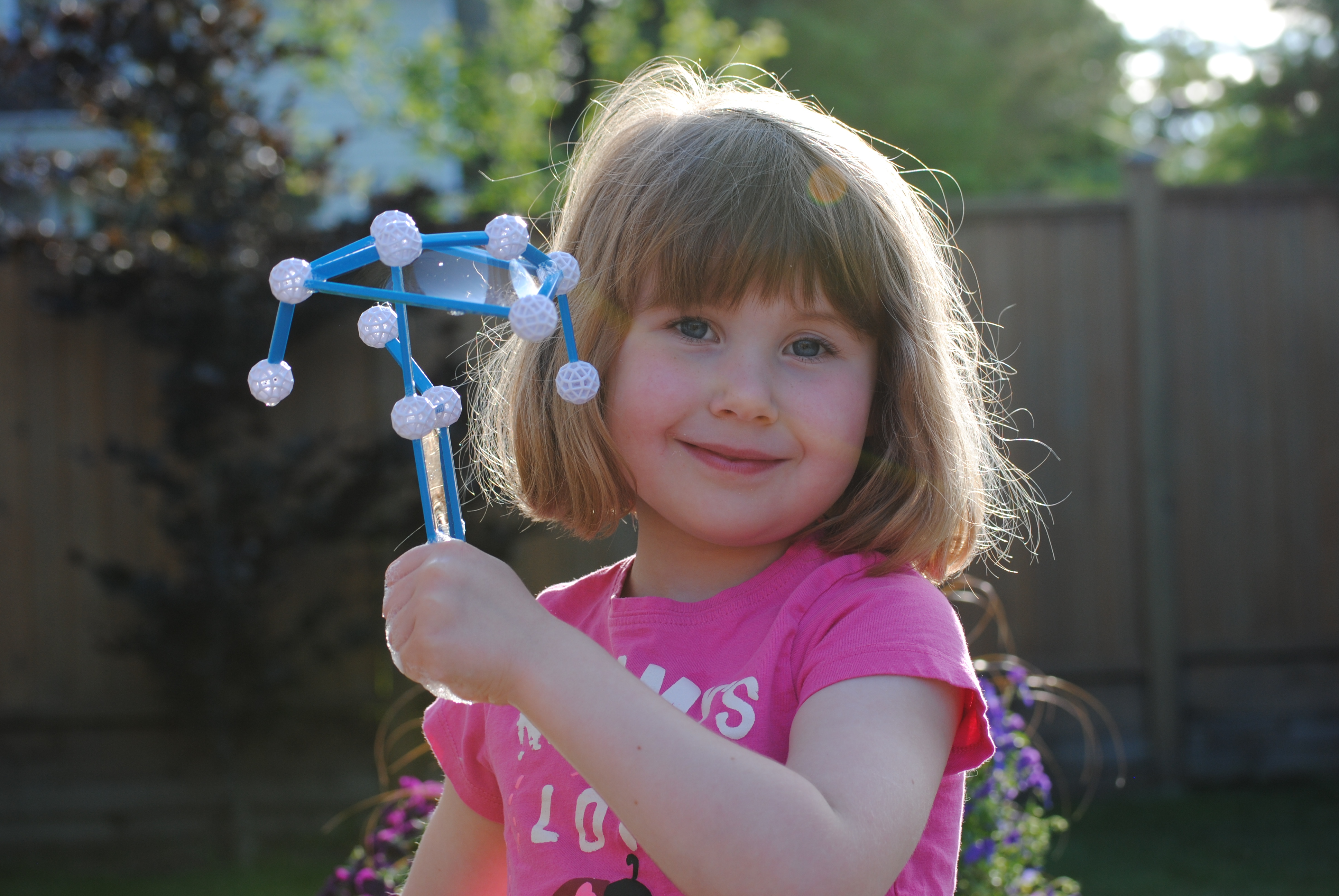
Gwyneth: Dad, is this a pentagon prism?

DSC_0817

Me: It is! Pentagonal.

Gwyneth: Look, Dad! There’s a pentagon inside the pentagon.

DSC_0815

Me: Cool. Hey Keira! What did you make? A puppy?

DSC_0841

Keira: It’s a POODLE, Dad! And it’s got a SQUARE body!

DSC_0851

More Decimals and Ten-Frames

What number is this?

123

123? 12.3? 1.23? One has to ask oneself one question: Which one is one?

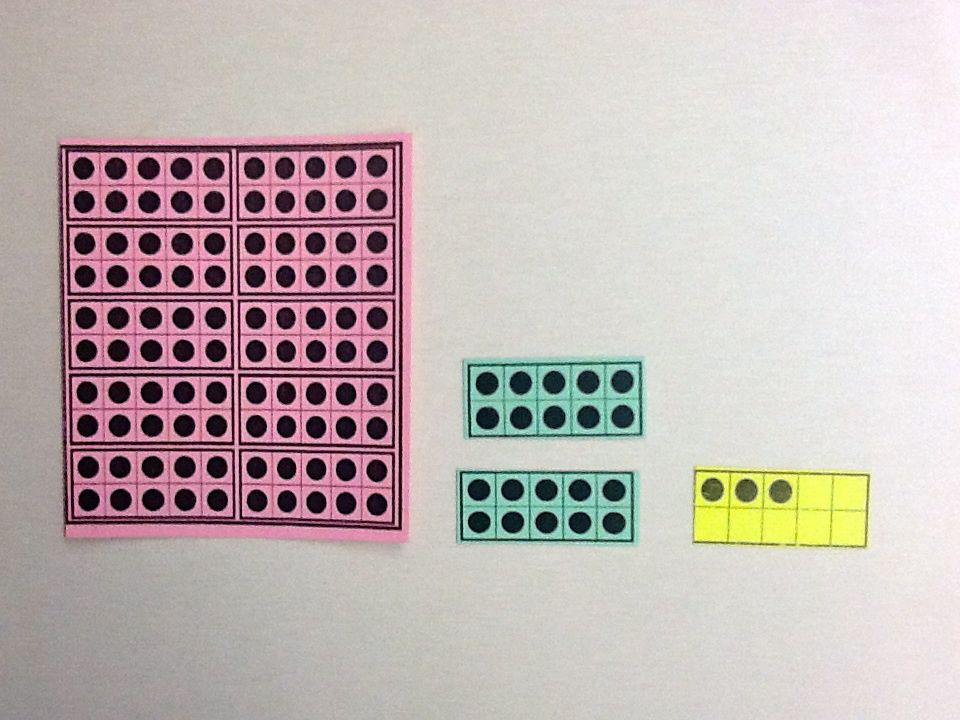
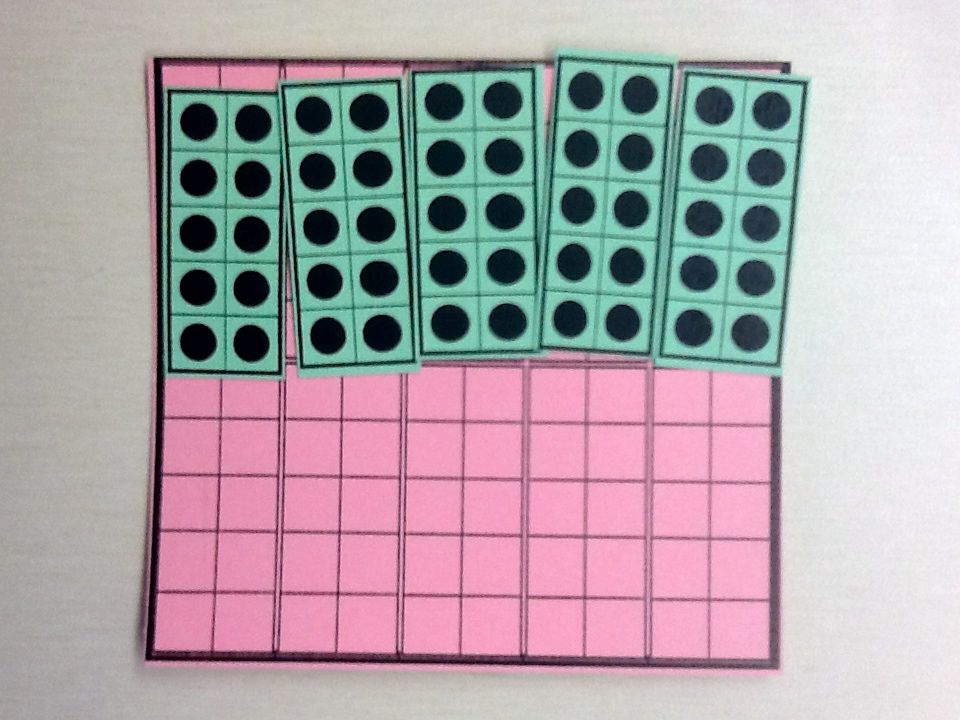
Earlier this year, I was invited into a classroom to introduce decimals. We had been representing and describing tenths concretely, pictorially, and symbolically. We finished five minutes short, so I gave the students a blank hundred-frame and asked them to show me one half and express this in as many ways as they could.

blank 100

5 tenths 50 hundredths

As expected, some expressed this as 5/10 and 0.5. They used five of the ten full ten-frames it takes to cover an entire hundred-frame. Others expressed this as 50/100 and 0.50. They covered the blank hundred-frame with fifty dots. I was listening for these answers.

One student expressed this as 2/4. I assumed he just multiplied both the numerator and denominator of 1/2 by 2. And then he showed me this:
two quarters

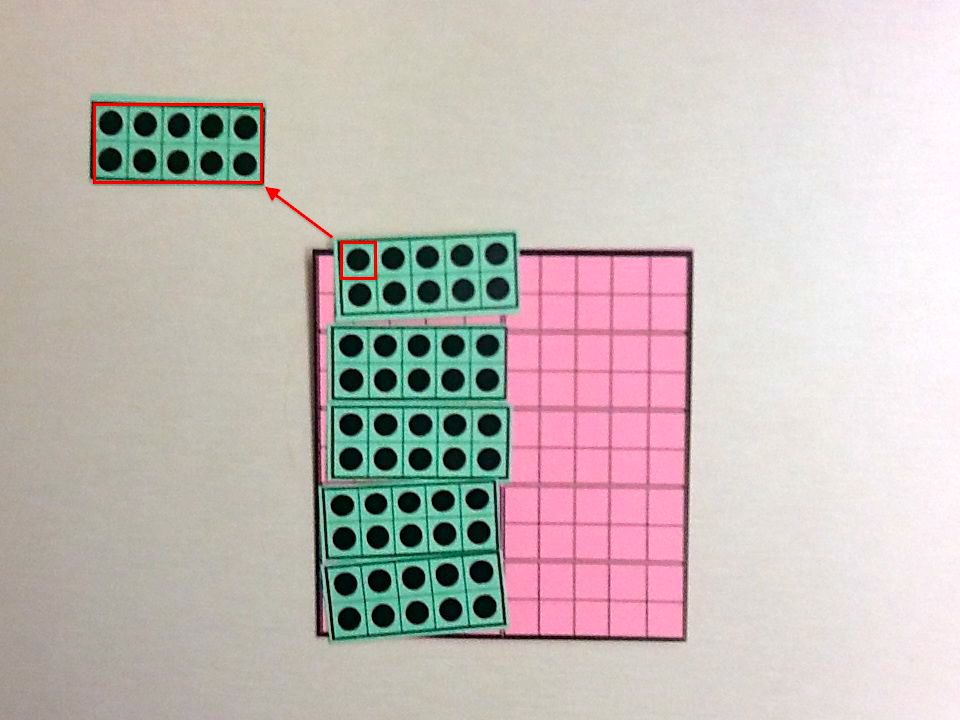
One student expressed this as 500/1000 and 0.500. I assumed he was just extending the pattern(s). “Yeahbut where do you see the 500 and 1000?” I asked challenged. “I imagine that inside every one of these *points to a dot* there is one of these *holds up a full ten-frame*,” he explained. As his teacher and I listened to his ideas, our jaws hit the floor.

annotated 500 thousandths

In my previous post, I discussed fractions, decimals, place value, and language. To come full circle, what if we took a closer look at 0.5, 0.50, and 0.500? These are equivalent decimals. That is, they represent equivalent fractions: “five tenths,” “fifty hundreds,” “five hundred thousandths,” respectively. From a place-value-on-the-left-of-the-decimal-point point of view, 0.5 is five tenths; 0.50 is five tenths and zero hundredths; 0.500 is five tenths, zero hundredths, zero thousandths. Equal, right?

Hat Tip: Max Ray‘s inductive proof of Why 2 > 4

Teaching Improper Decimals Using Ten-Frames

Professor Triangleman posed an interesting question a few weeks back:

If 15/10 is an improper fraction, then shouldn’t 1.5 be an improper decimal? Or is 1.5 a mixed decimal, having more in common with the mixed fraction 1 5/10? Both? Neither?

One definition of decimal:

A fraction whose denominator is a power of ten and whose numerator is expressed by figures placed to the right of a decimal point.

Thus, in 1.5, the implied denominator is 10 and the implied numerator is 5, the figure to the right of the decimal point. We read 1.5 as “one and five tenths,” a mixed decimal. The whole number part is treated separately, making an improper decimal an impossibility.

But what if we didn’t just look at the figures to the right? Nested tenths don’t stop/start at the decimal point. What if we looked at all the figures? We’d read 1.5 as “fifteen tenths,” an improper decimal.

Maybe the improper vs. mixed comparison is throwing me off track. Fractions can be classified as either proper or improper. Why not decimals? Decimals less than one, such as 0.5, would be proper; decimals greater than or equal to one, such as 1.5, would be improper (or, in Britain, top-heavy).

Christopher Danielson wasn’t trying to introduce new vocabulary to the world of math(s). Probably. Rather, he was making a point about place-value.

When we teach decimals using ten-frames we do.

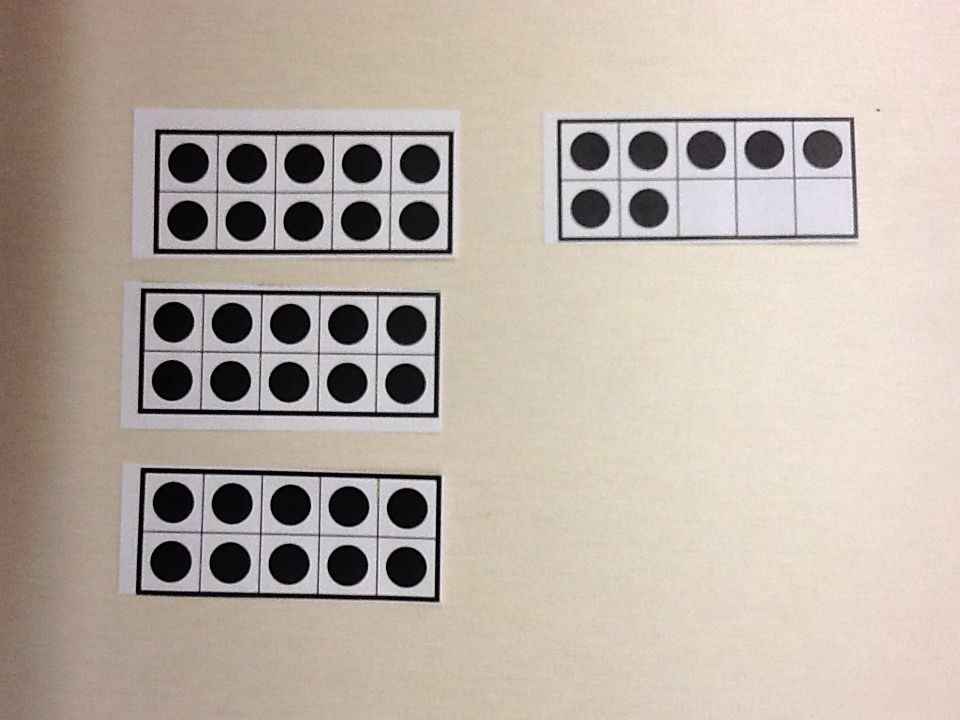
If the whole is one full ten-frame, students may build 3.7 like this:

37

Students will describe 3.7 as “3 ones and 7 tenths,” “37 tenths,” or even “2 wholes and 17 tenths.” This mirrors what students know about place value and whole numbers: 37 can be described as “3 tens and 7 ones,” “37 ones,” or even “2 tens and 17 ones.”

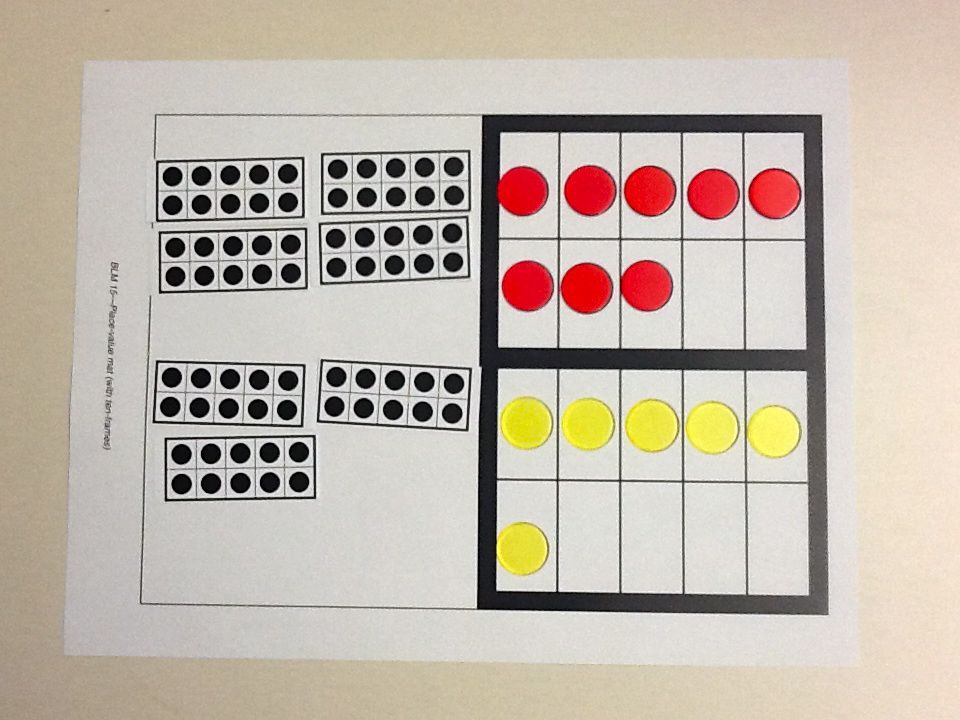
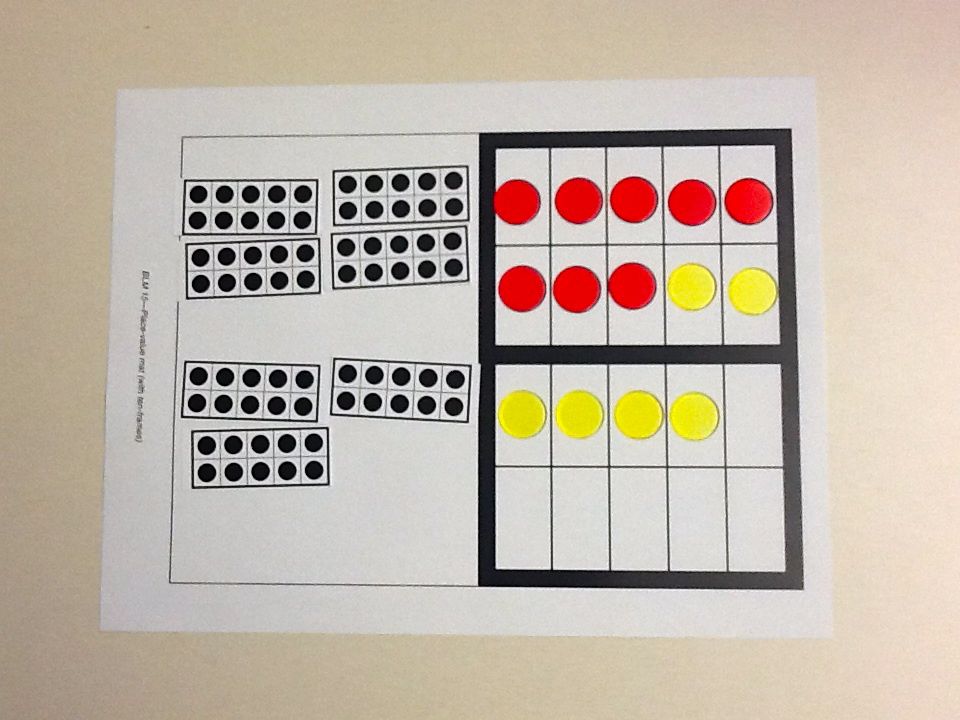
Just like with whole numbers, thinking about place value makes calculations with decimals easier. For example, consider 4.8 + 3.6:

48 plus 3650 plus 34

  • 4 and 3 make 7
  • 0.8 (“8 tenths”) and 0.6 (“6 tenths”) make 1.4 (“14 tenths”)
  • 7 and 1.4 (“1 and 4 tenths”) make 8.4 (“8 and 4 tenths”)

Note the shift in thinking, not notation, from 1.4 as “14 tenths” to 1.4 as “1 and 4 tenths.” With fractions, it’s a shift in thinking and notation. Probably why we know about improper fractions but not improper decimals.

Blackline Masters:

Ten-Frames – Full
Ten-Frames – Less-Than-Ten
Ten-Frames – Place Value Mat

What happened to five?

At 10:00 pm Saturday I returned home from #NCTMDenver. My daughters Gwyneth (8) and Keira (5) were glued to me for the next two and a half hours. Mostly playing with the Zometool kit I picked up at the exhibit hall, filling me in on the past five days.

In September, Gwyneth was concerned about the precise use of language. She’s still at it, researching dog breeds on the internet. Hasn’t stopped. Saturday night/Sunday morning, she wanted me to see this:

pedigree select-a-dog

Remember, her little sister is five.

“What should I click, Dad?” she asked. I was just about to reply “Doesn’t matter, just pick one” before I stopped myself. Instead, I told her to pick the best wrong answer. I was just curious, not trying to prepare my daughter for future success on bubble tests. “Six to eleven,” she quickly answered. Her confidence surprised me. “Nah, gotta be under 4,” I said.

With some prompting (needling?) she presented three arguments. First, Gwyneth reasoned that since Keira was “five and a bit” her sister was closer to six than four. She argued that it’s less than a year until her sixth birthday and it’s been over a year since her fourth birthday.

Second, she reasoned that “five and a bit” was more than five, the halfway point between four and six.

She gets it. Kids get it. They get that 37 is closer to 40 than 30. They get that 7.3 is less than halfway between 7 and 8. They get it until we ask them to memorize things like “Five and above? Give it a shove.”

Third, Gwyneth argued that since she is eight and her sister is five, the best answer is the one that includes the two of them. A stretch to connect this to measures of central tendency?

I’m not sure if Gwyneth enjoys finding these things for her dad or if she thinks it’s getting her one step closer to this:

cavalier-king-charles-spaniel_04_lg

A fun conversation, either way.

[Quiz Results] Content knowledge is important at all grade levels

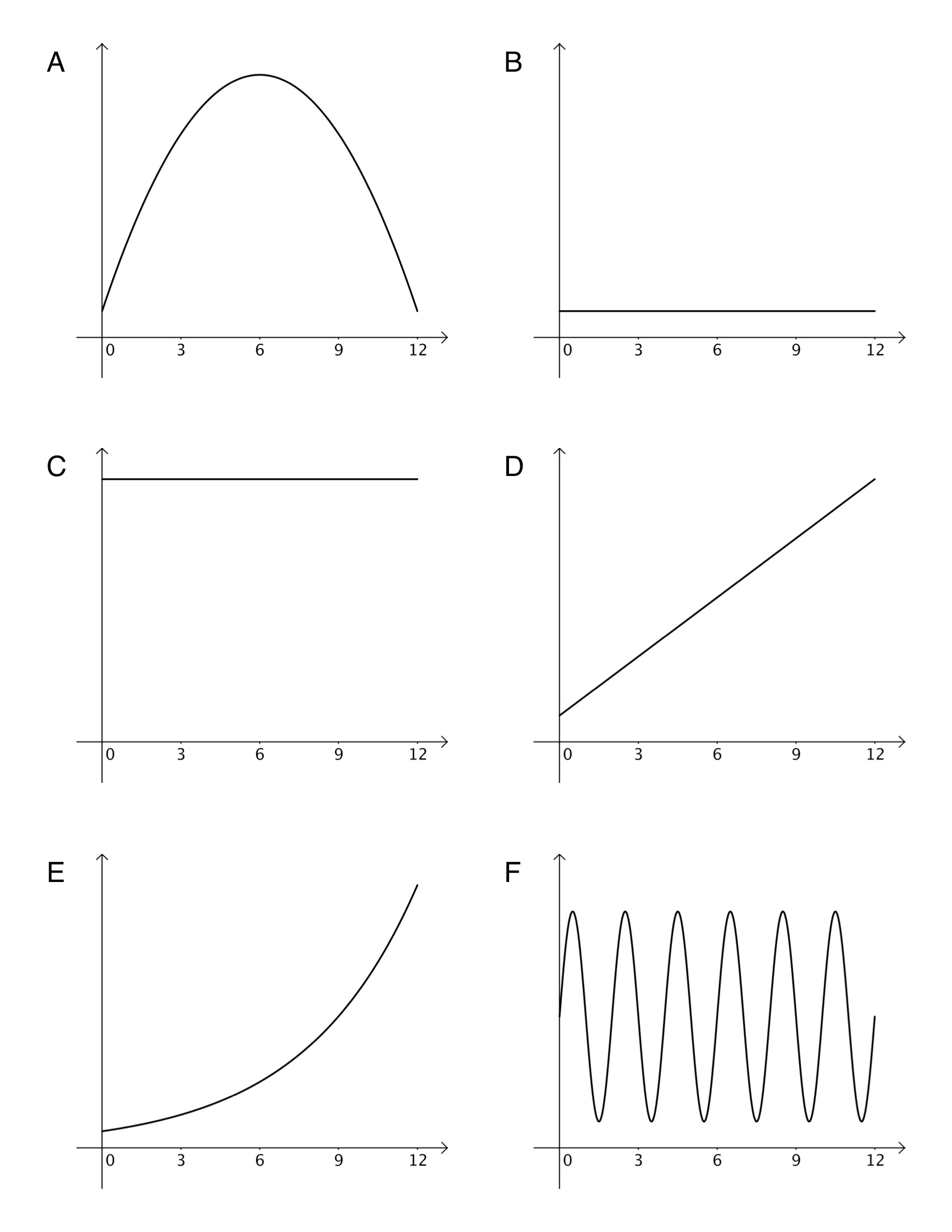
Two months ago, I asked, “Which graph best represents the importance of teacher knowledge of mathematical content as a function of grade level taught?”

CK vs GL Quiz

Twenty-six of thirty-five respondents answered C, matching my answer key. Three out of four math teachers agree: content knowledge is important at all grade levels.

For example:

Sure, you need lots of mathematical knowledge in order to be able to guide students to understanding of the advanced mathematical concepts taught at the upper end of school, but it is also vital that for early years teaching, and throughout elementary school, teachers have a strong knowledge of mathematics. Sure, they might only teach basic number skills, but they need to be able to make connections between ideas, understand the deeper significance of these ideas.

Some picked up on my choice of importance, rather than amount:

You said it’s about the IMPORTANCE of the content knowledge, not the amount they have. For students to develop concepts, they need tasks that help them to engage in and to connect with mathematical big ideas. From the choice or design of tasks, to the good questions that get asked to help students make those connections, the teacher’s content knowledge is critical – in some ways that’s even more important in the early years, but I think an argument could be made that it’s hugely important across the grades.

And again:

I think that teacher knowledge is equally important at every grade level, but a teacher needs to know more mathematics in the higher grades. If the question were about the quantity of knowledge rather than its importance, then I would choose D.

Not all who chose C would buy this amount argument. Not more/less, just different:

But the content is different as grade changes. Calc teachers don’t need to know cognitive structures of place value like K-3 teachers do, for example.

My guess is that those who chose E or its poor cousin D (six in all) would cite complexity. Tom wrote,

The more I learn about high school math (second year teacher, now teaching Alg I, Alg II, Pre-Calc), the more I realize how nuanced upper level topics are. I sat in on a Calculus class and was blown away at the difficulty of it (coming from a math major!) – we’re not just cranking out derivatives here. While TEACHING each grade level requires specific knowledge of HOW students learn each topic, I think the complexity of the math itself increases. Probably not exponentially, but faster than linearly.

Not so fast:

Too frequently it is assumed that elementary teachers don’t need deep knowledge because they’re just teaching kids how to count and add. How hard could it be? But the thing is, elementary teachers are helping very young children build very sophisticated concepts regardless of how easy an algorithm might be to memorize.

Graph A is my take on the complexity question, my response to “Anyone can teach Math 8.” Logarithms in Math 12? Easy peasy lemon squeezy compared to dividing fractions in Math 8. You know the algorithm–just flip it and multiply–but can you answer the 13-year-old who asks why? Then again, maybe I’ve just missed the nuance of logarithms. Thanks for planting that seed, Tom. By the way, nobody chose A.

Only one person chose B. This truly shocked me. I was expecting a much larger number. After all, the role of the teacher has shifted. No longer the primary source of content, no longer…

BErsVV3CQAER4RF.jpg-large
the sage on the stage.

But here’s the thing: dispensing knowledge requires only a little bit of content knowledge. That and a chisel tip whiteboard marker/Wacom pen. Posing differentiated tasks that will engage students in and help them develop an understanding of the mathematics to be learned? Now that requires content knowledge. It requires that the teacher understands this mathematics deeply. And yes, content is googleable but you need some mad Google-fu skills to get past the procedural.

At the risk of coming across like one of those nutjobs who finds a war on Christmas in “happy holidays,” what importance is placed on content knowledge in “I teach children, not math”? Kids before content. I get that part. Given a choice, I’d pick the pedagogue over the mathematician for my kids. Not even close. But “not mathematics”? To me, it paints a false dichotomy:

PK CK

Planning and implementing learning tasks, assessing and supporting students’ learning… these must be guided by an understanding of the mathematics at hand (and how this connects to other ideas students see earlier/later).

A better picture:

PK PCK CKIn fact, some respondents speculated about which graph best matches the importance of PK and PCK across the grades. Most landed on C.

An interesting comment with pro-d implications:

Content knowledge is always important. In the younger grades, teachers need to be able to build and encourage mathematical ability in young students. If they do not have a solid understanding of math, then they themselves can be wary, and students are given Mad Minutes and the like…

Here, the mad minute, a teaching practice, is seen as a symptom of a lack of content, not pedagogical, knowledge. This probably goes against conventional wisdom.

A final comment from David Wees:

What I really wanted to choose was a graph that showed that teachers mathematical content knowledge over time should increase, to demonstrate that they are learning. So while I think C would be ideal, teachers could start anywhere on the scale, provided they are willing to put in the same time exploring mathematics as do their students.

What does this mean? First, “this doesn’t mean elementary teachers need to be versed in differential equations.” Content knowledge can grow with experience… if it’s believed to be important.

Note: I’m wondering if responding to the survey implied anonymity. Please let me know if you wish to have your name attached to your comment.

Grade 3/4 Fraction Action

Recently, I was invited into three Grade 3/4 classrooms to introduce fractions.

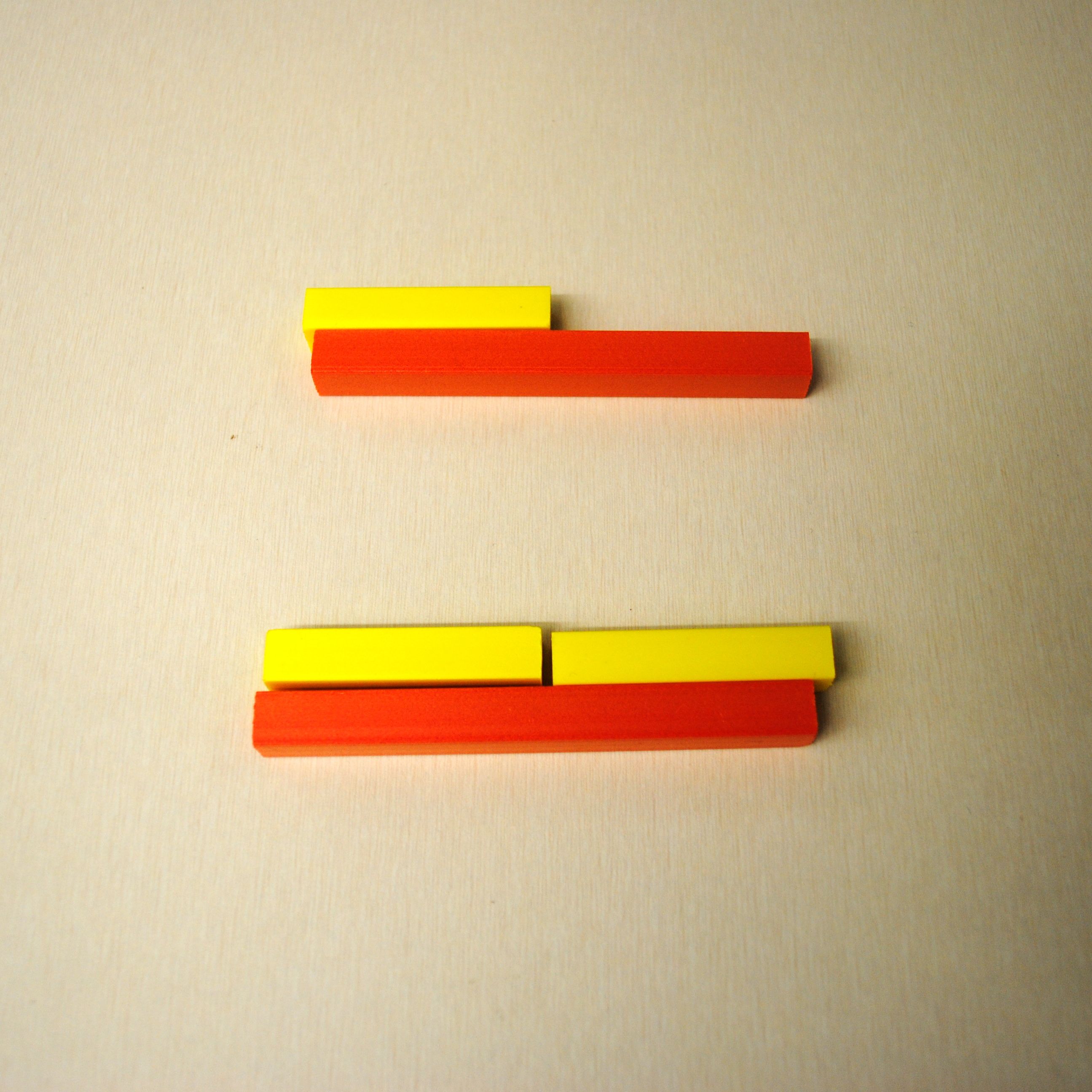
Cuisenaire rods give children hands-on ways to explore the meaning of fractions. After students built their towers, flowers, and robots, I asked, “If the orange rod is the whole, which rod is one half?” Students explained their thinking: “two yellows make an orange.” I emphasized, or rather, students emphasized that the two parts must be equal.

yellow orange

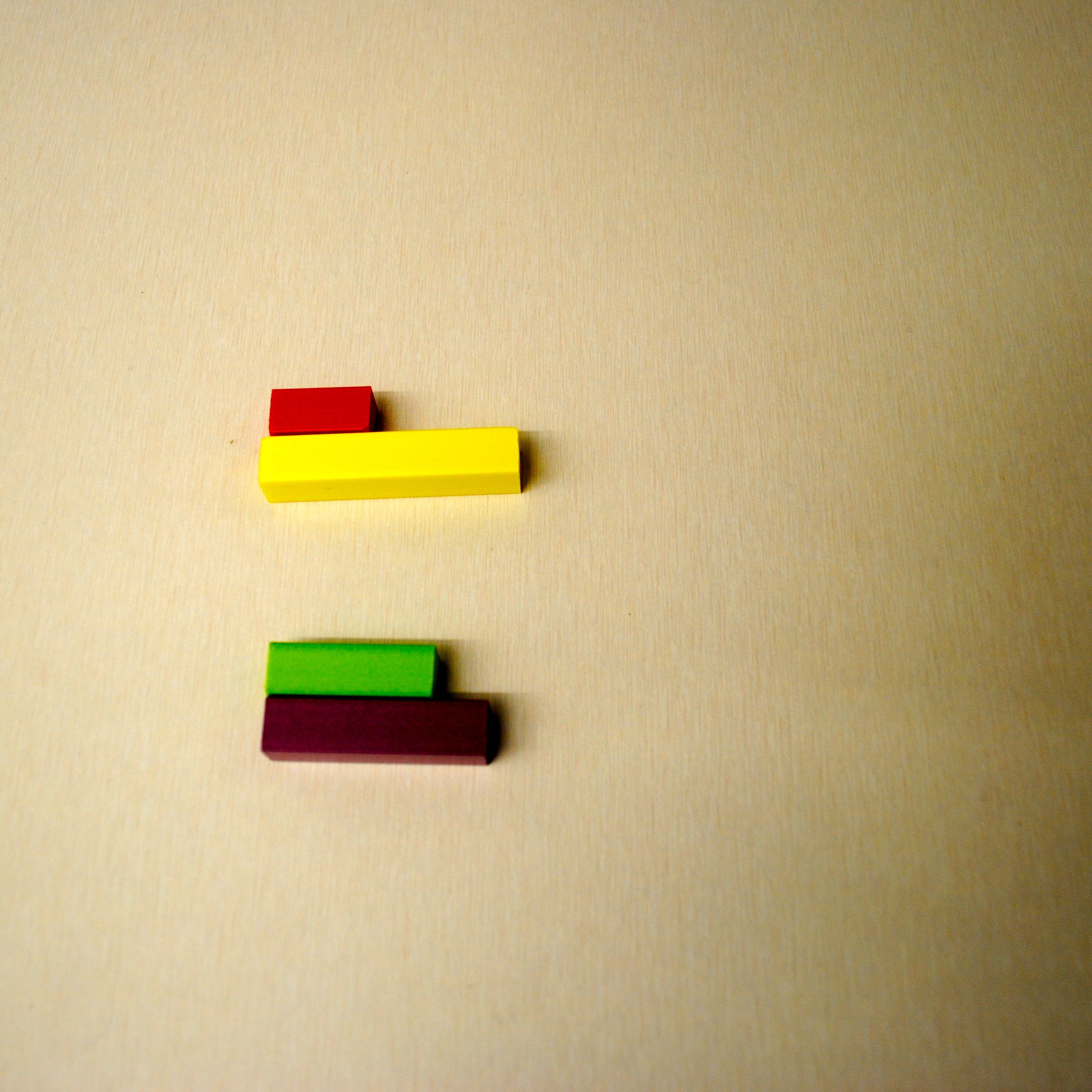
I asked students to find as many pairs as they could that showed one half. I let ’em go and they built and recorded the following:

one half

Once more, with one third:

one third

As children shared their pairs, we discussed the big ideas:

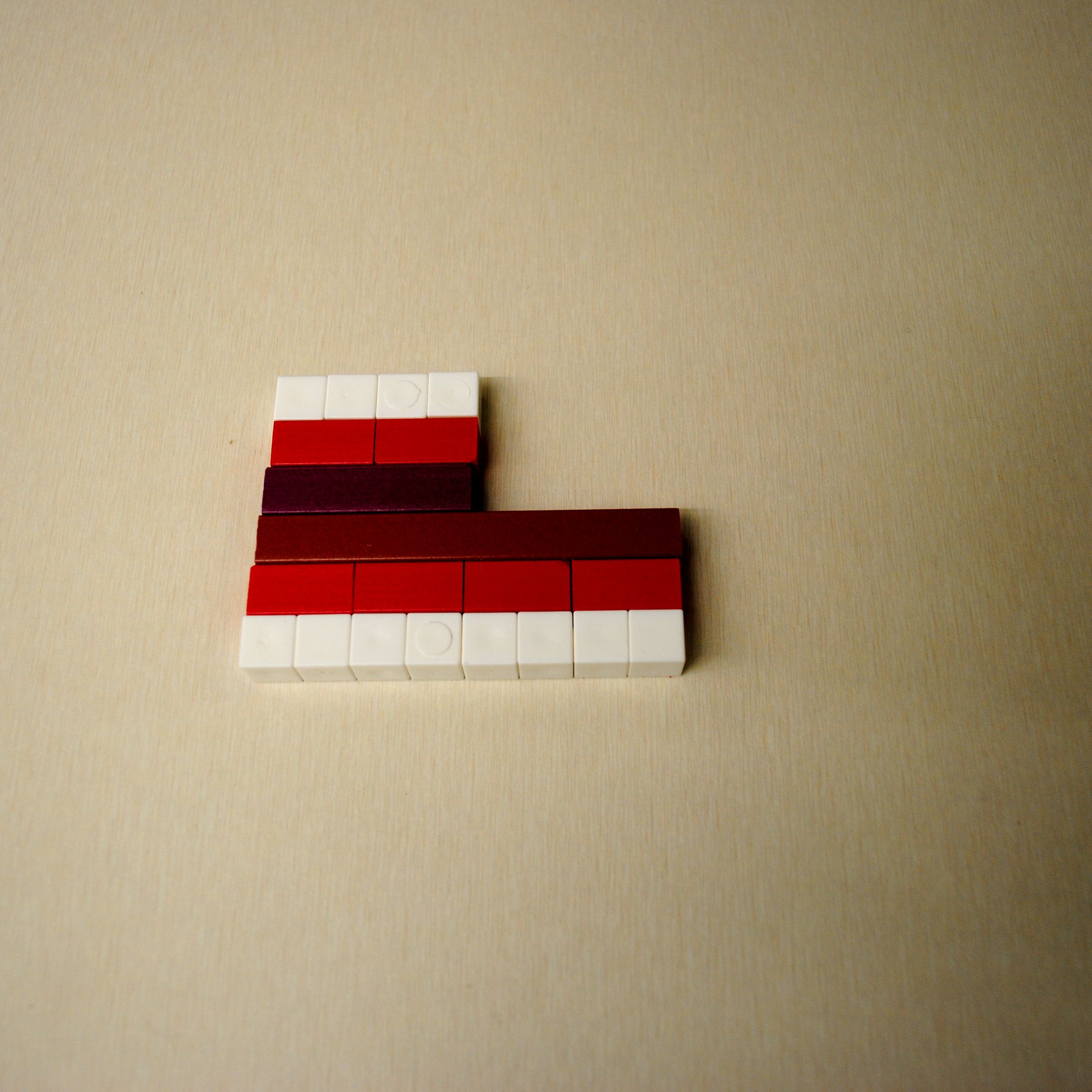
  • the denominator tells how many equal parts make the whole (e.g., two purple rods make one brown rod, three light green rods make one blue rod)
  • the same fraction can describe different pairs of quantities (e.g., one half can be represented using five different pairs, one third can be represented using three different pairs)
  • the same quantity can be used to represent different fractions (e.g., white is one half of red and one third of light green, red is one half of purple and one third of dark green, etc.)

Something interesting and outside the lesson plan happened in each of these three classrooms.

Some students described each pair of rods using equivalent fractions (e.g., 1/2, 2/4, 4/8):

equivalent fractions

I asked the “we’re done” students to represent their own fractions using pairs of rods and determine each other’s mystery fraction. Many students chose fractions like 2/5 or 3/4, not simply unit fractions:

two fifths three quarters

After students shared the three pairs of rods for one third, I asked if anyone found any more. “I did,” said one student, unexpectedly. Check this out:

four twelfths

I asked her why she chose to combine an orange rod and a red rod to make the whole. She explained that twelve can be divided into three equal parts. Without prompting, the rest of the class starting building these:

five fifteenths six eighteenths

adapted from The Super Source

Math Picture Book Post #4: One Is a Snail, Ten Is a Crab

One of my favourite read alouds is One Is a Snail, Ten Is a Crab. In April Pulley Sayre’s “counting by feet book,” one is a snail, two is a person, four is a dog, six is an insect, eight is a spider, and ten is a crab.

The odd numbers to nine and multiples of ten to one-hundred are represented as combinations of animal feet. For example, three is a person and a snail; ninety is nine crabs or ten spiders and a crab.

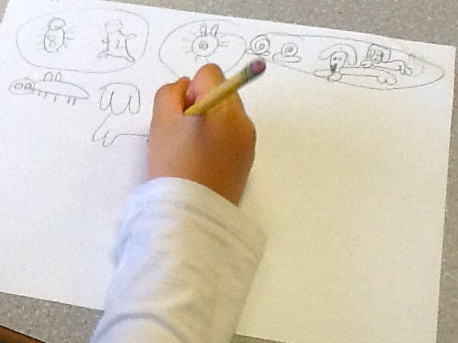
Last week, Sandra and I visited a Grade 1 classroom in which we asked “How many different ways can you make ten?” Children read a number sentence (e.g., “six and four make ten”) to go with each of their drawings. Some students built the animals using muli-link cubes. Some students wrote addition equations (e.g., 6 + 4 = 10). There were multiple approaches to solving this problem. For example, this student skip counted by twos (I think).

22222

These two students used the ten-fact pair of eight and two to make ten. Ten is a crab and a person (8 + 2) but this can be partitioned further as two snails and two dogs (1 + 1 + 4 + 4) or two dogs and a person (4 + 4 + 2).

82

442

Another student (sorry, no photo) broke up ten as five and five and then five as four and one; he drew a dog and a snail twice (4 + 1 + 4 + 1).

These solutions reflect an understanding of “ten-ness.” These students are not (just) counting feet. Gotta be the ten-frames.

It is important to provide opportunities for children to think about numbers as compositions of other numbers. Breaking up numbers, into tens and ones or in other ways, makes computations easier in later grades.

Click here for more math picture book (picture book math?) ideas.

Thanks to Ms. Long and the young mathematicians at Fraser Wood Elementary for inviting us into your classroom. Also, thanks to Pete Nuij and Lesley Tokawa for helping make this happen.

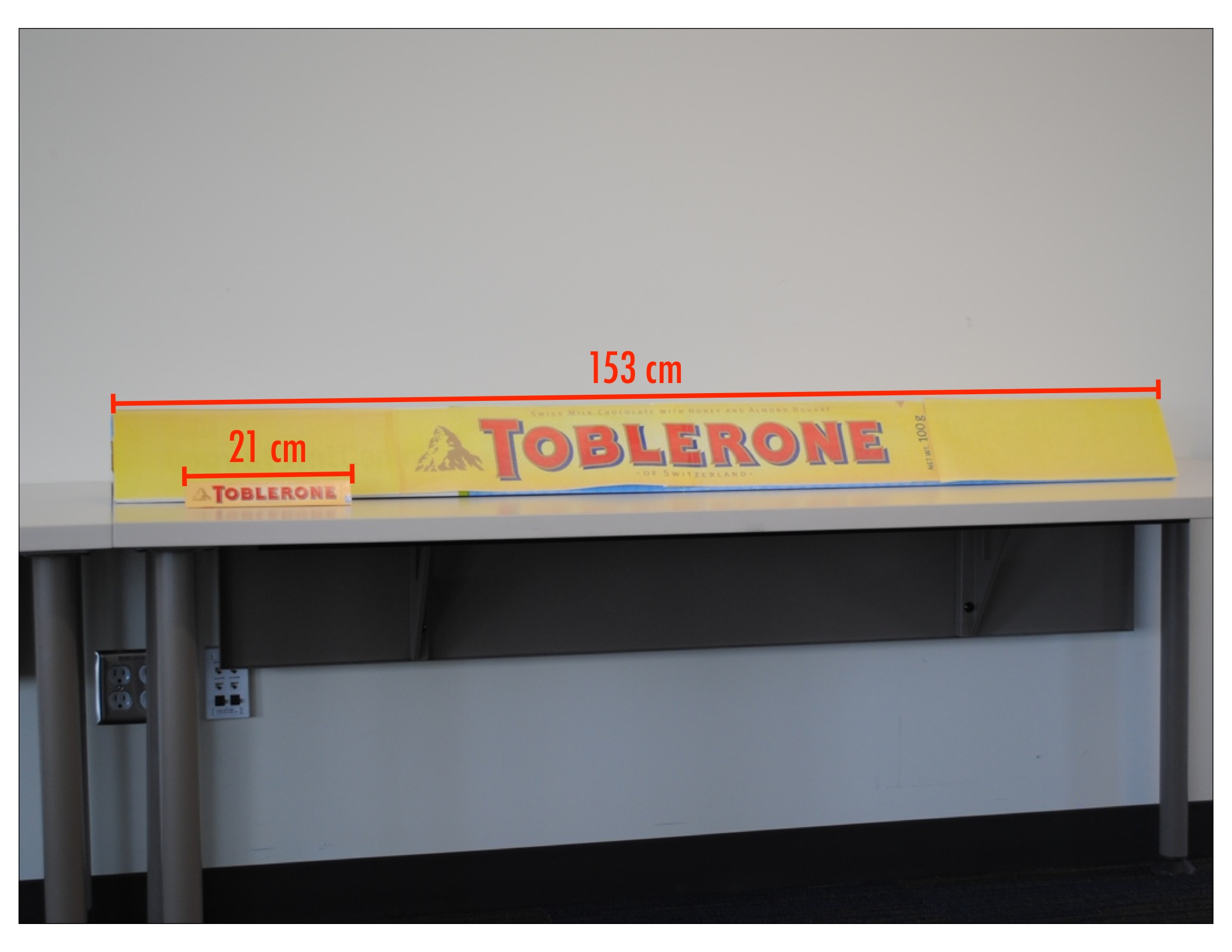
Toblerone Task

“I couldn’t help but admire your large triangular prism,” I wrote. Sadly, this is not the strangest way I have begun an email to a colleague.

“Are you talking about the giant Toblerone-shaped thing? You math guys are weird,” she replied.

Anyway… my three-act math task:

act one

  • About how many regular size Toblerone chocolate bars fit inside the giant Toblerone-shaped thing?
  • Give an answer that’s too big.
  • Give an answer that’s too small.

act two

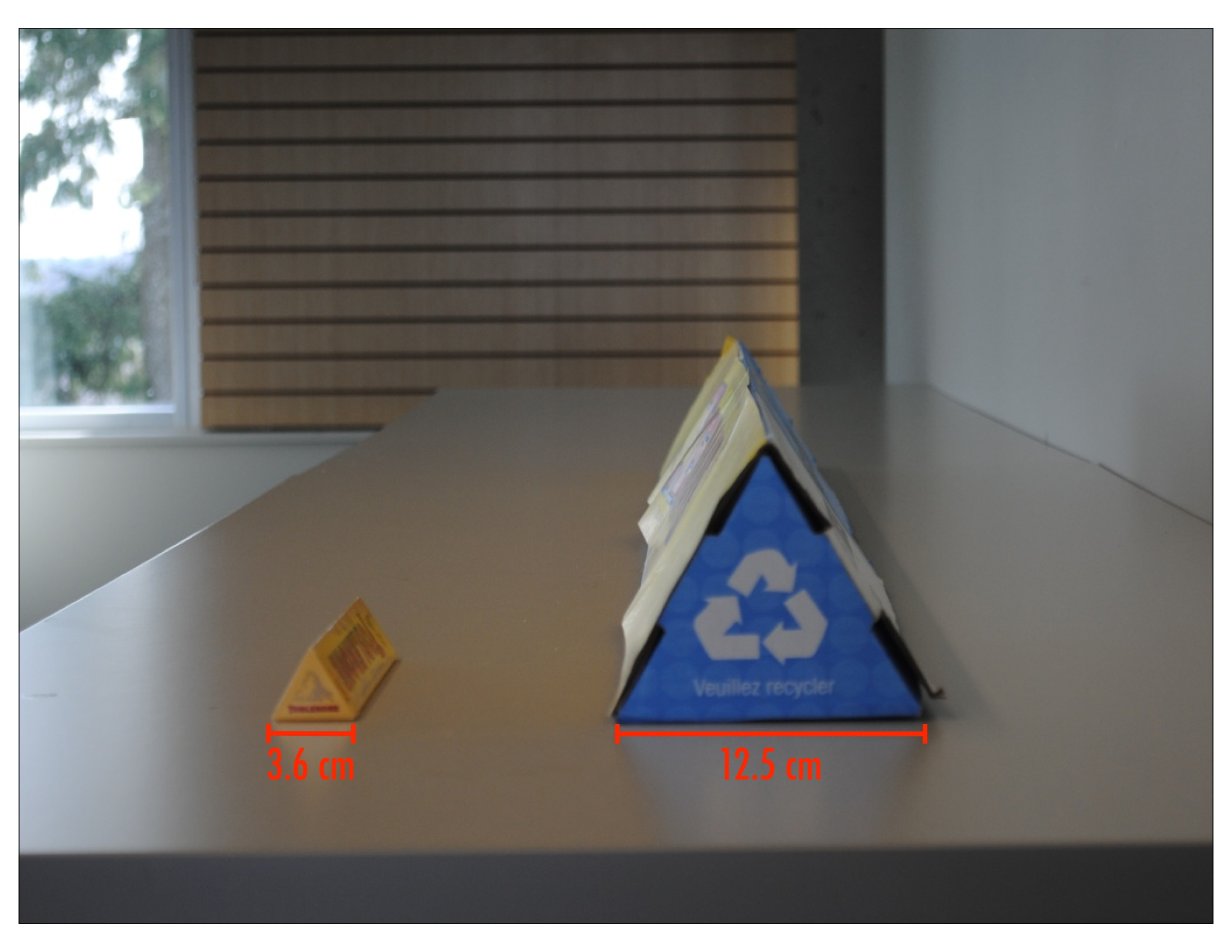
  • What information would be useful to know?

toblerone task act two 1

toblerone task act two 2

act three

63. Relax. The video is coming soon.

sequel

  • If 72 regular size Toblerone chocolate bars fit inside a mega Toblerone-shaped thing, how large would it be?
  • If 112 regular size Toblerone chocolate bars fit inside a mega Toblerone-shaped thing, how large would it be?

better still…

  • A mega Toblerone-shaped thing is a little bigger than a giant Toblerone-shaped thing. What could its dimensions be?
  • How many regular size Toblerone chocolate bars would fit inside?

I like the phrase “a little bigger.” Probably “borrowed” from Marian Small. The ambiguity here allows for multiple solutions. Students could increase the length of the prism or the size of the triangle base. Which has the greater effect?

Also, there’s something interesting happening here with the sum of consecutive odd numbers.

Oh yeah… a shout-out goes to Andrew Stadel for his Couch Coins task.